


 For all latest news, follow the Daily Sun's Google News channel.


Experts push for reform to future-proof SMEs
Daily Sun, in collaboration with Trust Bank, hosts roundtable on building Bangladesh’s next generation of entrepreneurs
Daily Sun Report, Dhaka
Published: 17 Jul 2026, 12:00 AM
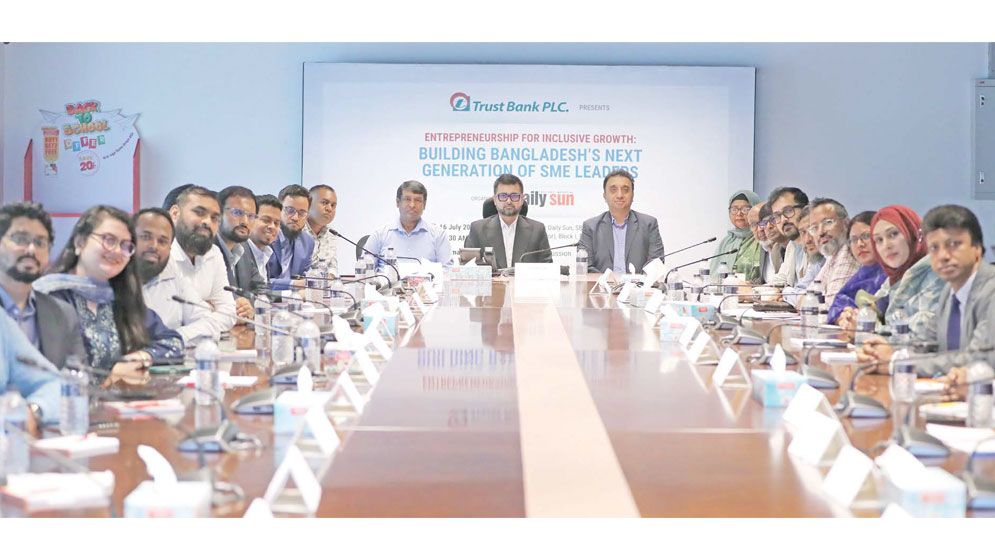
The Daily Sun organises a high-level national policy roundtable titled "Entrepreneurship for Inclusive Growth—Building Bangladesh's Next Generation of SME Leaders" at the Safwan Bashundhara Global (SBG) headquarters in the capital's Bashundhara Residential Area on Thursday. Daily Sun Editor Rezaul Karim Lotus, Executive Director Tasvir Ul Islam and Trust Bank PLC Head of SME Division Sadat Ahmad Khan attend the roundtable. - DAILY SUN PHOTO
Experts on Thursday called for institutional and structural reforms to ensure the sustainable development of Bangladesh's small and medium-sized enterprises (SMEs) sector, warning that the challenges facing entrepreneurs will only intensify following the country's graduation from Least Developed Country (LDC) status.
The call was made at a high-level national policy roundtable titled "Entrepreneurship for Inclusive Growth—Building Bangladesh's Next Generation of SME Leaders", organised by Daily Sun in collaboration with Trust Bank PLC at the SBG Headquarters in Bashundhara Residential Area of the capital.
Daily Sun Editor Rezaul Karim Lotus delivered the welcome address, while the paper's Executive Director Tasvir Ul Islam moderated the discussion. Sadat Ahmad Khan, head of the SME Division at Trust Bank, presented the keynote paper.
Speakers stressed the need to nurture entrepreneurship from an early age through education, widen digital transformation, and improve access to collateral-free financing.
They also called for closer collaboration between the government, private sector, financial institutions, academia and the media to build a sustainable SME ecosystem.
In his keynote address, Khan observed that despite a raft of incentive packages, Bangladesh's SME sector was yet to realise its full growth potential.
He argued that new entrepreneurs required greater support, noting that since bank loan processing was often slow, microfinance institutions (MFIs) could be roped in to disburse Bangladesh Bank's incentive funds, ensuring quicker and wider access to finance.
More than just finance
Abdul Haque, former director of the Federation of Bangladesh Chambers of Commerce and Industry (FBCCI), said SMEs needed more than financing alone.
"Entrepreneurs should be supported with product design, technology, skills training, market linkages, and free business advisory services. Providing such support is the responsibility of specialised government institutions, not commercial banks," he said.
Citing Japan's example, Haque said professional institutions there offered comprehensive support to SME entrepreneurs, and urged Bangladesh to modernise and strengthen the Bangladesh Small and Cottage Industries Corporation (BSCIC) and the SME Foundation.
He also called for dedicated district-level initiatives to promote local industries, attract investment, and integrate small enterprises into global supply chains.
He noted that roughly 22 to 23 lakh young people enter the job market every year, and said Bangladesh must prioritise skills development, expand the SME sector, and reform key government institutions, including the Ministry of Industries, to generate adequate employment.
Better export facilitation needed
Minhaj Ahmed, director of the Dhaka Chamber of Commerce & Industry (DCCI), flagged the absence of a national SME database as a major hurdle to effective policymaking, pointing out that more than half of the country's SMEs still operate without formal registration.
He said SMEs bore disproportionate regulatory costs, often paying the same licensing and exhibition fees as large corporations, and argued that reducing these costs would encourage more startups and formalisation.
"Market access remains another key challenge. Many SMEs cannot afford to participate in domestic and international trade fairs, while the country's halal certification and testing facilities still lack wider international recognition, limiting export opportunities," he said.
He added that SMEs continued to struggle with accessing bank loans despite various government schemes, as banks often viewed small businesses as high-risk while the cost of processing small loans discouraged lending. He called for stronger policy support, improved financing mechanisms, and better export facilitation.
Kamruzzaman Didar, head of the Department of Innovation and Entrepreneurship at Daffodil International University, called for greater patronage of SMEs in remote areas as well as urban centres.
"Despite the initiatives of Bangladesh Bank, SMEs don't get proper financial support from commercial banks due to the requirement of numerous documents. However, we need an ecosystem to boost the SME sector," he said.
Mohammad Mofazzol Karim, lead of operations and student engagement at the Centre for Entrepreneurship Development (CED), BRAC University, said the centre had supported 2,200 students, though many did not go on to become entrepreneurs.
"If someone puts forward an idea on entrepreneurship, we provide all necessary support to develop it. However, a common facility centre should be maintained at every university to support startups," he said.
Government expanding SME support
Md Shajebur Rahman, deputy secretary at the Ministry of Commerce, said the government regarded entrepreneurship as a key driver of inclusive and sustainable economic growth, with particular emphasis on building a competitive, export-oriented SME sector.
He said the ministry supported SMEs through product standardisation and certification, digital commerce, market access, trade fairs and export promotion, while working with the private sector to shape business-friendly policies.
He acknowledged that many SMEs faced low productivity and difficulty meeting international quality standards, and said the government was working to improve competitiveness and expand market access through coordination with the Export Promotion Bureau (EPB), Business Promotion Council (BPC), and Bangladesh's commercial wings abroad.
Farzana Khan, Deputy Managing Director of the SME Foundation, said the country needed to work across every region under the principle of "No One Left Behind."
"We must harness the innovative ideas of the next generation. Young people often have creative and innovative business ideas, but many fail to translate those ideas into viable enterprises because of weaknesses in the overall entrepreneurial ecosystem, bureaucratic hurdles, and a lack of institutional coordination. These challenges must be addressed," she said, adding that the foundation was currently working with 177 clusters nationwide to strengthen local entrepreneurship and industrial development.
Mill land to be converted into industrial plots
Sheikh Abdullah Shadid, senior assistant secretary at the Ministry of Textiles and Jute, said the government was strengthening SME support through export assistance, training and access to industrial land.
He said entrepreneurs could register with the Jute Diversification Promotion Centre (JDPC) for export support, incentives, and training on product development and diversification, noting that the JDPC had already developed around 282 diversified jute products.
He said the government was converting land from closed state-owned textile and jute mills into small industrial plots for SMEs, to be allocated through the Bangladesh Economic Zones Authority (BEZA) and other arrangements.
Several state-owned mills, he added, had already been leased or transferred under public-private partnership (PPP) arrangements, with more plots being prepared to encourage private investment and SME-led industrial growth.
Mirza Md Nazmul Huq, general manager of the Palli Karma-Sahayak Foundation (PKSF), described cottage, micro, small and medium enterprises (CMSMEs) as the birthplace of entrepreneurs and the pipeline for SME growth, saying their transformation into competitive, innovative and sustainable businesses was essential for building an inclusive economy.
"However, CMSMEs continue to face numerous challenges. Low productivity, inadequate business skills, limited access to finance and weak technological capabilities remain major obstacles to business growth," he said, calling for a simplified licensing process alongside greater emphasis on capacity building and modern technology adoption.
Irfan Mohammed Abir, head of business operations at ShopUp; Masud Parvez, head of emerging corporate at United Finance; Md Rabiul Islam, director of GreenPolaris Limited; and Quazi Sabir, founder and CEO of Khelbei Bangladesh, also spoke at the event.