



 For all latest news, follow the Daily Sun's Google News channel.


Regarding holding an HSC examination despite adverse weather conditions, the examinees demonstrated for a couple of days, which appears to be a reasonable demand from affected students; however, they also demanded easier question papers and a more lax guard system in the exam hall, which was highly irrational, said educationists.
They explained it as a change in students’ mindset due to the former Awami League government's education policy, including shorted syllabuses, automatic promotion without examinations, over-marking, curriculum changes and the effect of the mass uprising, during which students played a key role.
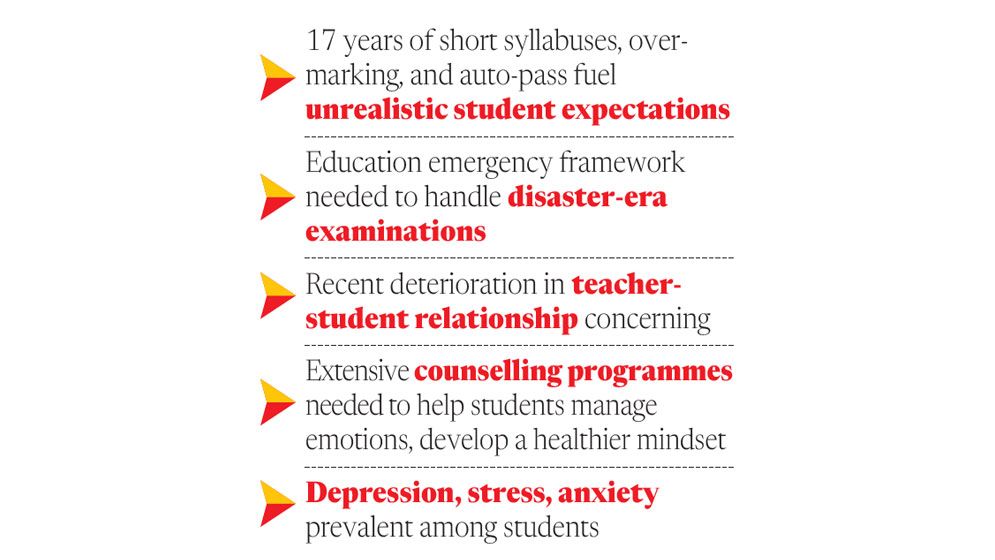
Dr Md Abdus Salam, a professor at Dhaka University’s Institute of Education and Research, said that among the practices followed over the past 17 years, one that severely harmed both Bangladesh's education system and students was shortening syllabuses.
According to him, policies adopted in previous years created unrealistic expectations among students and many now expect privileges such as automatic promotion without examinations, a trend that was also reflected in recent protests by National University students.
He added that the political change following the 5 August 2024 movement has also altered students' attention span, expectations, and attitude towards education.
The protesting HSC examinees on Tuesday carried a banner containing a six-point demand. One of their demands was the resignation of the education minister, but the other points were highly unacceptable from an academic standpoint.
The students demanded that the authorities take into consideration an allegedly unannounced change in the question paper format during evaluation and ensure that invigilators refrain from overly strict behaviour that causes mental stress among examinees.
One female protester claimed that the questions had not appeared in any test paper or previous board examinations. Another examinee demanded a more student-friendly examination environment.
Meanwhile, examinees allegedly vandalised the examination centre at Fatema-Matin Women's College in Bhola, protesting that the question paper was too difficult and that they had not been allowed to cheat during the examination.
After taking office, Education Minister Dr Ehsanul Hoque Milon has repeatedly warned that no one will be allowed to cheat in the examinations.
He introduced a CCTV monitoring system in the exam centres as well as conducted a series of meetings before the examination.
During the mass uprising of 2024, the government postponed HSC and equivalent examinations in several phases. However, when the interim government announced the schedule of the exam, examinees held the education adviser hostage and compelled him to announce the cancellation of the examination.
For these reasons, many observers believe that a section of examinees appears to think that by staging protests they can once again secure concessions or pass examinations more easily.
Mental health support needed as students' mindset shifts
According to the research article titled “Managing Student Well-Being After Social Upheaval: An Examination of Bangladeshi University Responses by T Husain”, published on 22 January 2026, participants reported elevated levels of anxiety, stress and emotional distress following the movement. The study found that 54 respondents (46.6%) said they had difficulty concentrating on their academic work, while many also reported sleep disturbances.
Another research article, Mental Disorders of Bangladeshi Students during the COVID-19 Pandemic: A Systematic Review, found that Bangladeshi students experienced a high prevalence of mental health problems during the pandemic.
The review reported that the prevalence of mild to severe depression ranged from 46.92% to 82.4%, anxiety from 26.6% to 96.82%, and stress from 28.5% to 70.1%. It also identified several risk factors associated with poor mental health, including younger age, gender, and lower educational level, among other socio-demographic characteristics.
Professor Salam noted that educational science recognises the concept of an "education emergency", under which governments may adopt special measures during natural or human-induced crises.
In cases of severe natural disasters, holding public examinations may become inhumane, and authorities can legitimately consider alternative decisions based on the situation, he added.
Referring to the recent controversy over errors in the HSC Physics examination, he said retaking examinations due to faulty question papers places additional administrative and financial burdens on the government.
However, he identified the deterioration of the teacher-student relationship as an even greater concern. The long-standing culture of respecting teachers is gradually disappearing, he said.
Following the political movement, many teachers were judged on the basis of their perceived political affiliations and were subjected to harassment, which he described as contrary to the country's educational traditions and values. Such moral decline is not desirable for the education system, he added.
He stressed the need for the government to launch extensive counselling programmes to help students manage their emotions and develop a healthier mindset.
Maintaining educational standards requires students to improve their knowledge, skills and competencies and qualify through competitive examinations.
The absence of such initiatives, he warned, could have long-term negative consequences. Citing the results of the 47th Bangladesh Civil Service (BCS) examination, he said the large number of vacant posts highlighted concerns over the shortage of qualified candidates.