



 For all latest news, follow the Daily Sun's Google News channel.


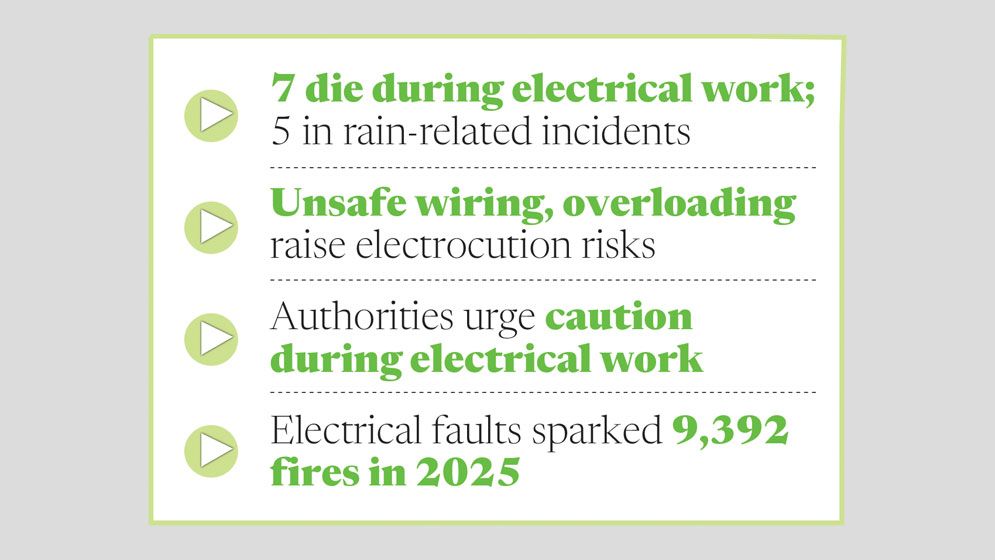
At least 18 people have died in electrocution incidents across the country in the first 13 days of this month, exposing preventable safety failures and prompting authorities to urge greater caution as monsoon rains increase electrical hazards.
One of the deadliest incidents occurred in Sunamganj's Bishwambharpur upazila on 6 July, where three members of a family died while attempting to rescue one another after coming into contact with a live power line.
Farhad Shah, 38, had climbed onto the tin roof of the family's grocery shop to repair rain-induced leaks when he was electrocuted after touching an overhead power line.
Hearing his cries, his father, Nurul Amin, 70, rushed to help but was also caught in the electric current. Moments later, his mother, Fatema Begum, 60, attempted to save them and suffered the same fate.
A Daily Sun investigation found that the Sunamganj tragedy was part of a broader nationwide pattern of preventable accidents.
Of the 18 deaths recorded between 1 and 13 July, seven occurred during electricity-related work, including power line maintenance, electrical repairs, construction activities and tree cutting near overhead cables, making workplace-related incidents the leading cause of fatalities.
Five others died while using electrical equipment at home, including checking a water pump, touching a switchboard, charging an easy bike or disconnecting an auto-rickshaw from its charger.
Four people were electrocuted while trying to rescue family members who had already come into contact with live electricity.
The remaining two deaths resulted from a storm-damaged power line lying on a road and another electrocution inside a residence.
The fatalities were reported from Dhaka, Chattogram, Jhenaidah, Jashore, Jamalpur, Khagrachhari, Kurigram, Feni, Sunamganj and Madaripur, highlighting the nationwide nature of the problem.
The monsoon has significantly heightened the danger. At least five of the 18 deaths were directly linked to heavy rain or storm-related conditions.
They included a former Bangladesh Bank official in Dhaka who was electrocuted while checking a water pump submerged in rainwater, the three family members in Sunamganj and a housewife in Feni who died while attempting to move a power line brought down during a storm.
The trend is also reflected in the Fire Service and Civil Defence Annual Report 2025, which identified electrical faults as the leading cause of fires, accounting for 9,392 incidents, or 34.71% of all fires recorded last year.
The report also documented 46 electrocution incidents that claimed at least 14 lives, although those figures cover only cases attended and officially recorded by the agency.
Officials say many of the deaths could have been avoided.
Paritosh Sutradhar, Director of the Directorate of System Operation at the Bangladesh Rural Electrification Board (BREB), said electrocution incidents typically increase during the monsoon but stressed that poor public awareness remains the primary concern.
"However, the bigger reason is a lack of public awareness. Many people try to carry out electrical work on their own without taking proper safety precautions," he said.