


 For all latest news, follow the Daily Sun's Google News channel.


File Photo
Cox’s Bazar is currently gripped by the panic of landslides. Amid the heavy rainfall of the past few days, at least two dozen people have lost their lives due to landslides. More than a thousand people remain at critical risk of death. The monsoon has only just begun, and the death toll could rise in the coming days. Over the last nine years, landslide incidents have been steadily increasing in this tourist city. Ever since the displaced Rohingya from Myanmar took shelter in Cox’s Bazar in 2017, this region has been experiencing various natural and environmental disasters, including landslides. According to statistics, at least a hundred people have lost their lives to landslides in Cox’s Bazar over the past nine years. In contrast, from 2007 to 2017 – a span of ten years – only nine people died from landslides.
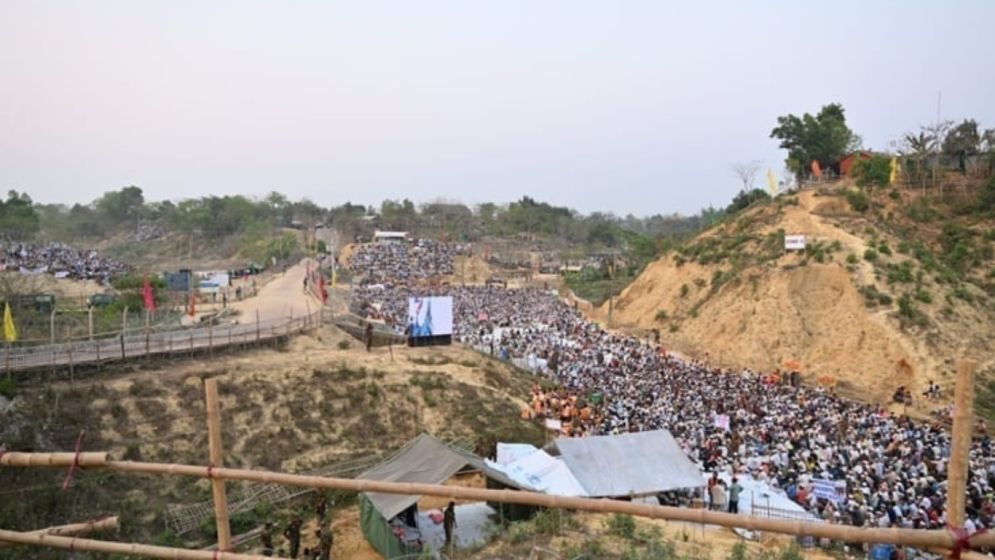
Following the Rohingya influx in August 2017, millions of Rohingyas took shelter on the slopes of undulating hills, which once used to be deep forests and sanctuaries for wildlife. All 33 Rohingya camps in Ukhiya were built on these hills. For all these camps, the monsoon season spells sheer terror. Heavy rainfall brings an immediate fear of death. Among them, 200,000 Rohingyas are living in the most vulnerable conditions.
The environment has suffered catastrophic damage due to the cutting down of hills for Rohingya settlements. Forests have been denuded, wildlife has been driven towards extinction, and a negative impact is being felt on climate change. Notably, an additional 200,000 Rohingyas arrived just last year, and all of their settlements are located on high hills, making them the most vulnerable. The deforestation, hill cutting, and loss of biodiversity in Cox’s Bazar are considered among the biggest environmental impacts of the Rohingya crisis. Vast swathes of forest land have been cleared to build the shelters. The environmental degradation of Cox’s Bazar and the resulting deaths only spark public outcry and discussion when landslides occur during the monsoon. But once the monsoon passes, we tend to forget everything.
Tourism and economic strain
Cox’s Bazar is the tourism capital of Bangladesh, boasting the world’s longest unbroken sandy sea beach – a land of unparalleled natural beauty and the country’s primary tourist destination. Bangladesh could have earned at least ten billion dollars annually from the tourism sector revolving around Cox’s Bazar. However, under the pressure of nearly 1.2 million Rohingyas since 2017, this tourist city is now virtually dying. Forget foreign tourists; even domestic travellers are losing interest in visiting Cox’s Bazar.
The Rohingya influx has caused more than just environmental disasters. This region is turning into an international route for drug and weapon smuggling. Bangladesh’s premier tourist city has transformed into a sanctuary for various crimes, including human trafficking.
Bangladesh is having to bear massive infrastructural, administrative, and security costs to manage the Rohingya crisis. Although international organisations provide significant aid, an extraordinary burden has fallen upon local education, healthcare, communication systems, and other public services. The local population of the Cox’s Bazar region is also feeling the brunt of rising living costs and competition in employment. World Bank research indicates that the economic and social impacts in areas adjacent to the camps are complex and multidimensional.
The rise of organised crime
Information from law enforcement agencies and various international reports highlights deep concerns regarding drug trafficking, human trafficking, extortion, kidnapping, and the activities of armed groups within the shelter camps. A powerful underworld network has developed around the Rohingya camps in Cox’s Bazar, and locals are also getting entangled in crimes alongside the Rohingyas. Over the past nine years, more than a thousand people have lost their lives here due to violence. Illegal weapons and drugs are entering Cox’s Bazar freely and spreading to different corners of Bangladesh.
In recent years, Bangladesh’s name has topped the list of illegal sea-route journeys to foreign countries. Statistical analysis reveals that illegal journeys to Europe via sea routes surged following the Rohingya influx into Bangladesh. Rohingyas are the masterminds behind these human trafficking networks. They easily obtain Bangladeshi passports and attempt to travel abroad using them. When news of their accidents is published in international media, it tarnishes Bangladesh’s reputation. Due to their forgery and deception, various countries around the world have either suspended or tightened visa processes for Bangladeshi citizens. As a result, the manpower export sector – one of Bangladesh’s largest sources of foreign currency earnings – is now under threat.
Sharing limited resources with the local population, competition in the labour market, and extra pressure on infrastructure have become major sources of social tension. On the other hand, a decline in international aid has put various humanitarian operations, including food, healthcare, and education, into a challenging position. UN agencies have warned that the crisis could become even more complex if funding continues to dwindle. Bangladesh is already grappling with an economic crisis, and on top of that, managing the pressure of this massive Rohingya population has become immensely difficult for the country. The Rohingya population is now a major obstacle to the economic development of Bangladesh.
National security threat and geopolitics
The Rohingyas are being viewed as a major threat to the security, independence, and sovereignty of Bangladesh. Experts believe that until the Rohingya problem is resolved, Bangladesh’s security will remain vulnerable and hanging in the balance. The Rohingyas sheltered in Bangladesh are linked to various terrorist organisations. This crisis has already created an international security threat, with Bangladesh at its epicentre. In the future, this could trigger regional conflicts involving India, China, and the United States.
Military analysts believe that the recent civil war in Myanmar and the establishment of authority by the Arakan Army over areas bordering Bangladesh pose a direct threat to Bangladesh’s security and sovereignty. Just this month, the Myanmar military junta carried out a series of airstrikes from fighter jets targeting Arakan Army positions in Maungdaw and Buthidaung townships of Rakhine State. The deafening sound of explosions across the border repeatedly shook a vast area stretching from Jadimora in Teknaf to Shah Porir Dwip. Under these circumstances, there are fears that Bangladesh could become a target for the Myanmar military at any moment.
Government response
It is precisely for this reason that the government has formed a high-level “National Action Plan Committee” to tackle the Rohingya crisis. Alongside continuing efforts for the safe and sustainable repatriation of displaced Myanmar citizens, this move signals a shift towards a more security-oriented approach to managing the crisis.
According to a government gazette published last Sunday, this committee, chaired by Prime Minister Tarique Rahman, includes senior officials from the military, police, intelligence agencies, and key ministries. The prime minister will serve as the chairperson of the committee, while the Principal Staff Officer (PSO) of the Armed Forces Division will act as the chief coordinator. The director general of the Directorate General of Forces Intelligence (DGFI) has been appointed as the member-secretary.
The formation of this committee immediately following the prime minister’s visit to China carries immense significance. It indicates that the government is prioritising the Rohingya issue with utmost urgency. It is hoped that the government will initiate a swift resolution by discussing the matter with the international community to resolve the Rohingya crisis. The Rohingyas are now a threat not just to Cox’s Bazar, but to the security of the entire nation. Therefore, the sooner they are repatriated, the safer it is for the country.
Audite Karim is an author and playwright. Email: [email protected]