



 For all latest news, follow the Daily Sun's Google News channel.


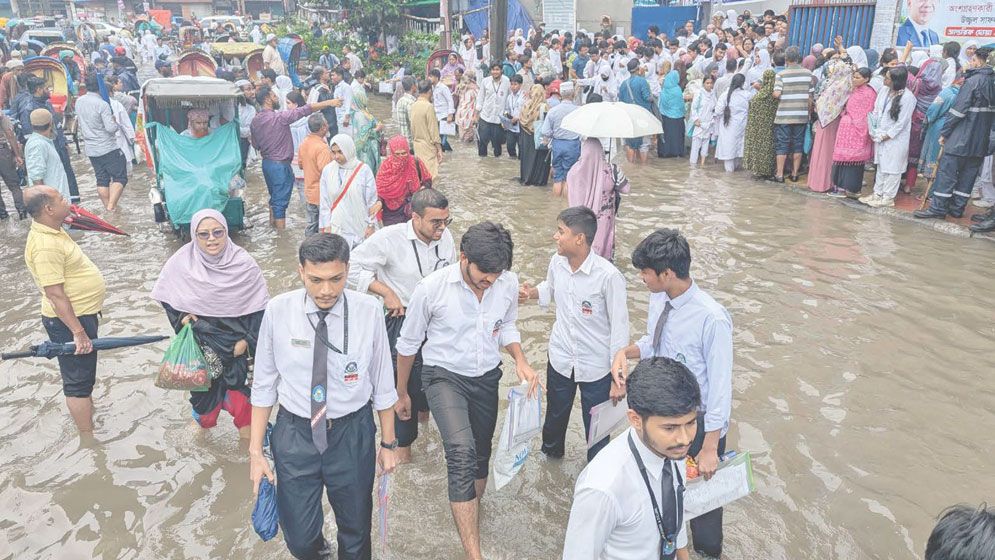
HSC examinees brave knee-deep, waterlogged streets in Arambagh area on Monday, as persistent rainfall continues to cause severe disruption across the capital. Students were forced to trudge through the submerged roads to reach their centres, adding further hardship to their examination day. -Daily sun Photo
The education administration’s erratic approach to scheduling public examinations during emergencies has ignited fresh outrage, with students and guardians alike questioning the authorities' crisis management capabilities.
As heavy rainfall crippled large swathes of the country on Monday, the decision to proceed with Higher Secondary Certificate (HSC) exams – while simultaneously exempting the Chattogram Education Board due to flooding – drew sharp criticism for its lack of consistency.
The confusion reached its nadir in the lead-up to the examinations, with authorities oscillating on their decision three times overnight.
It was not until 1:15am that the Chattogram Board jurisdiction was finally granted a postponement, leaving thousands of candidates in a state of high-stakes limbo.
"As floodwater started rising in the afternoon, I remained anxious about whether the exam would be held. In the morning I saw the news confirming

the examination had been postponed," said one Chattogram Board candidate, Towhidul Islam.
For those in other regions, the situation was arguably worse. A viral video from the Cumilla Government Women’s College centre laid bare the plight of students, who were forced to wade through waist-deep, filthy water to reach their exam halls. With clothes soaked and streets inundated for kilometres, candidates sat for their three-hour papers in conditions that education observers warn could trigger health crises, ultimately sabotaging their performance in subsequent tests.
The incident is the latest in a recurring pattern of reactive, last-minute decision-making.
Observers pointed to previous debacles, including the delayed postponement of exams following a fatal aircraft crash last year and the failure to anticipate school closures during the early stages of the pandemic.
Prof Mohammad Mojibur Rahman of the Institute of Education and Research at the University of Dhaka argues that these lapses are symptomatic of a deeper systemic failure.
"Examination schedules should have been revised in advance by taking adverse weather forecasts into account," he told the Daily Sun.
"The same question paper is being used in some parts of the country while examinations are being postponed in others. This raises concerns about the fairness of the assessment process. Students taking examinations amid disasters are not being assessed under normal conditions, which ultimately undermines the very purpose of the examinations."
Mojibur Rahman urged the government to formulate a long-term national education plan for disaster management and proposed shifting public examinations to seasons with more favourable weather.
In response, Prof Syed Akhtaruzzaman, chairman of the Dhaka Board and president of the Inter-Education Board Coordination Committee, maintained that the authorities are in constant contact with district administrations.
"We are collecting information on the ground conditions... However, overnight rainfall has caused fresh waterlogging in several areas. We are closely monitoring the developments," he said.
Despite the chaos, the sixth day of the HSC and equivalent exams proceeded in 59 districts.
The day was marked by 29 expulsions for malpractice across various boards.
Meanwhile, 19,592 candidates remained absent, and social media was rife with complaints regarding alleged errors in the Physics First Paper.
As the exams continue, the recurring indecision highlights a stark reality: without a robust, pre-planned strategy for operating under climate-induced disasters, the academic future of thousands of students remains precariously tied to the weather.
Read More