


 For all latest news, follow the Daily Sun's Google News channel.


State firms, multinationals in focus to end IPO drought
Govt expands direct listings, pushes the PM’s 17-point reform agenda to revive capital market

The Bangladesh capital market has remained largely stagnant amid a prolonged crisis of investor confidence, sluggish trading, a shortage of fundamentally strong listings, and a more than two-year drought in initial public offerings (IPOs).
With few quality investment opportunities available, investors have been circulating funds among a limited pool of companies, a trend market stakeholders say is undermining depth, liquidity, and foreign participation.
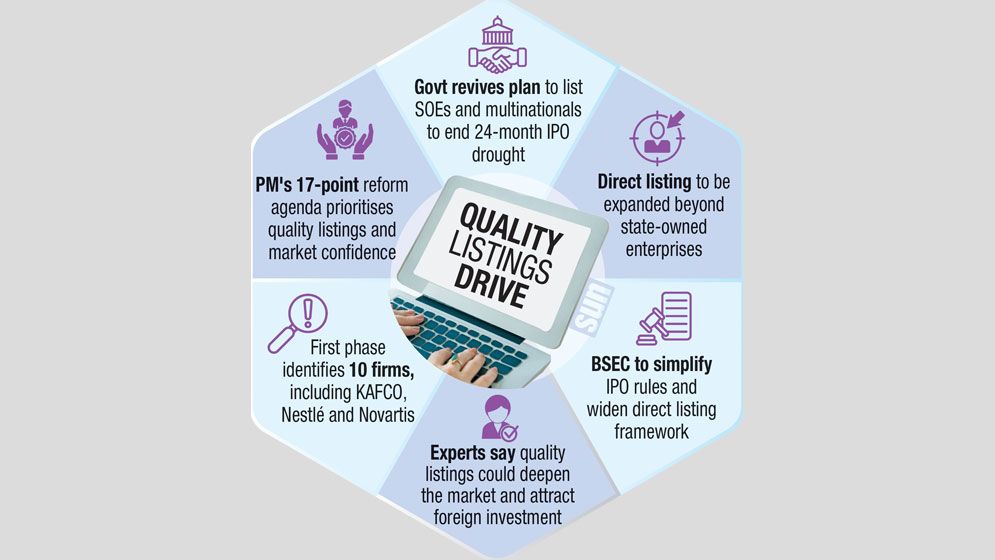
Against this backdrop, the government has launched a fresh initiative to revive the market by bringing profitable state-owned enterprises (SOEs) and multinational companies (MNCs) with government shareholding to the stock exchanges.
At the same time, the Bangladesh Securities and Exchange Commission (BSEC) is working to expand the scope of direct listing for large and established companies.
Market experts say the long-discussed initiative, if implemented, could significantly improve the quality and depth of Bangladesh’s capital market.
A government priority
The government has identified the capital market as one of the key pillars of the economy.
Addressing parliament recently, Prime Minister Tarique Rahman said the government is committed to restoring stability in the stock market and rebuilding investor confidence.
He said the goal is to develop a modern, sustainable capital market through stronger governance, greater transparency and accountability, deeper markets, and the inclusion of quality companies and new investment products.
To achieve this, the government has adopted a 17-point reform agenda.
The measures include listing profitable SOEs through share offloading, allowing direct listing for multinational and large-cap companies, encouraging fundamentally strong firms and SMEs to enter the market, simplifying IPO regulations, creating a more foreign investment-friendly environment, and reducing capital gains tax.
Although bringing quality companies to the stock market has been discussed for nearly two decades, little progress has been made.
The proposal regained momentum after a high-level meeting chaired by former Chief Adviser Professor Muhammad Yunus at the state guest house Jamuna on 11 May 2025.
10 companies identified
According to BSEC sources, 10 companies have been shortlisted in the initial phase.
The state-owned firms include Karnaphuli Gas Distribution Company, Karnaphuli Fertiliser Company (KAFCO), North-West Power Generation Company, Paschimanchal Gas Company and Sylhet Gas Fields.
Among multinational companies, Nestlé Bangladesh, Syngenta Bangladesh, Synovia Bangladesh and Novartis Bangladesh are also under discussion for potential listing.
BSEC pushes direct listing
Rather than relying solely on IPOs, BSEC plans to facilitate the listing of large corporations through direct listing.
The facility is currently available only to a limited number of state-owned enterprises, but the regulator intends to extend it to all eligible companies.
Under the proposed framework, large and established companies will be able to list on the stock exchanges by offloading a specified portion of their shares without going through the conventional IPO process.
BSEC Chairman Masud Khan recently said the commission is implementing a series of reforms to attract quality companies, including simplifying IPO procedures, expanding direct listing opportunities, revising margin loan regulations, introducing T+1 settlement, integrating the bond market into the main board, and launching derivatives trading.
He said the current IPO process requires companies to wait for long periods and submit extensive documentation, prompting many businesses to rely on bank financing instead.
“As a result, alongside simplifying IPO procedures, the commission is expanding direct listing to facilitate the market entry of large, fundamentally strong companies,” he said.Market participants say many profitable companies have little interest in listing because of the lengthy and complex IPO process.
Direct listing would allow companies to begin trading without conducting a traditional IPO, while enabling market demand and supply to determine share prices.
Why multinationals stay away
Market experts say multinational companies are reluctant to list because listed firms must publish regular financial reports, comply with stricter corporate governance standards, remain under greater regulatory scrutiny and become more accountable to minority shareholders.
ICB Chairman Prof Abu Ahmed said multinational companies do not enter capital markets only when they need financing.
“If Nestlé can be listed on the Bombay Stock Exchange, and multinational companies can be listed in Pakistan and Thailand, then why should Bangladesh be any different?” he said.
He suggested the government could consider tax incentives to encourage listing.
“But if they continue to avoid listing without reasonable justification, policymakers should consider addressing the issue through tax policy. Otherwise, we may have to wait many more years,” he added.
Calls for mandatory listing
Dhaka Stock Exchange Director Richard D Rozario said multinational companies generating substantial profits from Bangladesh have both social and economic responsibilities.
“Companies earning thousands of crores of taka from Bangladeshi consumers should allow ordinary citizens to become part-owners of those businesses,” he said.
He argued that the government could, if necessary, enact legislation requiring such companies to float 10% to 20% of their shares on the stock market.
Saiful Islam, president of the DSE Brokers Association of Bangladesh (DBA), said discussion alone would not be enough.
“It is unfortunate that not a single new company has entered the market so far,” he said.
According to him, listing fundamentally strong state-owned and multinational companies would provide the biggest boost to Bangladesh’s capital market.
Read More