


 For all latest news, follow the Daily Sun's Google News channel.


WB suspends funding before completion of DSCC project
Future of unfinished works remains uncertain

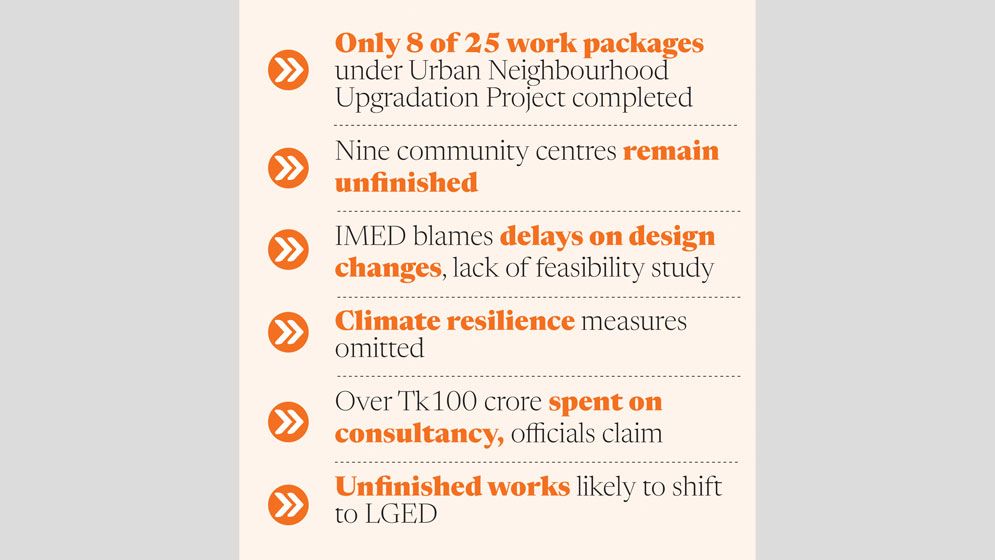
The World Bank has suspended funding for a major Dhaka South City Corporation (DSCC) infrastructure project before its completion, leaving the fate of several unfinished works uncertain.
The Urban Neighbourhood Upgradation Project, launched in March 2019, was scheduled to end in December this year under its second revised Development Project Proposal (DPP). However, DSCC officials said the World Bank suspended funding on 31 May.
According to an intensive monitoring report by the Implementation Monitoring and Evaluation Division (IMED), the project had achieved around 72% physical progress and 61% financial progress until May.
Of the project’s 25 work packages, only eight have been completed. Eighteen are under implementation, four remain in the tender stage, while design, engineering and standard bidding documents have been finalised for one package. Construction of eight community centres has reached about 60%, while work on another has remained suspended because of legal complications. Installation of street lighting, traffic signs and tree plantation has progressed by only around 6%, 7% and 2% respectively.
The project includes the development of 7,555 square metres of playgrounds, 18,721 square metres of parks, 9.24 kilometres of roads, 22.72 kilometres of drains, ponds, the construction of nine community centres and renovation of another, among other civic improvements.
The project was initially approved at a cost of Tk880.64 crore, including a World Bank loan of Tk834.49 crore. Following revisions, the project cost has been reduced to Tk504.75 crore, with the World Bank’s contribution standing at Tk466.74 crore. Project Director Rajib Khadem said only eight work packages had been completed so far.
“We have nine community centres, but none of them could be completed. All require electrical work, while some also need furnishing. We also failed to import lifts for the multi-storey community centres because of problems with letters of credit (LCs),” he said.
He added that the World Bank suspended funding on 31 May and that the remaining works are expected to be implemented under the upcoming Rural Transport Improvement Project (RUTIP) of the Local Government Engineering Department (LGED). The IMED report attributed the slow progress to the absence of a proper feasibility study and repeated changes in project design and work scope. Seeking anonymity, a DSCC official alleged that frequent design revisions by World Bank consultants significantly delayed implementation.
“The project has virtually stalled because of repeated changes in design and work scope. We had around 20 consultancy packages and individual specialists, which resulted in huge consultancy costs. These were conditions set by the World Bank,” the official claimed.
The official further said most contracts had to be revised, with both costs and implementation periods nearly doubling because of repeated design changes.
“In the past seven years, we received only Tk306.15 crore for implementation, while more than Tk100 crore was spent on consultancy services and specialists’ salaries,” the official added.
Deviation from original objectives
The project was originally designed to improve civic facilities in densely populated areas of Gulistan, Kamrangirchar, Khilgaon and Sutrapur through road widening, bridge construction, renovation of parks and playgrounds, pond development and improved waste management.
Although the project comprises 16 components, only one secondary waste transfer station at Kamrangirchar is under construction, with physical progress reaching just 10%. According to the IMED report, the project also aimed to strengthen resilience to climate change and natural disasters through energy-efficient designs, rainwater harvesting, renewable energy and other sustainable features.
However, most of these measures were not incorporated into the final designs. Roads, drains, footpaths and playgrounds were built using conventional designs, while LED street lights were installed instead of the proposed solar-powered lighting system.
Another DSCC official, requesting anonymity, said the feasibility study and detailed designs for the Shahjahanpur Jheel development and an iron bridge at Kamrangirchar had been completed but were later dropped from implementation.
“It was a sheer waste of public money,” the official said.
Read More