


 For all latest news, follow the Daily Sun's Google News channel.


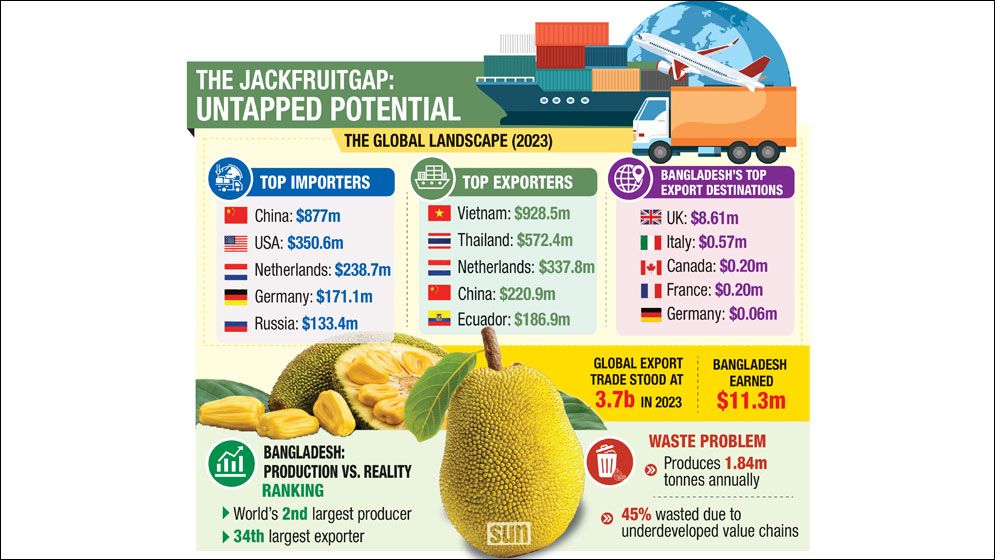
Bangladesh sits on a colossal agricultural secret that has remained largely dormant for decades.
As the second-largest producer of jackfruit in the world, the nation holds a treasure trove of potential. Yet, this massive annual bounty has failed to translate into a corresponding share of the global export market.
Food and Agriculture Organization (FAO) data shows that Bangladesh captures a mere 0.3% of the world's jackfruit trade which currently stands at around $4 billion.
This is a sobering figure for an economy desperately seeking to diversify its foreign currency earnings, according to analysts.
A significant portion of the harvest, exceeding 45%, simply goes to waste every single year.
The reasons for this are rooted in underdeveloped value chains and a persistent lack of modern marketing infrastructure.
Sector insiders, however, say the tide may finally be turning as the global food industry undergoes a radical transformation.
A global market in flux
The world is hungry for plant-based meat alternatives and fiber-rich, sustainable superfoods.
Projections from Mordor Intelligence suggest that the global jackfruit market is poised for significant expansion.
For processed, retail, and plant-based jackfruit products, a compound annual growth rate of 5.22% is expected between 2026 and 2031. The market value is anticipated to climb from $356.67 million in 2025 to $483.93 million by 2031.
Total global exports —encompassing the vast international exchange of fresh produce — have already surged from $2 billion in 2012 to $3.7 billion in 2023.
Countries like Vietnam and Thailand have been quick to capitalise on this shift, securing dominant market shares.
Meanwhile, Bangladesh has struggled to maintain its footing, facing a decline in jackfruit export volumes over the last four years.
From 2,231.82 tonnes in 2022-23 fiscal year (FY23), the export numbers have steadily dwindled. Data shows 2,024.10 tonnes for FY24, falling further to 1,199.27 tonnes in FY25. As of May 2026, the current fiscal year has seen only 1,083.09 tonnes exported.
This decline is stark, even as domestic production remains impressively stable at roughly 1.84 million tonnes.
The challenge of pricing and logistics
Bangladesh’s export pricing often remains significantly higher than the global average of $1,745 per tonne.
This discrepancy places local exporters at a competitive disadvantage against regional rivals.
Major markets like the United Kingdom and Saudi Arabia continue to be the primary destinations for the fruit.
Together with France, Italy, and Canada, these nations account for nearly 85% of all Bangladeshi exports.
The bulk of this volume, around 76%, is absorbed by the UK market alone.
However, relying on a narrow set of destinations limits the industry's ability to hedge against market volatility.
Infrastructure gaps, particularly in cold-chain management and rapid transport, further hamper the ability to reach premium markets.
The lack of large-scale commercial packing houses means that quality control remains a difficult hurdle to clear.
Without systematic investment, the industry remains trapped in a cycle of small-scale, sporadic shipments.
A strategic pivot toward China
The most promising horizon for this industry lies in the rapidly growing demand from China.
As the world’s largest importer of the fruit, China represents a massive, untapped demographic. Dhaka has recognised this opportunity and is currently engaged in high-level diplomatic discussions to facilitate trade.
Prime Minister Tarique Rahman recently highlighted the potential during the 13th Jatiya Sangsad.
He drew a compelling parallel to the success Malaysia has achieved by exporting durian to the Chinese market.
His vision is for Bangladesh to earn substantial foreign exchange by following a similar path. The strategy focuses on exporting green jackfruit, which is highly valued in Chinese culinary culture as a vegetable.
Green jackfruit offers a distinct advantage due to its significantly longer shelf life during transport.
Initial shipments are planned to originate from registered, pilot-programme orchards in Gazipur.
This controlled approach is designed to meet the rigorous expectations of Chinese food safety officials.
Navigating strict phytosanitary standards
Entering the Chinese market is no simple task, as it demands strict adherence to international protocols.
Agriculture Secretary Dr Rafiqul I Mohamed confirmed that the government is finalising a draft protocol with China.
This agreement focuses heavily on quality control, phytosanitary compliance, and packaging standards.
Abu Noman Faruq Ahmmed, a Global G.A.P. registered trainer and professor at the Department of Plant Pathology at Sher-e-Bangla Agricultural University, views these requirements as manageable.
He points out that the natural farming practices in Bangladesh provide a significant competitive edge.
“Meeting China’s phytosanitary requirements for jackfruit are comparatively easier because we do not use pesticides on jackfruit,” he noted.
“Since pesticides are rarely sprayed, there is almost no possibility of pesticide residue in the fruit,” the professor explained. However, meeting these standards requires a transition toward formalised, Good Agricultural Practices or GAP certification.
Abu Noman emphasises the need to promote firm-fleshed, export-oriented varieties like the local “Khaja”.
Expanding commercial orchards with these specific varieties is critical for long-term export viability.
The path toward value addition
Exporting raw fruit is only the first step in unlocking the industry’s true economic potential. Experts argue that building an industrial base for processed jackfruit products is essential. There is enormous potential for creating ready-to-cook meals, dried chips, and various by-products.
Razia Sultana, owner of Global Trade Link and a prominent fruit exporter, confirms this shift is already underway.
“We are currently diversifying beyond fresh produce to include frozen ripe jackfruit,” she noted.
“More importantly, we are actively developing jackfruit chips and meat-alternative patties, which could turn this seasonal crop into a year-round export powerhouse.”
She added that several local firms are now collaborating to scale these value-added products for both traditional markets and emerging opportunities in China.
Processing the fruit while it is still green could drastically reduce post-harvest waste.
Developing an industry around these products would create significant value addition and local employment.
“If we can attract foreign investment into this sector, it will generate employment, create value-added products and introduce new ready-to-cook items,” Prof Abu Noman said, adding, “In fact, processed jackfruit products are even more important than exporting fresh jackfruit.”
Attracting foreign investment into this sector could turn a seasonal crop into a year-round economic engine.
It would also allow Bangladesh to command higher prices in global retail and foodservice chains. Beyond the fruit itself, even the seeds possess untapped potential for manufacturing and food science applications.
The goal is to move from a raw-material supplier to a sophisticated producer of consumer-ready goods.
Building for the future
The success of this initiative will ultimately depend on the government’s ability to coordinate with the private sector.
Establishing a network of registered packing houses is the next logical step in this journey. These facilities must be equipped to handle the strict sorting, washing, and packaging requirements of international importers.
The current pilot programme in Gazipur will serve as a critical learning experience for the entire industry.
Success here would provide a blueprint for scaling up production in other major hubs like Tangail and Mymensingh.
It would also demonstrate to the global market that Bangladesh is ready to meet modern standards of reliability.
Farmers who have begun cultivating jackfruit on a commercial scale must be supported with proper training.
Certification processes must be streamlined to ensure that smallholders can easily integrate into the export supply chain. With the global demand for plant-based nutrition only set to increase, the timing is indeed perfect.
Bangladesh has the production capacity, the climate, and the diplomatic momentum to succeed. If all pieces align, the nation can finally transform its vast, underutilised jackfruit harvest into a pillar of its national economy.
The humble jackfruit is ready to shed its image as a seasonal curiosity and become a global economic player.
The reporter can be reached at: [email protected]