


 For all latest news, follow the Daily Sun's Google News channel.


Restore public trust in healthcare system, curb $5b medical flight
PM urges doctors as he addresses 81st founding anniv of DMC
Daily Sun Report, Dhaka
Published: 12 Jul 2026, 12:00 AM
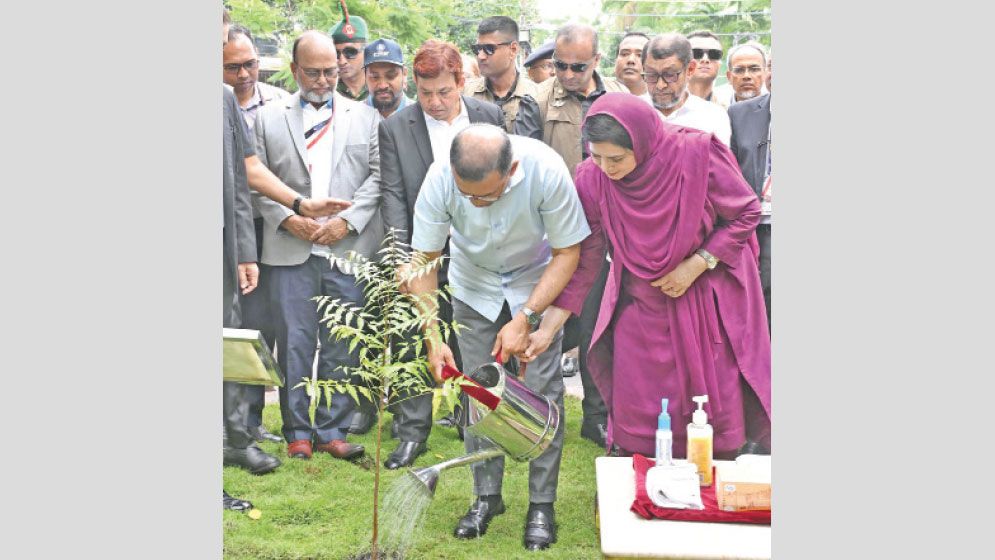
Prime Minister Tarique Rahman, accompanied by his spouse, Dr Zubaida Rahman, plants a sapling at Dhaka Medical College as part of the institution's 81st founding anniversary celebrations on Saturday. -PID Photo
Prime Minister Tarique Rahman has called upon the medical community to rebuild public confidence in the national healthcare system, warning that without a fundamental shift in patient care and professionalism, the nation will continue to haemorrhage billions in foreign currency.
Addressing the 81st founding anniversary of Dhaka Medical College (DMC) on Saturday, the prime minister highlighted the stark reality that Bangladeshis spend approximately US$5 billion annually seeking medical treatment abroad.
“Why can’t we provide this treatment at home? Why can’t we earn people’s trust?” Tarique Rahman asked, stressing that the erosion of faith in domestic services cannot be rectified by legal enforcement alone.
“Public confidence in our healthcare system can only be restored through compassionate patient care, professional conduct, and quality medical treatment.”
The prime minister underscored that punctuality, accountability, and empathy are the bedrocks of a functional healthcare infrastructure.
His wife, Dr Zubaida Rahman, a former DMC student, was present as a special guest at the event. Outlining a roadmap for reform, Tarique Rahman announced the government’s ambitious drive to recruit 100,000 healthcare workers, with women accounting for 80 per cent of the intake. These workers are tasked with delivering preventive care at the community level, aligning with the government’s “prevention is better than cure” philosophy.
This strategic pivot will focus on nutrition, vaccination, maternal health, and the early detection of non-communicable diseases, including diabetes,  hypertension, and cancer. To support these initiatives, the government has earmarked a record Tk69,409 crore for the health sector – amounting to 1.2% of GDP – with a pledge for incremental increases over the next five years.
Furthermore, the prime minister noted that treatment costs are being tempered through the reduction or withdrawal of VAT and taxes on essential medical supplies, such as dialysis filters, cardiac stents, and pacemakers.
Addressing the urban-rural divide, the prime minister revealed plans to upgrade all 31-to-51-bed hospitals to 101-bed facilities in phases.
With only five of the country’s nearly 500 upazilas currently boasting 100-bed hospitals, the move aims to decentralise specialised care and reduce the burden on major city centres.
Additional plans include the establishment of five 200-bed children’s hospitals, including new facilities in Rajshahi and Barishal.
Security, too, is receiving a major overhaul. Ten Ansar personnel are being deployed to every upazila health complex to ensure the safety of clinical staff. Simultaneously, the government is moving to fill vacancies for 5,000 MBBS doctors, alongside nurses, pharmacists, and medical technologists.
Reflecting on the legacy of Dhaka Medical College, the prime minister praised its storied history, noting the institution’s involvement in the Language Movement, the Liberation War, and the 2024 mass uprising.
He concluded by assuring students and faculty that the government is committed to transforming DMC into a world-class centre for medical education and research.
Earlier in the day, the prime minister inaugurated the anniversary celebrations and joined an open discussion with the student body.
Zubaida: Turn DMCH into hub of innovation, compassionate leadership
Dr Zubaida Rahman, vice-chairperson of the Ziaur Rahman Foundation, called for the transformation of Dhaka Medical College Hospital (DMCH) into a pre-eminent hub of innovation, international collaboration, and research excellence, driven by compassionate leadership.
Addressing a views exchange meeting titled ‘DMCians’ Thoughts on the Modernisation of Bangladesh’s Healthcare System’ at the college auditorium,
Dr Zubaida emphasised that human connection must remain the heartbeat of clinical practice, regardless of the pace of technological advancement. “No matter how technology-driven medical science becomes, human beings always remain at its centre,” Dr Zubaida said.
“The true foundation of the medical profession is humanity. Often, a few reassuring words from a physician work like medicine for a patient.”
Speaking with visible emotion, she recalled her own tenure at the hospital.
“While serving during my rotation in Gynaecology and Obstetrics, I witnessed the suffering of helpless and poor patients from very close quarters. We want DMCH to become a centre of excellence and compassion, where every patient receives the highest standard of treatment and empathy.”
Looking ahead to the next quarter-century, she expressed her hope that DMC would emerge as one of South Asia’s leading centres for medical education and research. She noted that while alumni are now scattered across the globe, their identity remains tethered to the institution.
“The time has now come for us to be united not only by the bond of memories but also by the bond of responsibility,” she urged.
“The true strength of an institution does not lie in its infrastructure, but in its people. The greatest asset of Dhaka Medical College is its talent, values, and its people.”