



 For all latest news, follow the Daily Sun's Google News channel.


The second (budget) session of the 13th National Parliament is scheduled to resume today after a seven-day recess, following the passage of the Tk9.38 lakh crore national budget for fiscal year (FY) 2026–27 and the Finance Bill.
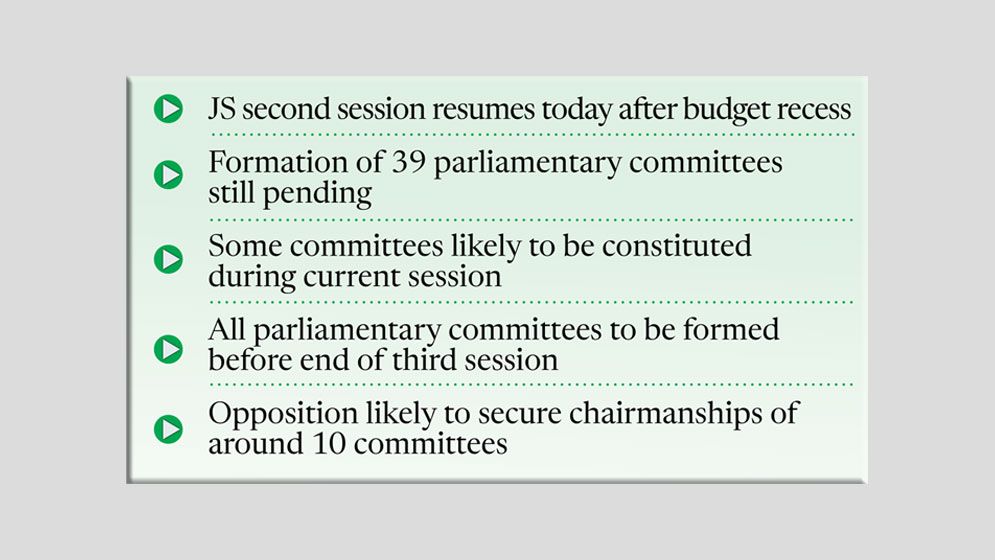
The current session of the Jatiya Sangsad (JS) is expected to continue until 16 July, but 39 parliamentary committees have yet to be constituted. Their formation is expected to top the parliamentary agenda during the remainder of the session.
Chief Whip Md Nurul Islam Moni said the parliamentary standing committees would be formed within the constitutional timeframe.
“All committees will be constituted before the end of the third session,” he said.
Parliament Secretariat sources said the membership lists and the names of chairpersons for several committees have nearly been finalised. While a number of committees are expected to be constituted during the remainder of the current session, the rest are likely to be formed during the third session of parliament, expected to begin in mid-September.
The delay in constituting the parliamentary committees has hindered full-scale parliamentary oversight of various ministries and government departments.
So far, only three standing committees on ministries have been formed — those on the ministries of planning, finance and law. Senior BNP MPs Dr Abdul Moyeen Khan (Narsingdi-2) and Mushfiqur Rahman (Brahmanbaria-4), along with BJP MP Barrister Andaleeve Rahman Partho (Bhola-1), have been appointed chairpersons of the committees respectively. The three committees comprise members from both the treasury and opposition benches.
Under the Constitution and the Rules of Procedure of the Jatiya Sangsad, all standing committees must be constituted within the first three sessions of a newly elected parliament. Of the 50 parliamentary committees, only 11 have so far been formed, including eight parliament-related committees and three standing committees on ministries.
Following the passage of the national budget on 30 June, both the treasury and opposition benches have turned their attention to the formation of the remaining committees.
Parliament Secretariat sources said the proposed lists of chairpersons for the remaining committees have already been reviewed by the Prime Minister's Office.
Senior MPs and former ministers with relevant technical expertise and ministerial experience are being given priority for committee chairmanships. However, several key committees are expected to be chaired by opposition lawmakers. Around 10 committee chairmanships may be allocated to opposition parties, including Bangladesh Jamaat-e-Islami, the National Congress Party (NCP), and independent MPs.
According to the sources, standing committees on the ministries of local government, rural development and co-operatives (LGRD), public administration, home affairs, education, health, agriculture, road transport and bridges, power, energy and mineral resources, foreign affairs, commerce, housing and public works, environment, forest and climate change, and information and broadcasting may be constituted during the current session.
Among those being considered for committee chairmanships from the treasury bench are Dr Khandaker Mosharraf Hossain, Dr Osman Faruk, Goyeshwar Chandra Roy, Altaf Hossain Chowdhury, Barkat Ullah Bulu, Zainul Abdin Farroque, Aman Ullah Aman, Lutfuzzaman Babor, Gias Uddin Quader Chowdhury, Barrister Mahbub Uddin Khokon and Dr Reza Kibria. From the opposition, ATM Azharul Islam, Shahgahan Chowdhury, Nurul Islam Bulbul and Akhtar Hossain are also under consideration.
The opposition is also expected to receive the chairmanships of four key committees — the Committee on Public Undertakings, the Public Accounts Committee, the Estimates Committee and the Committee on Privileges.
Nurul Islam Moni said the final selection of committee chairpersons and members rests with the Leader of the House, after which the proposed names will be placed before parliament for formal approval.
“Chairmanship of four major committees may be given to the opposition,” he said.
Article 76 of the Constitution stipulates that parliamentary committees are responsible for examining draft bills and legislative proposals, reviewing the implementation of laws and recommending measures for their enforcement, and investigating or inquiring into the activities and administration of ministries on matters of public importance referred to them by Parliament.
Read More