


 For all latest news, follow the Daily Sun's Google News channel.


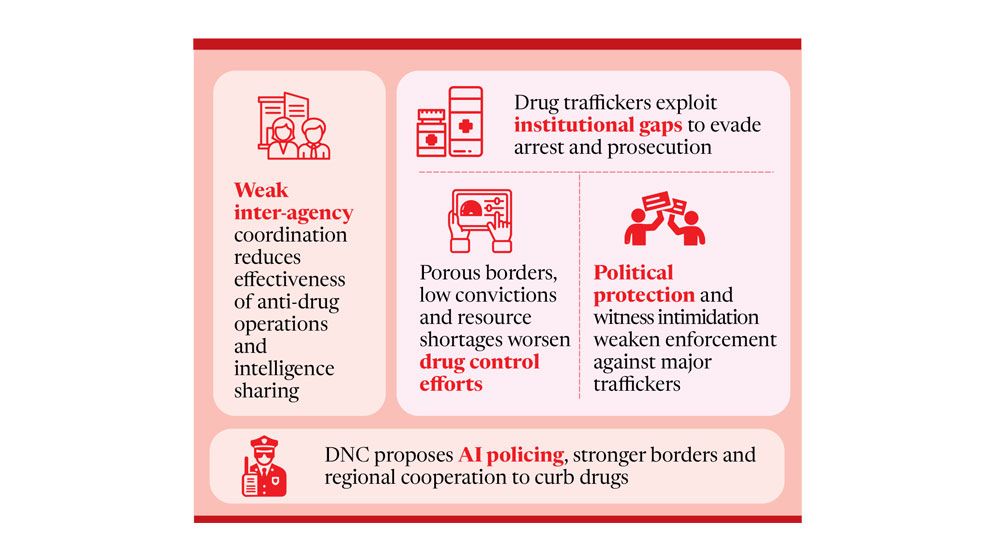
Weak coordination among the agencies responsible for tackling narcotics remains one of the biggest ob-stacles to Bangladesh’s anti-drug campaign, allowing traffickers to exploit institutional gaps and weak-ening enforcement efforts, according to the Department of Narcotics Control’s (DNC) Annual Report 2025.
Although the government maintains a “zero tolerance policy” against drug-related crime, inadequate communication, intelligence sharing and joint operations among enforcement agencies continue to hamper the overall effectiveness of anti-drug operations, the report says.
Published on Friday, the report states, “Weak coordination is one of the major factors. The lack of effec-tive communication, information sharing and joint operations often reduces the overall effectiveness of enforcement efforts.”
It warns that drug traffickers take advantage of these institutional shortcomings to evade arrest and continue their illegal activities.
“Strengthening coordination and cooperation among these agencies is therefore crucial to combating drug-related crimes more effectively. Selective enforcement and failure to prosecute masterminds un-dermine overall deterrence,” the report adds.
The agencies involved in drug control include Bangladesh Police, Border Guard Bangladesh (BGB), Bang-ladesh Coast Guard (BCG), Rapid Action Battalion (RAB), Customs authorities and the Ansar Battalion.
However, police and border security officials rejected suggestions of inadequate cooperation.
Khondoker Rafiqul Islam, additional deputy inspector general (Crimes and Operations) at Police Head-quarters, told the Daily Sun that the police remained fully committed to anti-narcotics operations.
“The police carry out different activities, of which drug control is one. But the work of the DNC is solely against drugs. I think policemen are more careful and attentive in working against narcotics than the DNC,” he said.
Lt Commander Sabbir Alam Sujon, media officer of the Bangladesh Coast Guard, said the force was “very cooperative” in anti-drug efforts.
A senior BGB official, speaking on condition of anonymity, also dismissed the report’s findings, saying the claim of weak cooperation was “not true”.
Beyond inter-agency coordination, the DNC identifies several other major challenges to combating drug crime, including porous borders, limited resources and institutional capacity, mounting case backlogs, low conviction rates, increasingly sophisticated drug markets, social and public health challenges, and political and social protection enjoyed by some traffickers.
According to the report, drug cases frequently remain pending for years because of overburdened courts, procedural delays, a shortage of specialised prosecutors, poor-quality investigations, weak evi-dence management and witness intimidation.
It also notes that some traffickers use political connections or local influence to shield themselves from prosecution, while fear of retaliation discourages honest officers and witnesses from taking action.
Way forward
The report recommends a broad strategy to strengthen the country’s anti-drug efforts, including tighter law enforcement and border management, technological modernisation, enhanced public health and rehabilitation services, greater regional cooperation and measures to address the socio-economic drivers of drug abuse.
It also proposes establishing dedicated cybercrime and money laundering units within the DNC.
The proposed technological upgrades include AI-driven predictive policing, expanded CCTV surveillance, drone deployment in border and drug-prone areas, portable X-ray scanners, sniffer dogs and advanced forensic laboratories.
The report also stresses the importance of strengthening cooperation with neighbouring India and My-anmar through the SAARC Drug Offences Monitoring Desk (SDOMD) and Interpol to curb cross-border drug trafficking.
Read More