



 For all latest news, follow the Daily Sun's Google News channel.


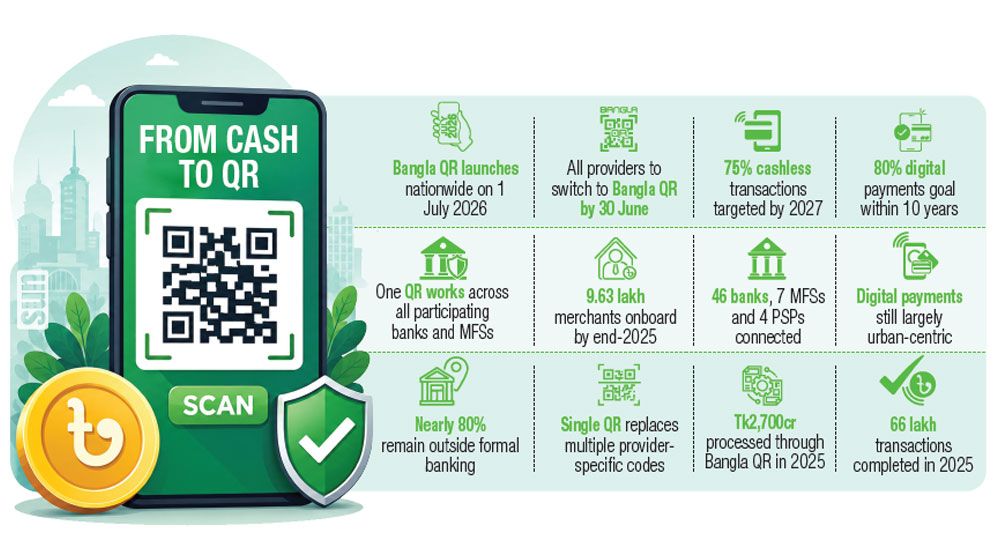
Bangladesh is set to take a major step towards a cashless economy on 1 July with the nationwide rollout of Bangla QR, an interoperable digital payment platform that promises to transform how consumers and businesses make and receive payments.
The initiative, led by Bangladesh Bank (BB), is designed to unify the country's fragmented digital payment ecosystem by allowing customers of any bank, mobile financial service (MFS) provider or payment service provider (PSP) to make payments through a single QR code.
From shopping malls and supermarkets to neighbourhood grocery shops, tea stalls and roadside vendors, merchants will no longer need to display multiple QR codes linked to different service providers.
Central bank officials view the platform as a key component of a broader strategy to reduce reliance on cash, improve transparency, curb corruption and tax evasion, lower transaction costs and expand financial inclusion.
Bangladesh Bank has set an ambitious goal of making 75% of transactions cashless by 2027 and increasing the share of digital transactions to 80% of all payments within the next decade.
To facilitate the transition, the central bank has instructed all banks, MFS providers, PSPs and payment system operators (PSOs) to replace proprietary QR codes with Bangla QR by 30 June. Institutions that fail to comply could face penalties of up to Tk30 lakh.
Bangladesh Bank Governor Mostaqur Rahman recently chaired the first meeting of a steering committee overseeing the implementation of Bangla QR and stressed the need for closer collaboration among government agencies, banks and MFS providers.
He also proposed bringing government fees, charges and other public payments under the Bangla QR network to accelerate adoption.
The central bank is scheduled to launch awareness campaigns on Thursday, particularly targeting small businesses, while financial institutions race to complete the migration process.
Bangladesh Bank spokesperson and Executive Director Arief Hossain Khan described the nationwide rollout as a “national agenda” extending beyond the responsibilities of the central bank alone.
He noted that MFS providers had been more successful than banks in bringing small merchants into the digital payments ecosystem, despite banks possessing larger networks and resources.
Industry experts believe the initiative could significantly improve access to financial services, especially in rural areas.
Arfan Ali, former president and managing director of Bank Asia, described Bangla QR as a timely and practical initiative.
“Currently, customers often have to visit different agents to access different services. Under the new system, all services will be available through a single agent,” he told the Daily Sun.
He said the move would stimulate economic activity in rural areas while creating additional business opportunities for agents. Customers of any bank or MFS provider will be able to make payments using the same QR code, regardless of the institution involved.
Ali pointed out that banks and MFS providers currently maintain separate agent networks, forcing customers to rely on different agents for specific services.
“The new system will remove this limitation. A single agent will be able to serve customers of all participating institutions, expanding service coverage and reducing inconvenience,” he said.
Bangla QR reaches nearly 10 lakh merchants
The foundations for the nationwide rollout have already been established.
Participation in the Bangla QR ecosystem requires two things: customers must have either a bank account or an MFS account, while merchants must register as Bangla QR agents through a bank or MFS provider.
According to Bangladesh Bank's “Payment Systems Report 2025”, the platform had expanded to nearly 9.63 lakh merchants by the end of last year.
At present, 46 banks, seven MFS providers and four PSPs are connected to the network.
More than Tk2,700 crore in transactions were processed through Bangla QR in 2025, with nearly 66 lakh transactions completed during the year.
The platform was initially launched in January 2023 to reduce transaction costs, improve transparency, minimise payment risks and encourage wider use of digital payments.
A major breakthrough came in November last year when banks, MFS providers, PSPs and PSOs began conducting live interoperable transactions. This enabled customers to transfer funds seamlessly across bank accounts, mobile wallets and PSP accounts, regardless of the service provider.
The central bank further strengthened the system in December 2025 by introducing instant settlement, allowing merchants, particularly small traders, to receive payments immediately. Officials say Bangla QR addresses one of the biggest shortcomings of Bangladesh's current digital payment landscape.
Merchants often display multiple QR codes from providers such as bKash, Nagad and Rocket, while customers are restricted to using the platform associated with their own service provider.
Under Bangla QR, a single code can be used by customers of any participating institution, making transactions faster, simpler and more convenient.
Experts believe the economic benefits could also be substantial. A fully cashless payment system could save the government an estimated Tk20,000 crore spent annually on printing, transporting and managing paper currency.
Greater use of digital payments is also expected to improve transaction traceability, helping authorities tackle bribery, corruption, tax evasion and other activities within the informal economy.
Alongside Bangla QR, Bangladesh Bank is promoting TakaPay, its domestic debit card scheme introduced in 2023 to reduce dependence on international card networks.
Now issued by 17 banks, TakaPay operates entirely through the National Payment Switch Bangladesh (NPSB) and provides access to around 16,500 ATMs and cash recycler machines, as well as approximately 130,000 point-of-sale terminals nationwide.
PM offers ‘munajat’ at parents' graves on returning home
BSS, Dhaka
Prime Minister Tarique Rahman offered “munajat” at the graves of his parents Shaheed President Ziaur Rahman and former prime minister Begum Khaleda Zia at Zia Udyan in the capital’s Sher-e-Bangla Nagar on Saturday afternoon.
On the occasion, Tarique Rahman stood before the graves, recited Surah Al-Fatiha, and offered munajat there seeking eternal peace of the departed souls of his parents.
PM's Defence Adviser Brigadier General (retd) Dr AKM Shamsul Islam, Jatiya Sangsad Whip Miah Nuruddin Ahmad Apu, PM's Additional Press Secretary Atikur Rahman Ruman, Private Secretary-2
>> Page-11 Col 1
Challenges remain
Despite the momentum, significant obstacles remain.
The biggest challenge is financial inclusion. Industry stakeholders estimate that nearly 80% of the population still lacks access to formal banking services.
Although Bangladesh has more than 42 crore bank and mobile wallet accounts, many individuals hold multiple accounts, while a substantial portion of the population remains outside the formal financial system.
Experts warn that achieving a truly cashless economy will be difficult unless these people are brought into digital finance. Low awareness and limited adoption at the grassroots level also remain concerns.
While digital payments have become increasingly common in major urban shopping centres, Bangla QR is still relatively uncommon among many small businesses.
Several merchants in Motijheel told the Daily Sun that customer demand for QR-based payments has declined compared with the early days of the initiative. Aminur Biswas, who runs a tea stall in the area, said customers once regularly paid for tea using QR codes, but usage has dropped sharply.
“The Bangla QR poster at my shop was damaged and never replaced. Very few customers ask about QR payments now,” he said.
Nearby restaurant owner Ranju Mia shared a similar experience, saying many of his customers are day labourers and low-income workers who neither maintain bank accounts nor feel comfortable using digital payment technologies.
According to him, the QR board provided by service providers now remains largely unused.
Analysts say these experiences underline a broader challenge in Bangladesh's digital transformation journey. Technology alone may not be enough to change consumer behaviour.
Sustained public awareness campaigns, greater financial literacy and stronger incentives for both merchants and customers will be essential if Bangladesh is to realise its ambition of becoming a truly cashless economy, they add.