


 For all latest news, follow the Daily Sun's Google News channel.


Budget debate sparks sharp divide in parliament
Daily Sun Report, Dhaka
Published: 26 Jun 2026, 12:00 AM
The parliament on Thursday witnessed a lively debate on the proposed national budget for fiscal year 2026-27 (FY27), with treasury and opposition lawmakers offering sharply contrasting assessments of the government's fiscal plans.
While ruling party MPs praised the budget for prioritising education, healthcare and social protection, opposition members criticised it as overly dependent on borrowing, vulnerable to corruption and disconnected from the aspirations of the 2024 mass uprising.
Among those participating in the discussion were treasury bench MPs Dr Reza Kibria, Dr Mahbubur Rahman, Mohammad Aktaruzzaman, Mohammad Ali Asgar, Mustafizur Rahman Bhuiyan Dipu and Sayeed Al Noman. Opposition speakers included independent MP Sheikh Mujibur Rahman Iqbal, Jamaat-e-Islami MPs Nurul Islam Bulbul, Dr Shafiqul Islam Masud and Salauddin Ayubi, as well as National Citizen Party (NCP) MP Akhtar Hossain.
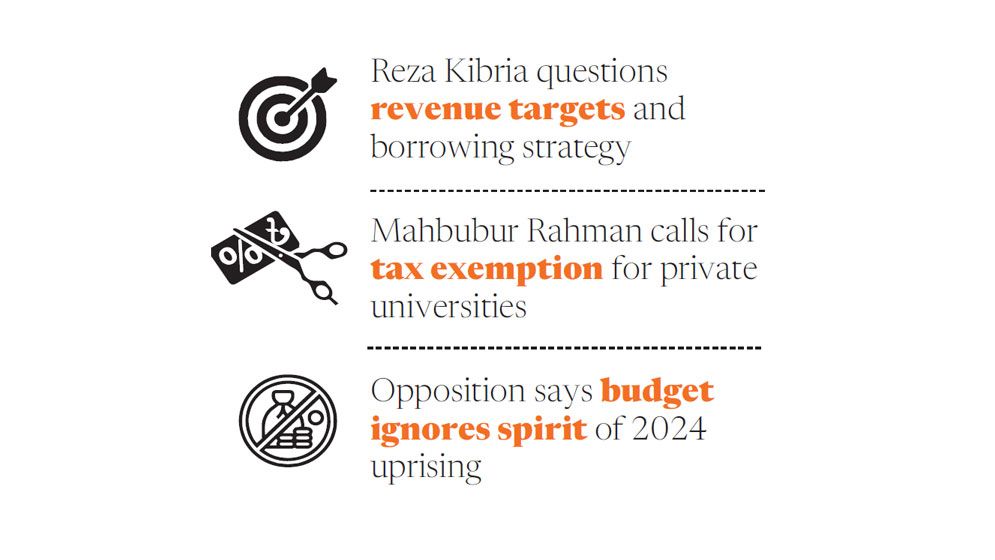
Dr Reza Kibria, a former adviser to the International Monetary Fund (IMF), urged the government to stop favouring wealthy business groups and instead direct resources towards marginalised communities to sustain economic growth.
Drawing on decades of international experience, he expressed concern over rising non-performing loans, weak banking sector efficiency and shortcomings in the definition of loan defaulters.
He also questioned the budget's revenue projections, describing them as unrealistic and noting that actual revenue collection rarely reaches the targets set.
According to him, the resulting shortfall forces the government to borrow domestically, fuelling inflationary pressures.
He further advised against costly commercial borrowing from abroad, recommending concessional financing from institutions such as the IMF and the World Bank.
Dr Mahbubur Rahman called for private universities to be exempted from taxation, arguing that they are operated by non-profit trustee boards and should not be treated as commercial enterprises.
He also welcomed the expansion of the social safety net programme, particularly the family card initiative.
Treasury MP Mohammad Aktaruzzaman said the budget had received a positive public response because of its substantial allocations for education, health and infrastructure. However, he alleged that some individuals had betrayed the ideals of the July uprising for personal gain.
NCP lawmaker Akhtar Hossain accused the government of increasing the country's debt burden by Tk1 lakh crore within four months of assuming office, pushing total public debt to Tk24 lakh crore.
He also criticised what he described as the government's failure to secure IMF support through meaningful economic reforms, citing delays in implementing revenue administration reforms.
Salauddin Ayubi argued that recent increases in the prices of essential commodities, electricity and fuel had deepened public disappointment with the budget.
He further contended that the budget failed to reflect the spirit of the 2024 uprising, noting the absence of allocations for the July Commission and support for the families of those killed during the movement.
He also questioned the reduction in the Anti-Corruption Commission's allocation.
Dr Shafiqul Islam Masud criticised the health sector, questioning accountability standards and the government's handling of recent public health crises.
The budget debate is expected to continue in the coming days before its final passage in Parliament.