


 For all latest news, follow the Daily Sun's Google News channel.


TIB: Tk12,633cr paid in bribes during interim govt’s first year
Daily Sun Report, Dhaka
Published: 26 Jun 2026, 12:00 AM
Bangladeshis paid an estimated Tk12,633 crore in bribes across public and semi-public service sectors during the first year of the interim government led by Chief Adviser Prof Muhammad Yunus, according to a new survey by Transparency International Bangladesh (TIB).
The findings were unveiled on Thursday at TIB’s Dhanmondi office in Dhaka as part of its “Corruption in the Service Sector: National Household Survey 2025”.
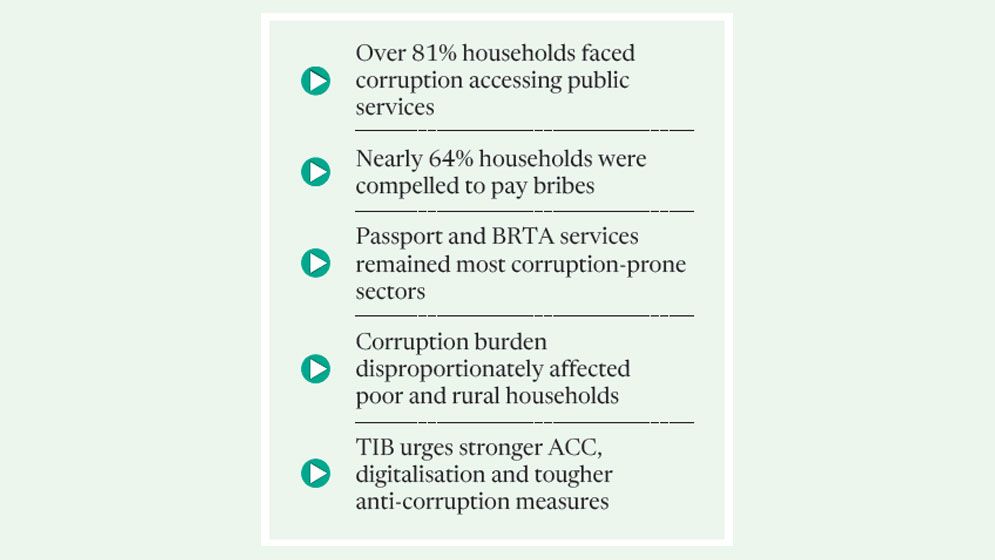
The survey, covering the period from November 2024 to October 2025, found that 81.6% of households experienced corruption while seeking public services, while 63.6% were forced to pay bribes.
Compared with 2023, the proportion of households affected by corruption and bribery rose by 15.1% and 25.2% respectively.
According to TIB, the total value of bribe transactions increased by 15.9% from 2023, accounting for 1.58% of the revised national budget for FY25 and 0.23% of the country’s GDP.
As in previous surveys, passport services and services provided by the Bangladesh Road Transport Authority (BRTA) were identified as the most corruption-prone sectors.
The report noted that despite partial digitalisation of public services, corruption remains deeply entrenched. It found that 98.1% of households using intermediary-dependent services had to pay bribes, while officials or employees of the relevant institutions were directly involved in collecting bribes in 91.2% of cases.
More than four-fifths (81.5%) of respondents who paid bribes said they did so because services could not be obtained otherwise, indicating what TIB described as the institutionalisation of corruption.
The survey also revealed weak public awareness of anti-corruption mechanisms.
More than half of households (53.3%) were unaware of complaint procedures, while only 1.4% knew about the government’s Grievance Redress System.
Among households that experienced corruption, only 10.3% lodged complaints. Of those complaints, 21.6% were not accepted and no action was taken in 51% of cases.
Respondents cited impunity (74.8%), lack of public awareness (60.8%), non-disclosure of officials’ assets (15.3%) and rewarding corrupt individuals (14.1%) as major drivers of corruption.
Speaking at the event, TIB Executive Director Dr Iftekharuzzaman said corruption disproportionately affects poorer and marginalised groups.
“While those who abuse power benefit from corruption, its negative impacts fall on poor and low-income people,” he said, adding that rural households, women, Indigenous communities, persons with disabilities and other disadvantaged groups face greater vulnerability and are often deprived of services to which they are entitled.
He also questioned the effectiveness of the Anti-Corruption Commission (ACC), noting that although 29.5% of respondents were aware of the institution, only 0.3% had ever lodged complaints with it. “This indicates a serious deficit of public trust in the Commission,” he said, urging the government to appoint credible and competent leadership capable of restoring confidence in the ACC and ensuring its independence.
The survey found that the average bribe paid per household fell slightly from Tk5,680 in 2023 to Tk5,124 in 2025. However, corruption increased sharply in some sectors because of a rise in frequent low-value payments, particularly in healthcare services and agricultural fertiliser distribution.
Households spent an average of 1.7% of their annual income on bribes. For families living below the poverty line, the burden was significantly heavier. In the five most corruption-prone sectors, bribe payments accounted for 5.1% of annual income, compared with 3.2% for better-off households.
The survey was conducted among 15,715 households across all eight divisions using the Bangladesh Bureau of Statistics’ Integrated Multi-Purpose Sampling framework. Field between 12 November and 20 December 2025.
TIB also presented a 10-point reform agenda, including stricter legal action against corruption, full digitalisation of public services, mandatory asset declarations by public officials, stronger complaint mechanisms, greater transparency and enhanced independence of the ACC.