


 For all latest news, follow the Daily Sun's Google News channel.


13 MoUs mark new Dhaka-Beijing chapter
Daily Sun Report, Dhaka
Published: 26 Jun 2026, 12:00 AM
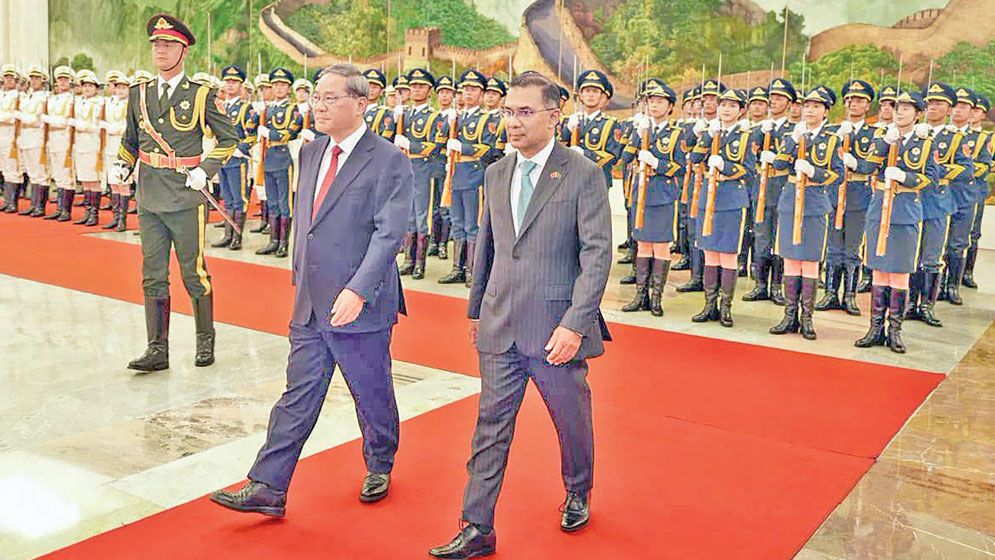
Prime Minister Tarique Rahman receives a ceremonial reception and Guard of Honour at the Great Hall of the People in Beijing on Thursday ahead of bilateral talks with Chinese Premier Li Qiang. Photo: PMO
Bangladesh and China on Thursday took a major step towards deepening economic and strategic partnership as the two countries signed 13 memorandums of understanding (MoUs) following extensive bilateral talks between Prime Minister Tarique Rahman and Chinese Premier Li Qiang at the Great Hall of the People in Beijing.
The agreements, signed after nearly three hours of discussions between the two leaders, covered a wide range of areas including trade, investment, infrastructure development and broader bilateral cooperation. Officials said the understandings are expected to elevate Bangladesh-China relations to a new level and provide fresh momentum for collaboration in key sectors.
Prime Minister Tarique Rahman led the Bangladesh delegation while Premier Li headed the Chinese side during the talks, which began at 3pm Bangladesh time and concluded around 5:45pm.
The Bangladeshi delegation included Foreign Minister Khalilur Rahman, Information and Broadcasting Minister Zahir Uddin Swapon, Water Resources Minister Shahiduddin Chowdhury Anee, State Minister for Power and Energy Aninda Islam Amit, Foreign Affairs Adviser Humaiun Kobir, Economic and Planning Adviser Rashed Al Mahmud Titumir, Education Adviser Mahdi Amin, Foreign Secretary Asad Alam Siam and other senior officials.
The Bangladeshi prime minister was accorded a red-carpet reception at the Great Hall of the People, while the venue and surrounding areas near Tiananmen Square were decorated with the national flags of Bangladesh and China to mark the visit.
Following the talks, the two leaders joined a state banquet hosted by Premier Li in honour of the Bangladeshi delegation.
The bilateral meeting came amid growing economic engagement between Dhaka and Beijing, with both sides signalling their intention to broaden cooperation beyond traditional infrastructure projects into investment, industrial development and technology-driven growth.
Prime Minister Tarique Rahman along with his delegation joined a banquet hosted by his Chinese counterpart Li Qiang at the Great Hall of the People in Beijing later in the day.
Tarique Rahman was accorded a warm reception after he reached the Great Hall in a ceremonial motorcade from Diaoyutai State Guesthouse to join the meeting.
A red-carpet was rolled on the occasion as the Chinese premier cordially welcomed him at the Great Hall of the People.
 The Chinese Prime Minister took his Bangladeshi counterpart to a specially decorated platform walking along the red carpet holding his hand. Then a smartly turned-out contingent of the Chinese Armed Forces presented a Guard of Honour to Tarique Rahman.
The national anthems of both countries were played during the ceremony. The two Prime Ministers received the salute and inspected the guard.
A gun salute was also presented in honor of the Prime Minister of Bangladesh.
During the ceremony, both Prime Ministers introduced the members of their respective delegations to one another.
Earlier in the day, Prime Minister Tarique Rahman used a high-profile investment forum in Beijing to make a direct appeal to Chinese businesses, urging them to extend their manufacturing value chains into Bangladesh and help build what he described as “the next great Asian economic miracle”.
Addressing business leaders, industrialists and institutional investors at the Bangladesh Investment Forum organised by the Bangladesh Investment Development Authority (BIDA), the prime minister said Bangladesh was undergoing a “monumental economic and governance transformation” and stood ready to welcome greater Chinese investment.
“Bangladesh is open for business, ready for the future, and keen to work with China, one of our longstanding and trusted friends,” he said.
Noting that China is moving rapidly up the global value chain and becoming a leader in advanced manufacturing, high-value infrastructure and clean energy, Tarique said Bangladesh could become a natural destination for parts of the manufacturing ecosystem seeking competitive and reliable production bases.
“We are inviting Chinese companies to extend their value chain into Bangladesh. We can help Chinese companies serve global markets while benefitting from growing large domestic demand,” he said.
Calling the relationship “complementary, practical and win-win”, the prime minister stressed that his government was backing its investment outreach with concrete reforms.
He highlighted a 180-day action plan designed to overhaul the country's investment management framework, reduce bureaucratic delays, improve policy continuity and accelerate digitalisation of government services.
“Through this plan, we are targeting bureaucratic inertia head-on. We are improving long-term policy continuity, reducing overlapping regulatory processes, and digitalising government services to improve transparency, predictability and speed,” he said.
He assured investors of non-discriminatory treatment, legal protection and the repatriation of capital and dividends in accordance with Bangladeshi laws and regulations.
Tarique also announced several initiatives aimed specifically at Chinese investors, including dedicated industrial zones, a specialised China relationship desk within BIDA, a Chinese-language investment platform and Bangladesh's first overseas investment office in China.
“Chinese investors should not have to wait until they arrive in Bangladesh to receive support. We want to be closer to you, speak to you more regularly and help you move faster from interest to decision,” he said.
The prime minister further revealed that the government was preparing to introduce a new licensing approval system that would allow businesses to begin operations in Bangladesh within 15 days.
He also pointed to incentives announced in the latest national budget for priority sectors such as renewable energy, pharmaceuticals and healthcare, electronics, digital infrastructure, agro-processing and advanced textiles.
Acknowledging existing challenges, Tarique said, “I will not stand here and say that everything is perfect. But I want to assure you that we know the issues, we are working on them, and we will continue to address them.”
He concluded by inviting Chinese firms to become partners in Bangladesh's next phase of economic development.
“Come to Bangladesh. Invest in Bangladesh. Let us prosper together in a true partnership of equals,” he said.
The forum produced several tangible outcomes. Four agreements and investment commitments were secured, including plans for two Chinese-backed economic zones, a new investment cooperation framework and a $220 million manufacturing project expected to generate around 13,000 jobs.
Among the major initiatives was an MoU for the China-Bangladesh Mongla Port Economic Zone in Bagerhat, which is expected to attract approximately $500 million in investment and create around 15,000 jobs.
Another agreement advanced the Chinese Economic and Industrial Zone (CEIZ) in Anwara, Chattogram. The 800-acre zone, located near Chattogram Port, is projected to attract around $1.35 billion in Chinese investment and create nearly 50,000 direct and indirect jobs upon full implementation.
A separate cooperation agreement between BIDA and the China Council for the Promotion of International Trade (CCPIT) aims to strengthen investment promotion, business matchmaking and investor facilitation.
In a major private-sector commitment, Handa Industries secured provisional land allocation in the Keraniganj Economic Zone to establish a manufacturing facility worth $220 million.
The project is expected to create around 13,000 jobs and will be the company's second major investment in Bangladesh following a $100 million venture in Mirsharai.
BIDA Executive Chairman Ashik Chowdhury said Bangladesh was positioning itself as a competitive destination at a time of heightened global uncertainty.
“In an unstable world, Bangladesh stands out for its stability, scale and forward momentum,” he said.
CCPIT Chairman Ren Hongbin described Bangladesh as an increasingly important destination for Chinese enterprises. He noted that China has remained Bangladesh's largest trading partner for 16 consecutive years and is currently its second-largest source of foreign investment. According to him, nearly 700 Chinese-funded enterprises are now registered in Bangladesh.
Beyond investment and trade, the prime minister's visit also focused on expanding political and developmental cooperation.
Earlier on Thursday, Liu Haixing, minister of the international department of the Communist Party of China (CPC), paid a courtesy call on Tarique Rahman at the Diaoyutai State Guest House.
During the meeting, the Chinese leader reaffirmed Beijing's support for Bangladesh's sovereignty, security and development and expressed interest in expanding cooperation in areas such as media exchanges, think tanks, people-to-people contacts and living standards improvement.
The meeting also witnessed a historic development in party-to-party relations, as the Bangladesh Nationalist Party (BNP) and the CPC signed their first-ever memorandum of understanding.
The agreement was signed by BNP Joint Secretary General (International Relations) and Foreign Affairs Adviser Humaiun Kobir on behalf of the BNP and by Liu Haixing on behalf of the CPC.
Liu congratulated Tarique Rahman on assuming office and recalled the longstanding ties between China and former BNP chairperson Begum Khaleda Zia, noting that a photograph from her 2001 visit to China is preserved in the Museum of the Communist Party of China.
During the meeting, Tarique sought Chinese cooperation in Bangladesh's development projects and requested support for the construction of a proposed China-Bangladesh Friendship Hospital.
He also expressed hope that the longstanding friendship between the two countries would continue to expand in the years ahead.
Water resource management emerged as another important area of cooperation during the visit.
In a separate meeting with Chinese Water Resources Minister Li Guoying, the prime minister highlighted Bangladesh's ongoing river excavation programme aimed at reducing flood risks, protecting the environment and improving water management.
Tarique sought Chinese technical support for the Teesta management project as well as assistance in riverbank protection, irrigation development and inland water transport.
The Chinese minister assured Bangladesh of full cooperation, pointing to existing collaboration under a 2005 bilateral memorandum and recent exchanges between water experts from the two countries.
He also invited Bangladeshi specialists to receive training in China and suggested that Bangladesh could benefit from China's experience in river and water resource management.
The flurry of agreements, investment commitments and high-level engagements underscored the growing breadth of Bangladesh-China relations, as both countries seek to transform longstanding diplomatic ties into deeper economic, industrial and development partnerships.