 For all latest news, follow the Daily Sun's Google News channel.



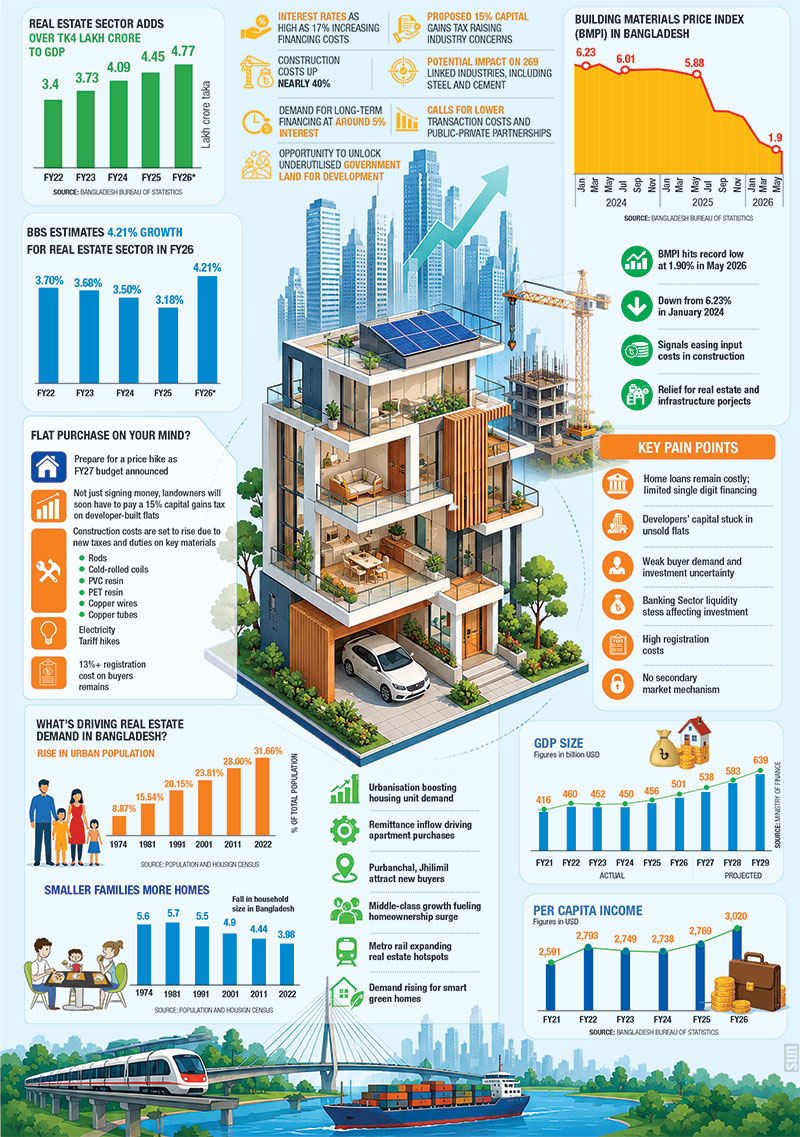
The proposed FY2026-27 budget could make apartments more expensive, with higher taxes on property transactions and construction materials expected to drive up housing costs.
Developers and industry leaders warn that the combined impact of increased capital gains tax, VAT, supplementary duty and advance income tax will raise apartment prices in major cities and further squeeze middle-income homebuyers.
Under the proposed budget, the government plans to increase the capital gains tax on flat transfers as part of efforts to boost revenue collection.
Developers, however, argue that the move could discourage property transactions and increase the overall cost of housing.
Capital gains tax concerns
The proposed Finance Bill would require landowners to pay a 15% tax on both the signing money and the apartments they receive from developers under joint venture housing projects.
Industry stakeholders say the proposed measure comes at a difficult time for the housing sector, which is already grappling with rising construction costs driven by higher raw material prices, inflationary pressures and increased financing expenses.
Real Estate and Housing Association of Bangladesh (REHAB) President Dr Ali Afzal said the sector is facing multiple challenges, including sluggish demand, escalating construction costs, financing constraints and policy uncertainty.
“In such a situation, imposing additional taxes while maintaining high registration costs will further aggravate the sector’s difficulties,” he said.
Dr Afzal noted that landowners currently pay a 15% tax on signing money received under joint development agreements.
The proposed FY27 budget introduces an additional provision requiring landowners to pay a 15% tax on apartments constructed and handed over by developers.
He warned that the measure could discourage joint venture development projects, reduce the number of new housing projects and dampen investment in the sector.
Explaining the impact, he said that in a 24-unit apartment project where a landowner receives 12 apartments worth Tk12 crore, the landowner would be required to pay around Tk1.8 crore in taxes.
“In effect, the value of nearly two apartments would be lost to taxation. Ultimately, the additional financial burden will be passed on to apartment buyers, leading to higher housing prices,” he said.
Dr Afzal added that the housing sector is linked to around 269 backward and forward linkage industries and directly and indirectly provides employment to nearly 50 lakh people.
“Instead of imposing additional tax burdens, the sector should be supported through investment-friendly policies,” he said.
Steel makers warn of higher construction costs
Steel manufacturers have also urged the government to withdraw proposed increases in VAT and duties in the FY27 budget.
They warned that the measures could raise costs by up to Tk12,000 per tonne at a time when most mills are operating below half of their installed capacity.
Bangladesh Steel Manufacturers Association (BSMA) President Mohammed Jahangir Alam said the industry is already struggling with rising electricity tariffs, port charges, river dues, transportation costs and other operating expenses.
“The recent increase in electricity prices alone has raised production costs by around Tk2,000 per tonne, while higher logistics and operational expenses have added another Tk3,000 per tonne,” he said.
He said the proposed budget measures – including higher VAT at the sales stage, increased VAT on locally sourced scrap, and additional duties on ferro-alloys, refractory materials and spare parts – would add another Tk2,000 to Tk2,500 per tonne to production costs.
“As a result, direct production costs could increase by Tk5,000 to Tk6,000 per tonne,” he said.
Jahangir added that most steel mills are operating at less than 50% of their installed capacity, increasing overhead, financing and other fixed costs.
This has created an additional indirect cost burden of Tk5,000 to Tk6,000 per tonne, bringing the total impact to Tk11,000-12,000 per tonne.
According to him, Bangladesh’s annual steel demand stands at around 50 lakh tonnes, while installed production capacity exceeds 1 crore tonnes, leaving substantial idle capacity across the industry.
Wider economic impact feared
Managing Director of Accept Consultancy Service Md Shafiul Islam Rayhan said that if landowners are required to pay an additional 15% tax on apartments received under joint development agreements, they will likely demand higher signing money from developers.
“This will inevitably increase apartment prices. At the same time, flat sales are likely to decline further. A slowdown in apartment sales will not only affect the real estate sector but also have wider economic consequences,” he said.
Rayhan, who has long been involved in the real estate business, particularly in the Bashundhara Residential Area, said the sector is closely linked to numerous supporting industries, and reduced activity could lead to lower investment and employment.
“To help address the country’s growing unemployment challenge, the sector needs greater policy support and expansion,” he said.
He also pointed to high property registration costs, which remain among the highest in South Asia.
“This creates a significant financial burden for apartment buyers and investors,” he said.
Rayhan further noted that home loan interest rates remain too high, discouraging many prospective buyers from purchasing flats through bank financing.
“Home loan rates should be reduced to single digits to make housing more affordable and stimulate demand in the real estate market,” he added.