


 For all latest news, follow the Daily Sun's Google News channel.


Govt rolls out digital migration drive, eyes new labour markets
Minister tells parliament
Daily Sun Report, Dhaka
Published: 24 Jun 2026, 12:00 AM
The government has launched a sweeping set of measures to modernise its overseas employment sector – digitising migration processes, expanding into non-traditional labour markets, and tightening welfare protections for workers abroad – as the country recorded a historic $30.32 billion in remittances during fiscal year 2024-25 (FY25).
Expatriates’ Welfare and Overseas Employment Minister Ariful Haque Choudhury laid out the government’s initiatives in Parliament on Tuesday, responding to questions from lawmakers on migrant safety, market diversification, and the fight against fraudulent recruitment networks.
Digital drive against middlemen
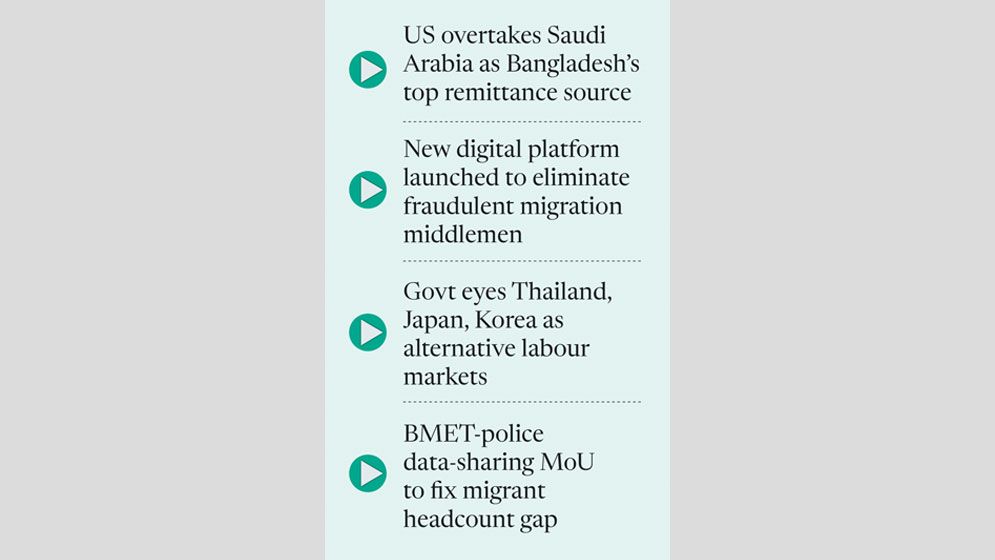
At the centre of the reform push is the newly launched Overseas Employment Platform (OEP), an automated system designed to eliminate exploitative brokers by digitising demand-letter validation, visa verification, and emigration clearances – cutting both costs and processing time for prospective migrants.
Alongside the platform, the government is steering its labour export model away from unskilled workers. BMET currently operates 110 training institutes – 104 Technical Training Centres and six Institutes of Marine Technology – offering 55 trade courses. Sixty centres additionally run language programmes in Japanese, English, Chinese, and Korean.
New markets as Middle East wobbles
The minister acknowledged that geopolitical instability across the Middle East had weighed on deployment numbers, prompting three high-level meetings chaired by the Prime Minister to map out alternatives.
A draft recruitment agreement has been sent to Thailand; Japan and South Korea outreach is being coordinated through a dedicated “Japan Cell” linking 96 sending organisations with 200 language centres.
Diplomatic efforts to reopen the Malaysian labour market – closed since 31 May 2024 – are continuing, while Qatar has signalled interest in skilled Bangladeshi professionals.
Visa submission centres are also being pursued in Dhaka for North Macedonia, Serbia, Portugal, and Mauritius.
Welfare and legal cover
The Wage Earners’ Welfare Board provides round-the-clock support through 30 Labour Welfare Wings across 27 countries.
Panel lawyers and specialised law firms are active in 11 foreign missions, with officials routinely inspecting prisons, detention camps, and workplaces to settle salary disputes and secure the release of detained workers. Record remittances, shifting sources
The initiatives come as Bangladesh posted a record $30.32 billion in remittance receipts in FY25, with the US emerging as the top source at $4.73 billion – overtaking Saudi Arabia’s $4.26 billion for the first time.
The UAE ranked third at $4.17 billion, followed by the UK at $3.17 billion and Malaysia at $2.80 billion. Italy, Oman, Kuwait, and Qatar each contributed over $1.2 billion.
Migrant headcount remains elusive
Despite tracking outbound departures since 2004 – totalling 15.007 million workers through 16 June this year – the government cannot yet provide an accurate net figure of Bangladeshis currently working abroad, as most returnees never formally deregistered.
BMET has signed an MoU with the Special Branch of Bangladesh Police to cross-reference data and close the gap.