


 For all latest news, follow the Daily Sun's Google News channel.


How 31 Bangladeshi sailors survived in a ‘floating prison’
MV Banglar Joyjatra crosses Hormuz after 115-day ordeal

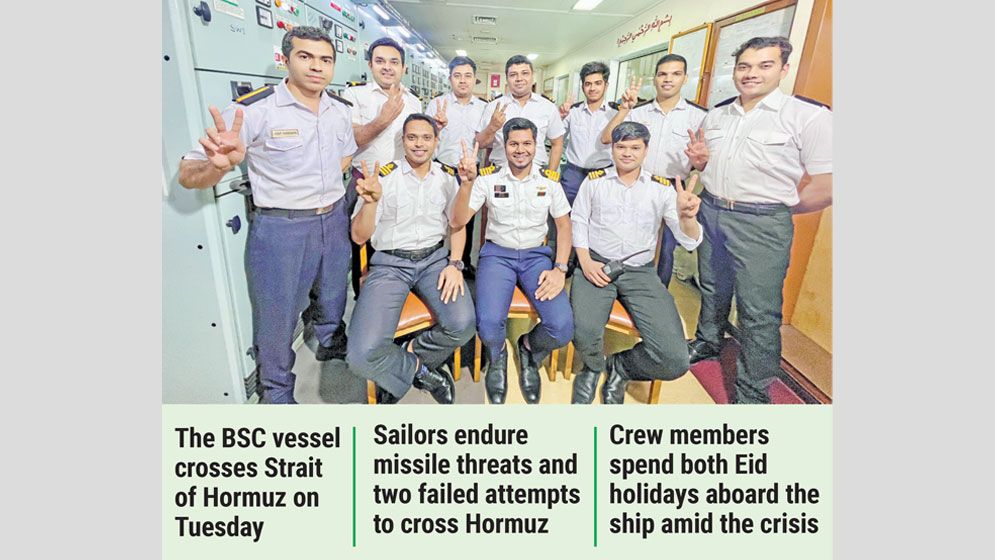
A day after the war began, a bomb exploded at an oil depot near our ship. The blast shook the entire vessel and sent panic through the crew. From then on, we witnessed waves of drone and missile attacks almost every day. Though we were not part of the war, living under the shadow of death for nearly four months was the toughest psychological test of our lives.
These were the words of Captain Md Shafiqul Islam Khan, master of the MV Banglar Joyjatra, as he described the 115 days of uncertainty and fear his crew endured before the vessel finally crossed the Strait of Hormuz in the early hours of Tuesday.
The Bangladesh Shipping Corporation (BSC) vessel spent nearly four months stranded in the Persian Gulf amid the conflict involving Iran, the United States and Israel.
The ship reached Jebel Ali Port in the United Arab Emirates on 26 February carrying nearly 39,000 tonnes of steel coils from Qatar. Two days later, the war broke out, leaving the vessel trapped in the region.
Several attempts to leave through the Strait of Hormuz failed, forcing the ship to spend months moving between ports and anchorages.
115 days in a ‘floating prison’
As the conflict intensified and normal operations were suspended,
the vessel became a floating prison for the sailors. The ship remained under blackout conditions at night, while water, supplies and communication facilities were restricted.
At the beginning of the conflict, while the vessel was at Jebel Ali Port, a missile strike hit an area barely 100 metres away, forcing cargo operations to remain suspended for three days.
Captain Shafiqul recalled another attack that unfolded before the crew’s eyes.
“We witnessed an attack targeting the US consulate in Dubai. The explosions took place just 20 to 30 kilometres from our ship. The fear was overwhelming at first, but gradually we adapted to the situation,” he said.
But the war outside was only part of the struggle. Each day brought a different challenge for the sailors on board.
Whenever possible, crew members contacted their families using limited internet access and satellite phones. However, they carefully hid their fears from their loved ones.
“Missile alerts flashed on our phones every day. Some nights I thought it could be my last, yet I kept telling my parents not to worry,” said Chief Engineer Rashedul Hasan.
Two failed attempts to cross Hormuz
Following a ceasefire announcement between Iran and the United States, the vessel sailed from Ras Al Khair in Saudi Arabia towards the Strait of Hormuz on 8 April.
However, the ship failed to secure clearance from Iranian authorities and had to turn back.
A second attempt was made on 17 April after Iran announced the reopening of the strait. Again, the journey ended in disappointment.
After reaching within 20 nautical miles of Hormuz, the vessel received instructions from the Iranian Navy to return, Captain Shafiqul said.
All 31 sailors spent both Eid-ul-Fitr and Eid-ul-Azha aboard the ship.
Eid prayers were held on the navigation bridge under Captain Shafiqul’s leadership.
“Everyone joined the prayers, but nobody smiled. Many crew members struggled to hold back tears during the prayers,” the captain said.
The crisis became even more difficult when sailors whose contracts had expired found themselves unable to leave.
At least 15 crew members remained on board for six to eight months beyond the expiry of their contracts.
Despite submitting verbal and written requests to sign off, they received no approval from either the vessel’s Singapore-based charterer, Daba Private Limited, or the Bangladesh Shipping Corporation.
The final crossing
After learning that another Bangladesh-bound vessel, MT Nordic Pollux, had successfully crossed Hormuz, Captain Shafiqul consulted Bangladesh Shipping Corporation Managing Director Commodore Mahmudul Malek and made the final decision.
“We left the anchorage after consulting both the owner and the charterer on Monday,” the captain said.
“Before entering Hormuz, we repeatedly tried to establish radio contact with the Iranian Navy, but received no response,” he said.
“By the grace of Allah, we crossed the strait safely despite the intense fear,” he added.
According to Chief Engineer Hasan, the transit along the Iranian coastline took around three and a half hours.
The ship cleared the strait at around 3am on Tuesday and anchored off Fujairah in the UAE at around 4pm.
After taking fuel, the vessel is expected to depart for Durban, South Africa, within two days, he said.
BSC Managing Director Commodore Mahmudul Malek said authorities kept the crossing confidential until the vessel safely cleared Hormuz.
He said the corporation ensured uninterrupted supplies and provided special meal allowances, Eid incentives and wartime benefits to maintain the crew’s morale.