



 For all latest news, follow the Daily Sun's Google News channel.


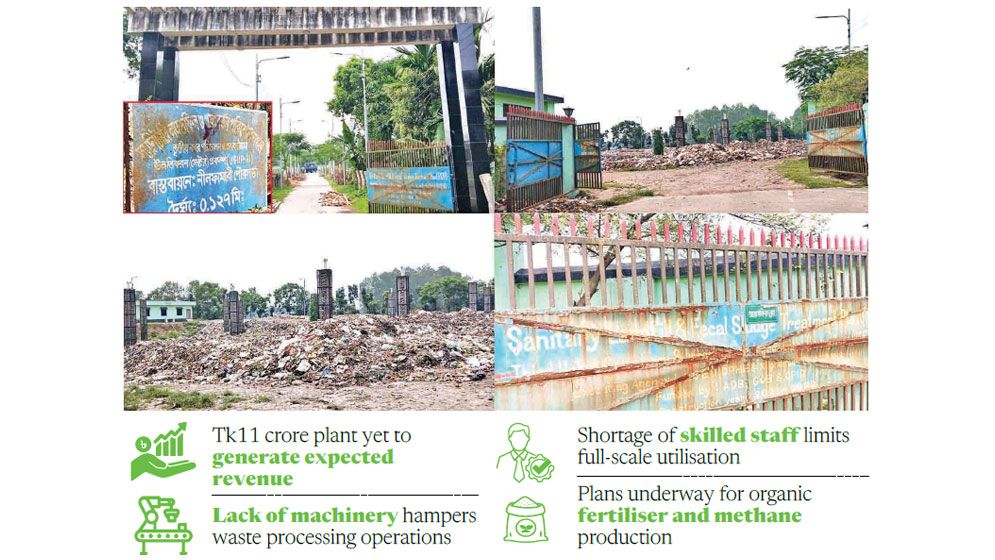
A modern sanitary landfill and faecal sludge treatment plant established by the Nilphamari Municipality with the aim of generating revenue through the processing of biodegradable and human waste has yet to achieve its intended financial returns, even three years after its completion.
The large-scale project, designed to introduce a planned sanitation system and modern waste management practices, was expected to transform sanitation services within the municipality. However, a shortage of skilled personnel and the absence of essential machinery have prevented the facility from operating at full capacity and generating revenue.
According to officials, the Faecal Sludge Treatment Plant (FSTP) was constructed in 2023 in the Markaz Mosque area of Nilphamari district town on 2.89 acres of land at a cost of approximately Tk11 crore. Under the project plan, human waste collected directly from household septic tanks, along with waste from municipal drains, would be safely transported to the treatment facility for processing. The initiative was intended to create a sustainable source of municipal revenue through waste treatment and resource recovery.
However, the project has struggled due to a lack of skilled manpower and the absence of an automatic waste separator machine. As a result, non-biodegradable materials, including polythene and plastic waste, cannot be effectively separated from the collected sludge, significantly hampering the facility’s revenue-generating potential.
Mohammad Abbas Ali, conservancy officer of Nilphamari Municipality, said human waste collected through specialised vacuum tankers is being safely transported to the treatment plant. He noted that the project comprises several units, including a dumping unit and a faecal sludge processing unit.
“The absence of necessary machinery is affecting revenue generation from the project,” he said.
Speaking on the issue, Executive Engineer of Nilphamari Municipality Engr Mohammad Tariq Reza said the project was developed as part of a broader plan to establish an organised sanitation system and create a sustainable source of municipal income.
“The lack of an automatic separator machine is the main obstacle to revenue generation, as polythene and other non-biodegradable materials cannot be properly separated from the waste stream,” he said. “Once the required machinery is installed, the municipality is expected to benefit from significant revenue generation in the future.”
Nilphamari Municipality Administrator Mohammad Saidul Islam told The Daily Sun that waste is currently being treated through several stages within the facility. He added that there are future plans to produce organic fertiliser and methane gas from the processed waste.
Acknowledging the project’s limitations, he said: “The shortage of skilled manpower and necessary machinery has affected the project’s revenue objectives. Effective measures will be taken in the future by recruiting trained personnel and installing the required equipment.”
Local residents believe that, if implemented as originally planned, the project could have become a model for municipal revenue generation and contributed significantly to the local economy. They argue that with modest technological upgrades and operational improvements, the facility still has the potential to play a transformative role in Nilphamari’s economic development.