



 For all latest news, follow the Daily Sun's Google News channel.


Strong policy support, institutional reforms and investment in skills will determine whether Bangladesh’s ambitious attempt to build a creative economy becomes a genuine engine of growth or another missed opportunity, economists say.
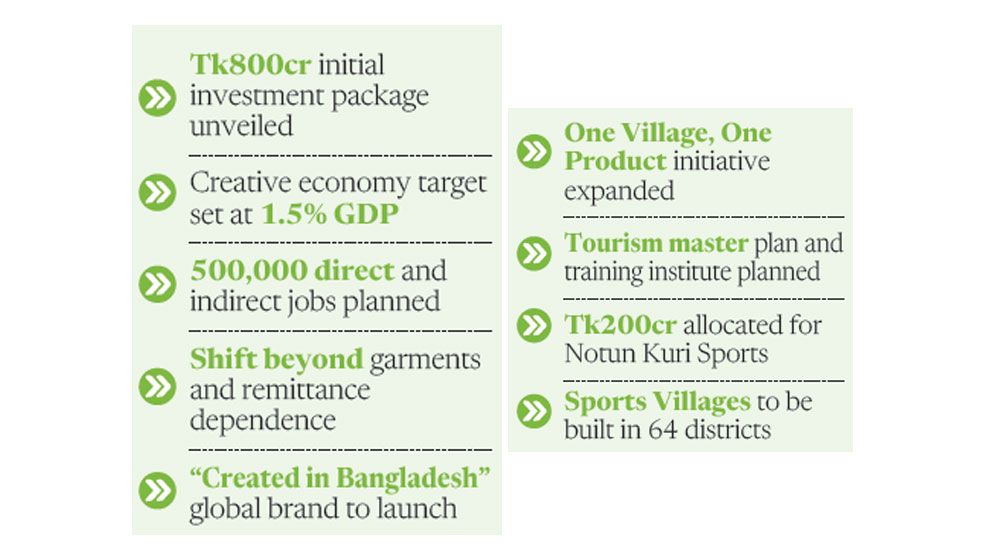
Their caution comes as the government unveiled an Tk800-crore package aimed at creating 500,000 jobs and raising the creative economy’s contribution to 1.5% of GDP, signalling a major shift away from the country’s traditional dependence on garments and remittances.
Dr Zahid Hussain, former lead economist of World Bank’s Dhaka office, told the Daily Sun that the transition was both timely and necessary, but warned that successful implementation would be critical.
“The transition to a creative economy is both timely and necessary, but its successful implementation will require strong policy support and institutional reforms,” he said.
“Shifting from a knowledge-based economy to a creative economy offers significant opportunities for sustainable growth and diversification. Rather than relying primarily on the garment sector and remittance income, Bangladesh should pursue a broader range of export-oriented initiatives.
“To achieve this, greater emphasis must be placed on skill development,
innovation and the growth of creative industries, which have the potential to become important drivers of employment, investment and economic competitiveness.”
Tk800cr push to create 500,000 jobs
Presenting the proposed FY27 budget, Finance Minister Amir Khosru Mahmud Chowdhury said the government was giving special priority to an area that had remained neglected despite its immense promise.
“The creative industry, despite being one of Bangladesh’s most promising economic sectors, has long remained underprioritised. To unlock its vast potential and integrate it into the mainstream economy, the government is giving special emphasis to developing the creative economy in line with its electoral commitments,” he said.
He said the sector could make a significant contribution to human resource development, national branding and long-term economic welfare.
The budget allocates Tk300 crore for the creative economy, while another Tk500 crore will be mobilised from Bangladesh Bank’s Corporate Social Responsibility funds, taking the initial investment package to Tk800 crore.
Officials described the initiative as the country’s first comprehensive effort to make knowledge, innovation, culture and sports new drivers of economic growth.
Creative hubs to nurture talent nationwide
At the centre of the strategy is a nationwide network of Creative Hubs aimed at supporting entrepreneurship and developing local talent.
A feasibility study is already under way to establish a flagship Central Creative Hub on 160 acres in Purbachal under a public-private partnership model. The proposed complex will feature cultural venues, bookstores with reading facilities, cineplexes, small cafés, exhibition spaces and marketplaces for regional products.
Authorities are also drawing up a 10-year investment strategy to expand creative hubs across the country. Unused government land in Karwan Bazar, near the Survey General’s Office in Tejgaon, and vacant industrial plots under BSCIC are being considered.
The facilities will gradually be extended to divisional, district and upazila levels, including within Bangladesh Shishu Academy and Bangladesh Shilpakala Academy premises. Innovation hubs already operating in engineering and technology universities will also be expanded to universities and undergraduate colleges nationwide.
The government expects the initiative to create at least 500,000 direct and indirect jobs for skilled and semi-skilled workers.
Turning culture and creativity into exports
The creative economy framework encompasses entertainment, publishing, software, gaming, design and traditional crafts, with officials hoping to strengthen Bangladesh’s position in global creative markets.
Under the “One Village, One Product” initiative, authorities will identify region-specific products, including handloom items, pottery, shital pati, shataranji, wooden toys, handmade jewellery, terracotta products and bamboo and cane crafts.
To improve quality and competitiveness, a National Pool of Designers will be formed, while the BSCIC design centre will be upgraded to international standards through collaboration with universities and leading fashion professionals.
The government also plans to launch the “Created in Bangladesh” brand to promote local creative products abroad.
Support will be extended to content creators, filmmakers, theatre groups and creative enterprises seeking overseas markets. International-standard film studios will be established to support the film industry and OTT platforms, while performance-based grants will finance export-oriented projects and start-ups.
Special emphasis will also be placed on promoting folk music, folk dance, pala gaan, jari gaan and traditional festivals in international markets.
Tourism and sports recast as economic sectors
The budget also places strong emphasis on cultural tourism and eco-tourism.
Authorities plan to restore heritage structures and develop a national festival calendar featuring winter pitha festivals, Baul festivals, Jamaai Melas and other events linked to rivers and local traditions.
An international-standard tourism training institute will be established, while a specialised tourism training centre is planned in Cox’s Bazar to enhance professional skills and competitiveness. A comprehensive Tourism Master Plan is also being finalised.
Sports, meanwhile, are being viewed not merely as entertainment but as a full-fledged economic sector covering events, media, tourism and merchandising.
A total of Tk200 crore has been allocated for the Notun Kuri Sports programme in FY2026-27. The scheme provides scholarships for talented athletes aged 12 to 14 in football, cricket, kabaddi, athletics, badminton, chess, swimming and martial arts.