


 For all latest news, follow the Daily Sun's Google News channel.


Dhaka-Sylhet journey turns into a gruelling ordeal
Slow six-lane mega-project on Dhaka-Sylhet highway, rail shortage and high airfares have marooned millions

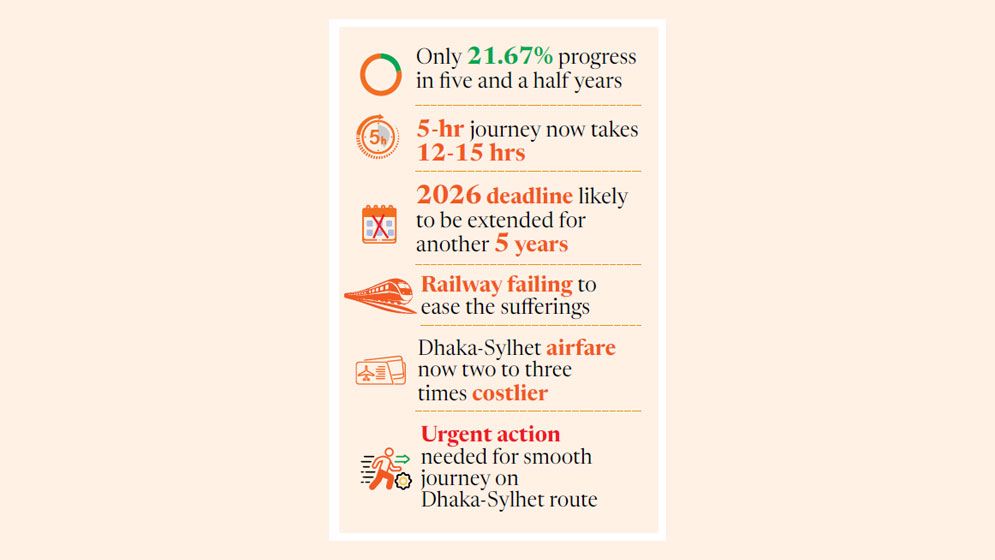
The journey from Dhaka to Sylhet has turned into a harrowing experience for millions of people due to the slow six-lane mega project on the Dhaka-Sylhet highway, the shortage of intercity trains and skyrocketing airfares.
The Dhaka-Sylhet Highway, a vital economic and tourism route in the country, once enabled people to travel the route in five hours, but the journey now often becomes a 12 to 15-hour nightmare due to the snail-paced progress in road widening and the current dilapidated road condition.
Over five years ago, in January 2021, the government initiated the South Asia Subregional Economic Cooperation (SASEC) Dhaka-Sylhet Corridor Road Development Project to upgrade the 209 km highway into a six-lane expressway, including service lanes on both sides.
The progress of the Tk16,918-crore SASEC six-lane expansion project stands at 21.67%, rising only 5% from the 16% recorded nine months ago in September last year. Land acquisition is mainly responsible for the slow process.
Road Transport and Bridges Minister Shaikh Rabiul Alam said that only 47.90% of land acquisition has been completed till now, while the progress of utility shifting is 35.78%. The overall physical progress of this mega-project stands at 21.67%.
As the original five-year deadline of December 2026 approaches, there is doubt whether the remaining over 78% of the work can be completed in the next five years. The slow overall implementation means commuters will have to suffer the consequences for a prolonged period.
Debashish Ray, an executive engineer at Roads and Highways Department (RHD) and project manager-6 for the SASEC project, however, expects that the whole of the SASEC six-lane expansion project will be completed by 2028. “We expect to see visible progress on the Dhaka-Sylhet Highway by December 2028, and the entire work will be completed by 2029,” he told the Daily Sun on Friday.
According to RHD sources, the project has been crippled by over 66 land-related cases that prevented authorities from handing over required land to the contractors. The construction—such as earthwork, bridges, and culverts—is currently restricted only to areas already owned by RHD or where disputes have been settled. A separate project was taken up for land acquisition. Debashish Ray, however, said that most of the cases have already been resolved. Although the implementation is being delayed mainly due to land acquisition complexities, the problem is now being resolved. He wants to give credit to the current deputy commissioner (DC) of Sylhet, Md Sarwar Alam, for resolving the land acquisition issue and accelerating the road work.
Meanwhile, the snail-paced construction, combined with rainfall and a complete halt in regular maintenance, has turned the highway into a nightmare. Massive potholes and craters have developed on the road, particularly in the Narsingdi and Brahmanbaria parts of the highway. The road conditions are so deplorable that patients heading to hospitals in those areas are frequently forced to disembark from vehicles and walk. The dilapidated road condition is also disrupting the local economy and transport fares, with local short-distance fares jumping from Tk20 to as high as Tk50.
Railways failing to ease the sufferings
Against this backdrop, the pressure has shifted towards the railways. However, Bangladesh Railways is struggling to meet the demand. Currently, only four pairs of intercity trains – Parabat, Jayantika, Kalani, and Upabon Express, and one pair of mail trains – operate on the Dhaka-Sylhet route.
This is drastically insufficient for the demand. Despite the huge increase in passenger demand, the number of trains has remained unchanged for a couple of years, resulting in a severe shortage of seats, and tickets are not available even after planning a week in advance to book them.
“For the past few days, tickets have been released online and at the counter, but I have not been able to collect a train ticket despite making several attempts. However, it is difficult to use the Dhaka-Sylhet Highway because of its current poor condition,” said Abu Nasar Muhammad Sufian, a senior teacher at Sylhet Government Pilot High School who has visited Dhaka several times in recent months.
The 30-year Bangladesh Railway Master Plan (2016-2045) outlines an upgrade of the Dhaka-Sylhet route to a double-line configuration, but the reality is different. An investment proposal titled “Construction of Dual Gauge Railway Line Parallel to the Proposed Dual Gauge Railway Line in Akhaura-Sylhet Section” has been drafted, but it is dependent on securing external funding. As a result, the long-standing demand for a double-line railway track on the Akhaura-Sylhet section is now uncertain. Shaikh Rabiul Alam, who is also in charge of the Railways Ministry, said that further steps can only be taken once funding for the project is secured.
Skyrocketing airfares
Air travel as an alternative to road and rail for professionals, businessmen and a large number of expatriates returning to the Sylhet region has created a monopoly environment, with domestic airlines charging high and unprecedented airfares for short flights of just 30 minutes between Dhaka and Sylhet.
Airlines have faced fierce criticism for aggressive pricing. Passengers complain that air tickets are sold at prices two to three times those of one to two years ago. Dr Ashik Anwar Bahar, a professor of Surgery at Manikganj Medical College, said, “Even a year ago, when we often used to travel on the Dhaka-Sylhet-Dhaka air route for Tk3,000-4,000, now we have to pay Tk8,000-9,000. Even when the price is low, it rarely drops below Tk5,000.”
Civil Aviation and Tourism Minister Afroza Khanam on Wednesday told parliament that the government has taken steps to amend the ‘Civil Aviation Act, 2017’ to enhance transparency in air ticket pricing and prevent abnormal fare hikes.
Urgent action demanded
Regular travellers and transport experts emphasise that the communication system to the Sylhet region requires immediate intervention. They called upon the authorities to take special steps to expedite the highway work and to increase the number of trains on the Dhaka-Sylhet route.
Shammi Akhter, a woman lawmaker from Habiganj, told the Daily Sun that the transport infrastructure connecting the capital to the Sylhet region remains in a state of severe bottleneck. In the proposed budget for the 2026-2027 financial year, it is necessary to end the current situation by increasing the allocation for the development of the Dhaka-Sylhet highway and train route and increasing the number of trains, she said.
_____________________________________
The reporter can be reached at: [email protected]