




 For all latest news, follow the Daily Sun's Google News channel.


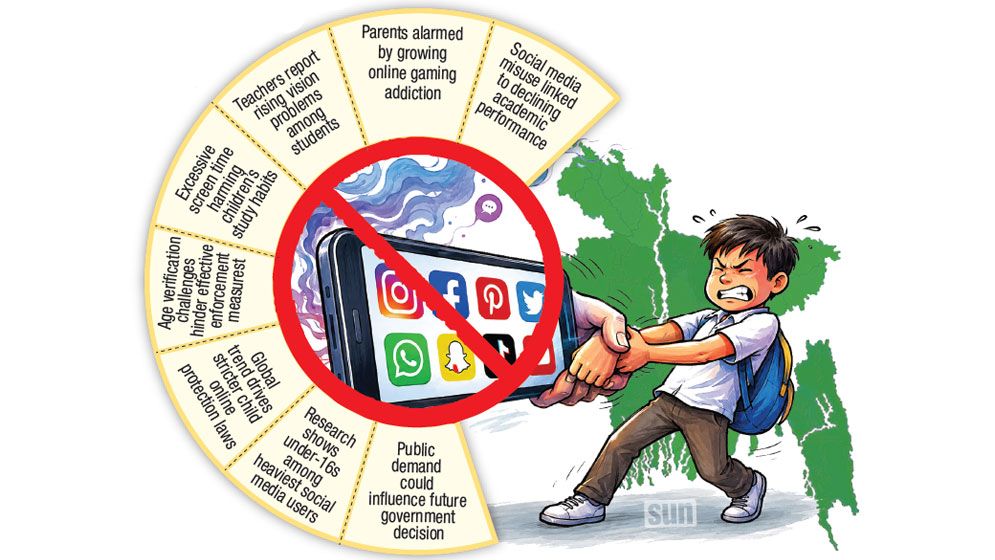
As a growing number of countries move to restrict children’s social media use, Bangladesh is still without a clear national policy – though officials now say a ban for under-16s is under active consideration amid rising concern over online harm.
The country has yet to finalise any strategy to ban or restrict social media use among children, despite growing alarm over mental health risks, exposure to harmful and illegal content, and excessive screen time.
The issue has triggered wide debate across society, with teachers, parents, government officials, child development experts and child rights advocates urging stricter measures to protect children from social media addiction and its wider impacts.
The government is now considering restricting access to social media platforms for those under 16, according to Taibur Rahman, director general of the National Cyber Security Agency.
Speaking to the Daily Sun, he said concerns over online safety, cyberbullying, harmful content and excessive screen time are driving internal discussions.
Globally, a growing number of countries have moved to impose or strengthen age restrictions.
Australia has introduced an outright ban for users under 16 on major platforms, while the United Kingdom is advancing similar legislation. France requires parental consent for users under 15, Malaysia enforces strict age verification, and China operates “minor mode” systems with content filters and screen-time controls. Denmark, Spain, Greece and Austria are also considering or developing comparable frameworks, typically targeting children under 14 or 16.
Taibur Rahman said any move in Bangladesh would depend on public sentiment and feasibility.
“We will consider the ban if a public demand is raised to address the issue,” he said, adding that discussions are ongoing within government agencies in line with global trends.
He further noted that “the government can take a decision after reviewing public opinion, international practices and the feasibility of enforcing age-verification measures in Bangladesh, assessing the importance of the demand.”
A study is also underway to assess usage patterns, with a preliminary report suggesting children under 16 are among the highest users of social media.
Taibur Rahman said excessive use is already affecting children’s academic performance, eating habits, and participation in outdoor activities.
However, he also stressed the need for children to develop digital literacy, including familiarity with artificial intelligence, to remain competitive in a changing global landscape.
He added that parental responsibility remains central, saying parents must help children avoid “non-productive screen time.”
Mohammad Saiful Hassan, joint secretary and director general (additional duty) of the Department of ICT, said restricting social media access could protect minors from inappropriate, illegal and highly polarised content.
However, he warned that such a move could also trigger public resistance. “It remains a matter of concern as any aggrieved group could wage a movement against such decision,” he said.
He also pointed to enforcement challenges, noting that age verification is difficult in practice because many users falsify their age to register as adults on platforms such as Facebook.
“Many users falsify their ages to appear 18+,” he said, referring to one of the world’s largest social networking platforms.
Saiful also highlighted a cultural factor, saying some parents themselves encourage early social media use to preserve memories or stay connected, which inadvertently increases children’s exposure. He urged parents to reconsider such practices.
Concerns from educators are also mounting. Arifa Akter, head of the Feeder Branch of Dhanmondi Government Boys High School, said visual health problems among students have risen sharply.
“At least 20% to 25% of my students wear glasses due to vision problems and many of them cannot take notes from the board during their class. The problem has been increasing alarmingly among the students over the past 10 to 12 years largely due to excessive use of mobile devices and other technologies,” she said.
She added that many children are now heavily involved in online gaming.
“I came to know from many parents that their children are habituated to playing games online through mobile devices,” she said, calling for a government policy to prohibit such games on social media platforms.
She further warned about the risks of unrestricted access: “It is a digital era and everything bad for the children and society is available on social media, thanks to the availability of the internet connection everywhere. The children can visit objectionable sites unconsciously, which is enough for the moral degradation of the young generation.”
Parents echo similar concerns.
A couple whose ninth-grade child studies at the same school said their son has become addicted to online live games.
“Our child often attempts to beat us up when we want to take away mobile phone from him. Furthermore, he also misbehaves with us when we want to prevent him from playing games on mobile devices,” they said.
They added that he had created a Facebook account using a false age and they have been unable to curb his addiction.
Across households, many parents say platforms such as Meta Platforms services including Facebook and Instagram, along with WhatsApp, TikTok, Snapchat and YouTube, are increasingly being misused by children and adolescents.
They report growing inattentiveness to studies, reduced school engagement, and a decline in moral values and discipline.
In response to mounting concern, Barrister Sanaullah Noori of the Legal Voice Foundation submitted a legal notice on 7 May to the secretaries of the Posts and Telecommunications Division, the Information and Communication Technology Division, and the Bangladesh Telecommunication Regulatory Commission, seeking a ban on social media use for those under 16.
In his notice, he urged the authorities to take effective steps to prevent misuse and strengthen regulatory control over social media platforms in the interest of children and adolescents.