



 For all latest news, follow the Daily Sun's Google News channel.


The budget’s financing structure presents its own concerns.
Bangladesh’s largest-ever national budget opens with a promise millions of households desperately want to believe: that inflation will fall to 7.5% in the coming fiscal year.
But after four years of persistent price shocks, shrinking purchasing power and declining real wages, economists, businesses and ordinary consumers are asking whether that target is realistic – or merely aspirational.
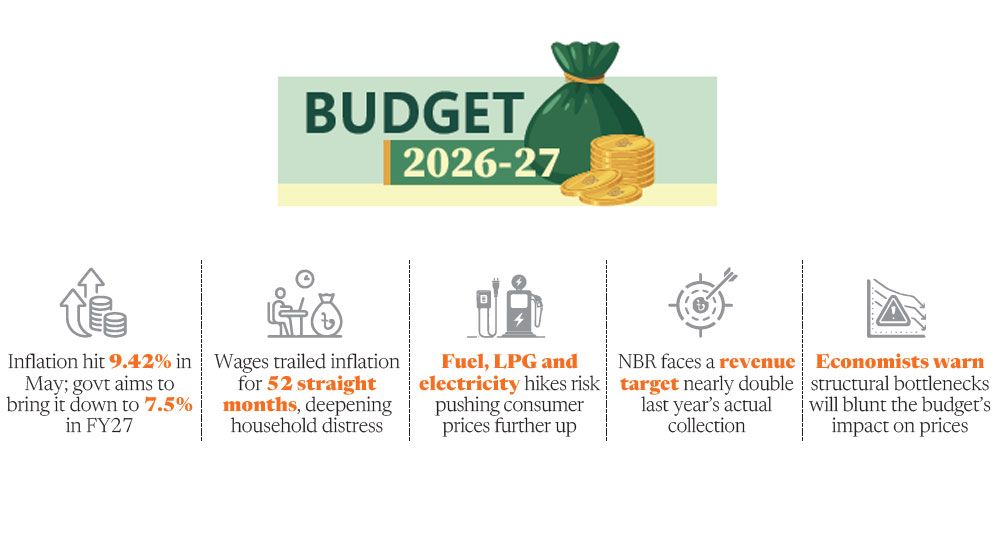
The proposed FY27 budget arrives at a fraught moment. Inflation climbed to 9.42% in May, its highest level in 16 months, driven largely by soaring food prices.
Over the same period, wage growth stood at just 8.21% – the 52nd consecutive month that earnings have failed to keep pace with the cost of living.
The result has been a prolonged and deepening squeeze on household finances.
Across the country, families are cutting back on non-essential spending, drawing down savings and turning to borrowing simply to cover food, housing, healthcare, education and transport.
Some have exhausted nest eggs built over years; others are taking second jobs or longer hours just to stay afloat.
Against this backdrop, the government has unveiled an ambitious Tk9.38 lakh crore budget anchored in higher spending, stronger growth and a pledge to restore macroeconomic stability.
Whether it succeeds may ultimately come down to a single, simple measure: whether it actually brings prices down.
Cost pressures still building
The problem is that inflationary forces are not receding. Several significant cost increases have come into effect just ahead of the budget’s implementation.
Diesel prices have been raised twice, LPG costs have risen in multiple phases, and higher electricity tariffs have been approved.
Economists warn that these adjustments rarely stay confined to business balance sheets.
“When fuel prices, electricity costs or taxes rise, transport costs increase, production costs increase and distribution costs increase. Eventually those costs are transferred to consumers,” said Dr Mustafa K Mujeri, former chief economist of Bangladesh Bank.
That observation goes to the heart of the difficulty facing policymakers.
Higher energy and fuel prices feed through supply chains, raising the cost of moving food, running factories and delivering services – with consumers ultimately picking up the bill.
A target under pressure
Bangladesh Bureau of Statistics data show that after a period of gradual moderation earlier in the fiscal year – inflation fell from 11.66% in July FY25 to a low of 8.17% in October – the downward trend has since reversed. By May, it had climbed back to 9.42%.
To meet the government’s FY27 target, inflation would need to fall by nearly two percentage points despite rising utility costs and a markedly expansionary fiscal stance.
Dr Fahmida Khatun, Executive Director of the Centre for Policy Dialogue (CPD), described the challenge plainly.
“Bringing inflation down to 7.5% will require adequate food and energy supplies alongside a credible and effective monetary policy.
A contractionary monetary stance may need to continue for some time,” she said, adding that if increased public spending fails to generate genuine productivity gains, it risks adding further inflationary pressure rather than relieving it.
Revenue ambitions add another layer of risk
The budget’s financing structure presents its own concerns.
The National Board of Revenue (NBR) has been handed a collection target exceeding Tk6.04 lakh crore – among the most ambitious revenue goals in Bangladesh’s history.
For context, the NBR collected around Tk3.70 lakh crore in FY25, and in the first ten months of FY26, collected Tk3.27 lakh crore against a revised target of Tk5.03 lakh crore, leaving a shortfall of nearly Tk70,000 crore.
If revenue falls short again, there is a real risk that authorities turn to indirect taxes, duties and administrative levies that feed directly into consumer prices. Mostafa Azad Chowdhury Babu, former senior vice-president of the FBCCI, put it bluntly: “In reality, businesses frequently absorb these taxes as costs and pass them on to consumers. That eventually affects market prices.”
The budget also projects a deficit of roughly Tk243,000 crore, to be financed through domestic and foreign borrowing.
Dr Zahid Hussain, former lead economist at the World Bank’s Dhaka office, cautioned that many of Bangladesh’s inflationary problems are structural rather than a function of insufficient spending.
“If industries cannot access reliable gas, electricity and logistics services, higher public expenditure alone cannot generate production or employment,” he said.
Government pins hopes on reform
Finance Minister Amir Khosru Mahmud Chowdhury, speaking at a post-budget press conference, argued that the path to lower inflation lay not in market monitoring alone but in cutting the cost of doing business – through streamlined regulation, better governance, improved logistics and greater efficiency.
He pointed to lengthy approvals, bureaucratic delays, high financing costs and port bottlenecks as root causes. “If we can successfully implement these reforms, bringing inflation under control will not be very difficult,” he said. Recommended Stories