



 For all latest news, follow the Daily Sun's Google News channel.


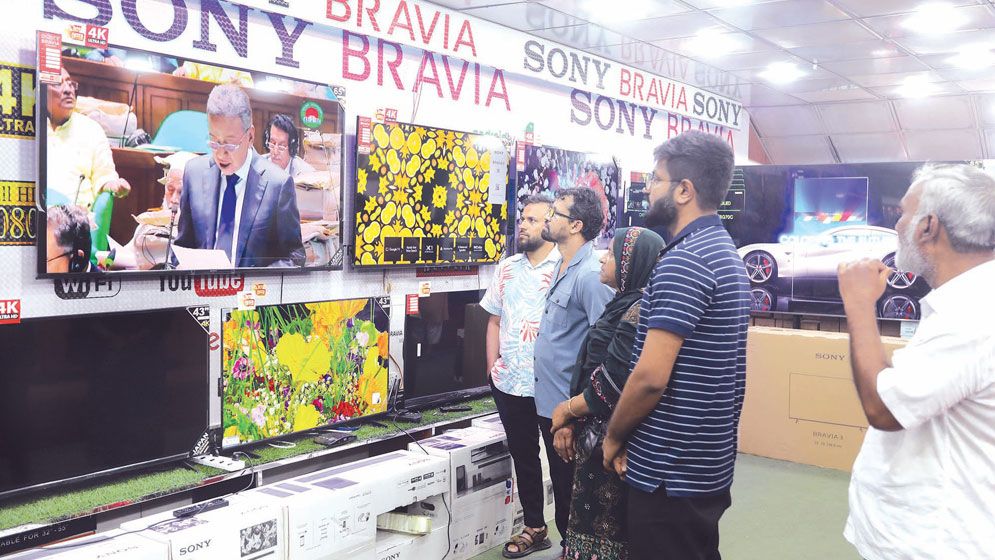
General people watch the live broadcast of the national budget for the fiscal year 2026–27 on display televisions at the National Stadium electronics market in the capital on Thursday. Photo: Reaz Ahmed Sumon
The proposed Tk9.38 lakh crore national budget for the 2026-27 fiscal year has drawn cautious optimism from citizens, students, professionals and business owners.
Many of them welcomed the budget’s focus on education, healthcare and inflation relief while stressing the need for effective implementation.
Finance Minister Amir Khosru Mahmud Chowdhury presented the budget in parliament on Thursday, describing it as a roadmap to stabilise, revive and accelerate the country’s economy.
Students hail education boost
Student reactions were particularly strong over the increased allocation for education.
Monnujan Khan, a law student at North South University (NSU), described the move as a historic step.
“Breaking a four-year stagnation to finally cross the 2% GDP threshold is a historic pivot for our generation. By increasing investment in education, the government has recognised that classrooms, not just infrastructure, are the foundation of the country’s future,” she said.
However, she stressed that implementation would be key.
“A budget is only as effective as its execution. The increased allocation must translate into institutional accountability, research opportunities and curriculum reforms that prepare students for a competitive global environment,” she added.
Public relief over inflation measures
Many citizens welcomed the government’s decision to reduce taxes on essential goods, expressing hope that it would ease inflationary pressure.
Ayesha Khatun, a Dhaka-based housewife, said rising prices have become a major burden for middle-income families.
“My husband is an office employee, and managing household expenses has become increasingly difficult. We hope these tax reductions will bring down the prices of daily necessities,” she said.
Jamal Mia, a rickshaw puller in the capital, said ordinary people would judge the budget by its impact on daily living costs.
“A budget of Tk9.38 lakh crore sounds huge, but what matters to us is whether food, medicine and education become affordable,” he said.
Healthcare and business reactions
Healthcare professionals also responded positively to the increased allocation for the sector.
Dr Jahid Hasan of Rajshahi Medical College said the rise in health spending could strengthen public healthcare if effectively implemented.
“Reaching more than 1% of GDP in health spending is a major achievement. The challenge now is ensuring the funds reach hospitals, diagnostic services and primary healthcare facilities,” he said.
Small business owners urged the government to prioritise practical development that directly improves daily life.
Md Jilani, a tea stall owner in Dhaka, said development should not be measured only by large infrastructure projects.
“People want better roads, drainage systems and uninterrupted public services. If everyday problems are solved, citizens will truly feel the benefits of the budget,” he said.
Creative sector welcomes cost relief
Members of the creative community expressed optimism over measures expected to reduce the cost of imported multimedia equipment and musical instruments.
Freelance filmmaker Rafi Khan said lower equipment costs would support content creators.
“Professional camera equipment is very expensive. Any reduction in prices will help creators like us,” he said.
Musician Ziad bin Hannan also welcomed the move, saying it could make instruments more accessible to emerging artists.
Concerns over budget deficit
Despite positive reactions, concerns remain in the financial sector over the budget deficit and financing strategy.
Atikur Rahman Khan, a banker at Uttara Bank, said the banking sector would closely monitor revenue mobilisation and borrowing plans.
“The budget is ambitious and growth-oriented, but financing it will be a major challenge due to the large deficit. Maintaining stability will depend on achieving revenue targets without excessive pressure on the private sector,” he said.
While responses remain largely positive, observers said the budget’s success will ultimately depend on effective implementation in the coming fiscal year.