




 For all latest news, follow the Daily Sun's Google News channel.


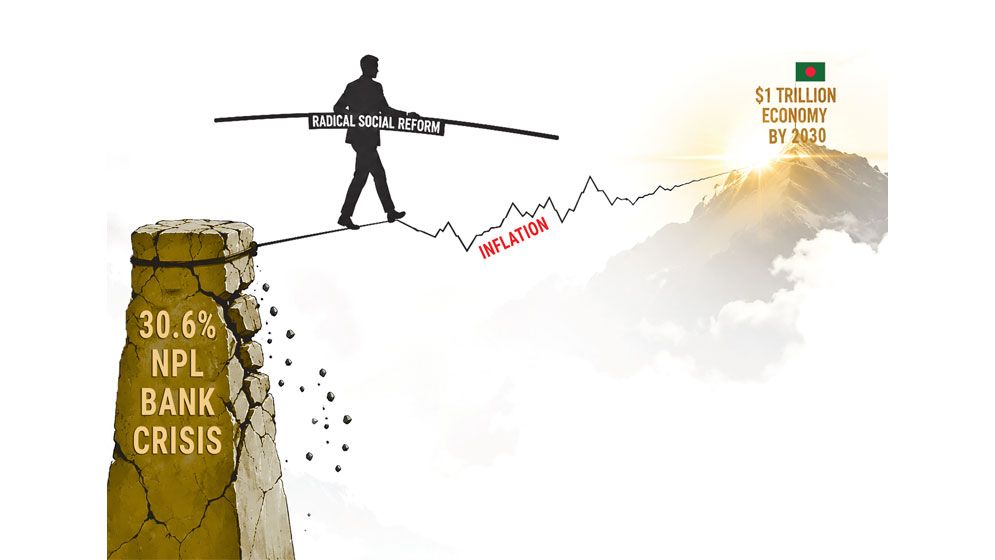
 Finance Minister Amir Khosru Mahmud Chowdhury on Thursday placed a record Tk9.38 lakh crore national budget for the 2026-27 fiscal year (FY27) on an unmistakably ambitious premise: that a massive state-led push can simultaneously tame inflation, revive private investment, and restore economic momentum after several difficult years.
Unveiling the maiden fiscal blueprint of the newly elected administration, the finance minister laid out an expansive reform agenda aimed at delivering a “democratic, humane and inclusive economy” after years of institutional erosion.
Yet this bold vision faces immediate structural friction, as the treasury plans to finance a projected Tk2,43,000 crore deficit by borrowing a staggering Tk1,12,000 crore directly from commercial banks.
Independent economists warn that extracting over Tk1 lakh crore from a banking sector currently buckling under a record 30.60% non-performing loan (NPL) ratio risks triggering a severe crowding-out effect.
With commercial banks highly risk-averse, analysts caution that lenders will lock their remaining liquidity into safe, high-yielding sovereign bonds, effectively starving private enterprises of the vital credit required to meet the government’s ambitious 6.5% GDP growth target.
Inflation remains the ultimate macroeconomic frontier
The government has rightly identified inflation as its most urgent, politically sensitive macroeconomic concern.
Although price pressures eased slightly earlier this year, Bangladesh’s point-to-point inflation climbed back to a bruising 16-month high of 9.42% in May 2026, driven relentlessly by volatile food prices and supply-chain blockages.
For millions of households, particularly low- and middle-income families across urban and rural segments, the cost-of-living crisis remains an acute reality.
Real incomes have steadily deteriorated over the past four years as wage growth has consistently failed to keep pace with consumer price indices.
Household purchasing power has severely weakened, national savings rates have cratered, and consumption patterns have adjusted downwards, forcing families to cut back on basic nutritional needs.
The administration’s target of curbing inflation to 7.5% next fiscal year faces intense skepticism from independent macroeconomists.
This skepticism is sharpened by the central bank's tight monetary stance, which maintains a short-term policy interest rate at a historic high of 10% to anchor price expectations, consequently driving commercial lending rates up to a restrictive 15 to 16%.
Dr Zahid Hussain, former lead economist at the World Bank’s Dhaka office, told the Daily Sun that inflation remains the economy’s most pressing challenge and has severely eroded living standards.
“Purchasing power has fallen significantly over the past four years while quality employment opportunities have narrowed. People are earning, but their incomes are buying much less,” Dr Zahid observed.
According to him, the government’s expansionary fiscal approach may fail to address the actual root causes of contemporary inflation, which are fundamentally structural rather than purely demand-driven.
“The assumption underpinning this budget is that a larger public outlay will automatically stimulate growth, employment, and incomes. But many of our constraints are supply-side in nature. If industries cannot obtain gas, electricity, or reliable logistics services because of foreign exchange shortages or import blockages, higher government spending alone cannot generate real production or sustainable jobs,” he explained.
Adding to this complex dynamic is the external energy environment.
The ongoing closure of the Strait of Hormuz amid escalating Middle Eastern conflicts has dealt a brutal $3 billion blow to the national exchequer in energy import costs over the past four months alone.
Former Bangladesh Bank chief economist Dr Mustafa K Mujeri warned that the state’s unavoidable choices to adjust primary energy prices, raise utility tariffs, and aggressively pursue indirect taxes will inevitably feed back into the domestic supply chain.
“Increases in fuel prices, utility costs, or indirect transaction taxes could further fuel cost-push inflation through higher transportation, manufacturing, and irrigation costs,” Dr Mujeri stated.
Supply-side optimism backed by ten strategic priorities
To achieve its growth target of 6.5% amid these headwinds, the government has anchored its fiscal plan to ten core strategic priorities.
These priorities are engineered to systematically shift the state’s economic focus away from the debt-heavy, brick-and-mortar “vanity infrastructure” of the previous regime and back toward human capital and micro-regulatory deregulation.
The most radical manifestation of this philosophy is the structural realignment of public funding toward education and healthcare, whose combined allocations have surged by 63% to reach Tk1,85,347 crore, commanding an unprecedented 19.8% share of total public expenditure.
Education alone is slated to receive Tk1,22,495 crore (a 42.7% year-on-year increase), shifting resources toward mandatory technical training from Class VI, expanding the Mid-Day Meal Programme, and funding the “One Teacher, One Tab” initiative to bridge the rural-urban digital divide.
Concurrently, the healthcare sector has received a long-overdue boost to Tk62,852 crore, doubling its previous baseline to finance universal vaccine supplies, district hospital modernisations, and the rollout of digital e-health cards for low-income citizens.
Beyond social spending, the budget introduces an aggressive supply-side regulatory mechanism to revive stalled private investment: a statutory “deemed approved” clause for industrial approvals.
This automated framework legally mandates that if regulatory bodies fail to process business and industrial licenses within a strict, seven-day window, the permissions are legally granted.
To break the country’s dangerous over-reliance on low-margin Readymade Garment (RMG) exports, the budget places a smart, long-term bet on high-tech manufacturing.
Semiconductor and chip-design operations will enjoy a concessional 1% import duty on advanced machinery until 2031, paired with total exemptions from VAT, regulatory duties, and supplementary duties.
To lower the entry barriers for financial inclusion in rural segments, the state has entirely abolished the Tk300 tax on mobile SIM cards, sacrificing Tk1,200 crore in annual revenue.
This is matched by zero-VAT shielding for agricultural inputs like fertilisers and pesticides to protect primary production from international cost fluctuations.
However, independent analysts caution that the success of these measures will depend entirely on administrative execution.
Dr Fahmida Khatun, executive director of the Centre for Policy Dialogue (CPD), noted that while the budget appears deliberately designed to translate policy commitments into structural action, financing and implementation remain major hurdles.
“Expanding expenditure without significantly strengthening revenue mobilisation could increase fiscal deficits, debt burdens, and inflationary pressures. The challenge will be balancing development ambitions with macroeconomic stability,” she said.
The reality of investment and the corporate credit squeeze
Private investment and employment generation sit at the absolute centre of the government's growth strategy, yet these objectives face daunting structural realities.
While the budget promises extensive deregulation, improved ease of doing business, and investment facilitation, business leaders argue that long-term investment decisions depend far more on the ground-level operating environment than on optimistic parliamentary announcements.
Mostafa Azad Chowdhury Babu, former senior vice-president of the Federation of Bangladesh Chambers of Commerce and Industry (FBCCI), emphasised that attracting both local and foreign direct investment (FDI) requires a stable, predictable business climate.
“Foreign investors first look for policy stability, affordable financing, efficient utility services, and a predictable business environment. Tax incentives alone are not enough,” he said, noting that investors continue to navigate excessive bureaucracy.
“In many cases, businesses still need dozens of approvals and licences from multiple overlapping agencies before they can break ground. The single-window service exists largely in theory; in practice, investors still move from office to office.”
Babu also pointed out that Bangladesh’s tax structure remains less competitive than its regional peers, with relatively high corporate tax rates and indirect transaction levies.
Furthermore, the operational reality of existing investments remains constrained by structural shortages.
As Dr Zahid Hussain observed, “There are industrial projects worth tens of thousands of crores that remain severely underutilised simply because industrial gas and electricity are unavailable. In such cases, the capital investment has already taken place. What is missing is the enabling environment needed to make those investments productive.”
This investment slowdown is starkly visible in macroeconomic data. Bangladesh’s investment-to-GDP ratio has drifted downwards, and net FDI – despite ticking up to $1.77 billion in 2025 – remains far below the estimated $8 billion required annually to support the nation's long-term development targets.
Economists argue that the stagnation of local investment serves as a critical warning sign for international capital markets. Simply put, if local entrepreneurs lack the confidence to expand their operations under current borrowing rates of 15 to 16%, foreign investors will be even harder to persuade.
The deficit financing framework and the banking sector paradox
The fiscal strategy projects an overall budget deficit of Tk2,43,000 crore, equivalent to 3.6% of GDP.
To bridge this gap, the government has structured its financing by planning to borrow Tk1,27,000 crore from domestic market channels and Tk1,16,000 crore from foreign development partners and bilateral creditors.
It is within the domestic financing leg that the most severe structural faultline of the budget emerges: the treasury intends to borrow Tk1,12,000 crore directly from the commercial banking system.
Herein lies the central arithmetical contradiction of the FY27 blueprint.
The government is attempting to extract over a lakh crore Taka from an institutional banking apparatus that is already on life support.
According to official central bank disclosures, non-performing loans (NPLs) in the banking sector hit a staggering, record-high 30.60% at the end of December 2025.
This mountain of toxic debt has hollowed out commercial banks' capital buffers and crippled their capacity to extend fresh private credit, causing private-sector credit growth to plummet to an historic low of 4.7% in April.
By turning to these weakened commercial banks to bankroll its deficit, the state risks triggering a severe crowding-out effect.
Commercial banks, highly risk-averse in an environment defined by systemic defaults, will naturally treat sovereign Treasury bills and bonds as a highly profitable safe haven, especially since the government is offering attractive, risk-free yields of around 11 to 12%.
This aggressive sovereign credit demand risks starving private enterprises of liquidity, directly running counter to the central bank’s newly announced Tk60,000 crore “Stimulus Package 2026” intended to revive industrial activity.
Dr Zahid Hussain warned of the long-term systemic consequences of this borrowing framework. “High yields on government bonds prompt commercial banks to halt private sector lending completely,” he noted, adding that when the state increasingly relies on bank borrowing to finance routine operational expenditures – such as the Tk1,05,000 crore domestic interest bill and the new public pay scale – rather than expanding revenue collection, it risks falling into a vicious debt loop.
Dr Mustafa K Mujeri echoed these alarms, highlighting the narrow corridor available to policymakers.
“Excessive state bank borrowing will starve private entrepreneurs, causing immediate nationwide employment contraction,” he stated.
He emphasised that if commercial bank liquidity dries up completely and the treasury ultimately resorts to printing money to cover its gaps, inflation will spiral entirely out of control.
Financing assumptions and the implementation bottleneck
The financing assumptions underpinning the budget rely heavily on an unprecedented performance by the National Board of Revenue (NBR), which has been assigned a monumental collection target exceeding Tk6,04,000 crore – a 17% scale-up from the outgoing year.
To expect such a yield from an under-digitised tax administration that was already running a massive Tk70,000 crore shortfall by April FY26 requires an extraordinary leap of faith.
While the budget introduces valid structural tools – such as making Tax Identification Number (TIN) certificates mandatory to open bank accounts across the country’s 17.79 crore active accounts – the short-term administrative capacity to execute this dragnet without driving capital into the informal cash economy remains unproven.
Exacerbating this revenue pressure is a chronic implementation bottleneck on the expenditure side.
The government plans to spend around Tk3 lakh crore through the Annual Development Programme (ADP), the largest development layout in the country's history.
Yet, according to the latest Implementation Monitoring and Evaluation Division (IMED) data, ADP implementation reached only 41.41% during the first ten months of the current fiscal year.
If ministries struggled to efficiently execute a smaller development program, economists question how they will manage a substantially larger, more complex portfolio.
Dr Mujeri argued that Bangladesh’s development challenge has transitioned away from a question of mere budgetary allocation.
“The real issue is spending efficiency, institutional accountability, and implementation quality. Large budgets do not automatically create welfare,” he noted.
Furthermore, the external financing target of Tk1,16,000 crore from development partners arrives during an unforgiving international environment. While the transition to a market-based exchange rate regime has stabilised the Taka near Tk122 against the US dollar, it has triggered a depreciation of 18 to 20% against the Euro and the Pound Sterling.
Because Bangladesh’s manufacturing core relies on raw materials imported from Europe and China, this currency slide acts as a persistent machine of cost-push inflation.
This external pressure has forced a piece of institutional realism: the government has formally requested a three-year deferral of its transition from Least Developed Country (LDC) status to protect duty-free market access for garment exporters ahead of the scheduled graduation.
Fahmida Khatun offered a sharp critique of this broader debt trajectory, noting that Bangladesh’s combined domestic and foreign public debt has already climbed to approximately 38% of GDP.
“Continuous borrowing is entirely unsustainable; the state must focus on aggressive revenue collection,” she argued, emphasising that the government must shift away from debt reliance by cutting out administrative waste and launching genuine, direct tax reforms.
