


 For all latest news, follow the Daily Sun's Google News channel.



When Muhammad Yunus assumed leadership of Bangladesh’s interim government in August 2024, expectations extended far beyond electoral reform and political stabilisation. Unlike most political leaders, Yunus entered office carrying decades of international credibility as a development practitioner, social entrepreneur and global advocate for sustainable development. His cabinet was populated by technocrats, academics, policy specialists and reform-minded professionals rather than conventional politicians. More importantly, Yunus himself had spent years championing a global vision built around three ambitious goals: zero poverty, zero unemployment and zero net carbon emissions.
For a country as climate-vulnerable as Bangladesh, these credentials mattered. Bangladesh did not need another government to discover climate change. It needed a government capable of translating international reputation into adaptation finance, institutional coordination and long-term resilience. If any administration was uniquely positioned to achieve that objective, it was the Yunus-led interim government.
Yet by the end of its tenure, the gap between climate rhetoric and climate governance had become increasingly difficult to ignore. Controversial decisions or dramatic policy reversals do not define the government’s climate legacy. Rather, it is defined by inaction. At a time when climate adaptation required urgent political attention, Bangladesh witnessed institutional stagnation, declining development allocations, missed financing opportunities, and the absence of strategic leadership on one of the country’s most significant national security challenges. The result is an uncomfortable paradox: a government internationally celebrated for its commitment to sustainable development presided over a period in which climate adaptation remained largely absent from the national political agenda.
Few countries face climate risks on the scale that Bangladesh does. At the same time, Bangladesh has often been praised internationally for its adaptation successes. Investments in cyclone shelters, disaster preparedness systems, early warning networks and community resilience programmes have significantly reduced mortality from climate-related disasters. These achievements demonstrate that adaptation works when governments prioritise it. However, adaptation is not a one-time investment. It is a continuous process requiring sustained financing, institutional coordination, technological innovation and political commitment. The costs are enormous. International estimates suggest that Bangladesh requires billions of dollars annually to prepare for future climate impacts adequately. Against this backdrop, climate governance should have occupied a central place within the interim government’s policy agenda. However, it remained largely peripheral.
The most striking aspect of the Yunus government’s climate record is not what it did, but what it failed to do. Bangladesh already had institutional mechanisms to coordinate climate policy and monitor its implementation. Yet reports indicate that the National Action Plan Committee and related climate coordination structures remained effectively dormant during the interim period. The interim government regularly established commissions, committees, dialogues, consultation mechanisms, and reform initiatives in other sectors. Constitutional reform, governance restructuring, electoral systems, transitional justice and administrative modernisation all received sustained political attention. Yet climate governance largely drifted without direction. The omission is particularly surprising because climate policy is one of the few areas where broad political consensus already exists in Bangladesh. The result was a lost opportunity to use a rare political transition to build stronger institutions capable of managing Bangladesh’s most significant long-term challenge.
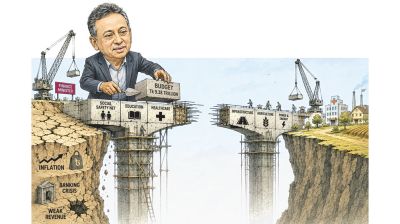
Government priorities are ultimately revealed through budgets rather than speeches. Although climate-related spending remained part of the national budget, development allocations associated with climate action declined during the interim period. At a time when Bangladesh required expanded investments in embankments, water management systems, climate-resilient agriculture, disaster preparedness and adaptation infrastructure, fiscal commitment weakened rather than strengthened.
This decision carries consequences beyond accounting figures. Every delayed embankment project increases vulnerability to flooding. Every postponed water management initiative increases the risk of salinity intrusion. Every underfunded adaptation programme leaves vulnerable communities more exposed to future disasters.
The problem is not simply that Bangladesh spent too little. The problem is that the government failed to signal that climate adaptation represented a strategic national priority. This is particularly concerning because adaptation spending generates long-term savings. Numerous international studies demonstrate that investments in resilience significantly reduce future disaster recovery costs. In practical terms, money not spent on adaptation today often reappears later as emergency expenditures, reconstruction costs, agricultural losses and humanitarian assistance. Bangladesh has learned this lesson repeatedly. Yet during a period when adaptation financing should have accelerated, momentum slowed.
Perhaps the most disappointing aspect of the Yunus government’s climate record concerns international financing. Few Bangladeshi leaders have possessed greater access to global political networks than Muhammad Yunus. Yet tangible outcomes remained limited. No breakthrough in adaptation financing emerged during the interim period. No transformative climate funding package was secured. No significant new financing architecture was established. If a globally recognised development leader with extensive international connections could not significantly expand adaptation financing during a period of heightened international goodwill, questions naturally arise regarding how effectively those opportunities were pursued.
The most significant weakness of the interim government’s climate approach may have been its apparent failure to recognise that climate adaptation is not a separate environmental issue. It is a development issue. It affects agriculture, health, migration, infrastructure, water security, energy systems, employment and poverty reduction. Climate resilience is increasingly linked to economic stability and national security. Climate outcomes will influence every major development objective Bangladesh hopes to achieve over the coming decades. This reality should have aligned perfectly with Yunus’ broader development philosophy.
The Yunus government will undoubtedly be remembered for overseeing a critical political transition and facilitating Bangladesh’s return to electoral politics. That achievement deserves recognition. Yet history may judge its climate record far more harshly.
It was a government led by one of the world’s most recognisable development figures. It possessed an unusually technocratic cabinet. It enjoyed substantial international goodwill. It entered office with a global reputation built in part on sustainability and social innovation. It governed a country widely recognised as one of the world’s most climate-vulnerable states. Under those circumstances, expectations were inevitably high. What Bangladesh needed was stronger climate governance, more ambitious adaptation financing, greater institutional coordination and aggressive international resource mobilisation. Instead, it received caution, delay and administrative inertia.
Muhammad Yunus spent years promoting a world defined by three zeros: zero poverty, zero unemployment and zero carbon emissions. The unintended climate legacy of his government may be remembered through three different zeros: zero urgency, zero institutional momentum and zero financing breakthrough. For a country confronting an accelerating climate crisis, that is a legacy Bangladesh can ill afford.
_____________________________________
The writer is a political and international affairs analyst