




 For all latest news, follow the Daily Sun's Google News channel.


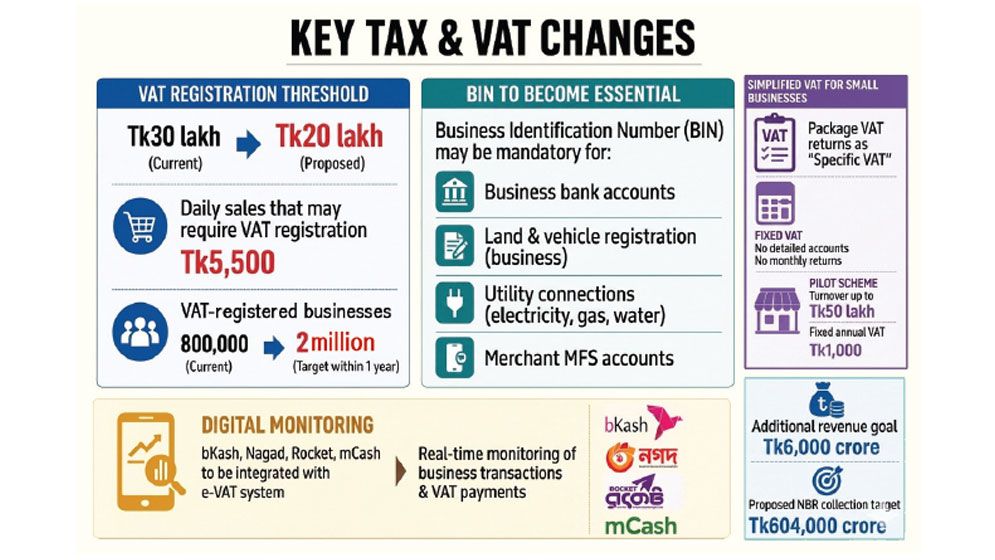
 The government is preparing a major push to widen the country’s tax base, with plans to lower the VAT registration threshold and make Business Identification Numbers (BINs) mandatory for a range of commercial activities as part of a drive to generate at least Tk6,000 crore in additional annual revenue.
Under proposals being finalised for the national budget for the 2026–27 fiscal year (FY27), businesses with annual turnover of Tk20 lakh or more may be required to register for VAT, down from the existing threshold of Tk30 lakh.
The National Board of Revenue (NBR) is also considering measures that would make BIN registration essential for opening business bank accounts, obtaining utility connections and carrying out other key business transactions.
Officials say the initiatives form part of a broader strategy to expand the tax base rather than raise tax rates, while gradually bringing a large segment of the country’s informal economy under the formal taxation framework.
According to NBR officials, millions of small businesses at union and thana levels remain outside the VAT system. The reduction of the turnover threshold is aimed at bringing these enterprises into the formal VAT network.
Currently, Bangladesh has around 800,000 VAT-registered entities. The NBR has set an ambitious target of increasing that number to 2 million within the next year.
The measures come as the government prepares a national budget worth nearly Tk9.30 lakh crore and seeks to overcome a widening revenue shortfall.
The NBR is expected to receive a revenue collection target of around Tk604,000 crore for FY27, compared with a revised target of Tk554,000 crore for the current fiscal year.
However, economists and business leaders warn that widening the tax net at a time of persistent inflation, declining purchasing power and sluggish private-sector investment could place additional pressure on small entrepreneurs and consumers.
Finance Minister Amir Khosru Mahmud Chowdhury is scheduled to place the national budget before Parliament on 11 June.
At the beginning of the current fiscal year, the NBR was assigned a revenue collection target of Tk4.99 lakh crore. Later, the government revised the target upward by Tk55,000 crore to Tk554,000 crore.
Despite aggressive collection efforts, the revenue shortfall during the first 10 months of the fiscal year, from July to April, stood at Tk1.04 lakh crore.
Dr Zahid Hussain, former lead economist of the World Bank’s Dhaka office, believes automation alone will not solve the problem.
“If the same administrative rules and procedures remain unchanged, merely automating them will not yield significant benefits. The NBR expects people to pay taxes, but unless a suitable business environment is created, these plans will be difficult to implement,” he said.
According to him, policy reforms and stronger measures against tax evasion are essential to increase revenue collection.
Economists also argue that reforms within the NBR have repeatedly stalled because of pressure from vested business interests. They want the upcoming budget to include a roadmap for separating the policy-making and management functions of the revenue authority.
Expanding the VAT net
Speaking at a pre-budget discussion organised by the Economic Reporters’ Forum (ERF), NBR Chairman Abdur Rahman Khan recently said the government intends to expand the VAT base rather than increase tax rates in the upcoming budget.
“We will introduce technology-based monitoring systems to prevent tax and VAT evasion. Surveillance will be strengthened, particularly at the production and sales stages of cigarettes and other packaged goods,” he said.
The NBR also plans to strengthen information-sharing mechanisms with the Registrar of Joint Stock Companies and Firms (RJSC) to identify businesses that are operating but not paying taxes. Initiatives are also under way to cancel Taxpayer Identification Numbers (TINs) belonging to deceased individuals or entities that have remained inactive for long periods.
BIN to become essential for doing business
The government is considering several measures to make VAT registration virtually unavoidable for businesses.
Under the proposal, a BIN will be required to open a bank account in the name of a business. It will also be mandatory for registering land or vehicles under a business entity. Utility connections, including electricity, gas and water, may also require a BIN. In addition, merchants seeking to open Mobile Financial Services (MFS) accounts will need to obtain one.
The NBR further plans to integrate mobile financial service providers such as bKash, Nagad, Rocket and mCash directly with the e-VAT system. This would allow authorities to monitor business transactions and VAT payments in real time.
‘Package VAT’ returns as ‘Specific VAT’
The government is also planning to introduce a simplified VAT mechanism for small businesses.
The once-popular “Package VAT” system is set to return under a new name — “Specific VAT”.
Under this system, small businesses will not have to maintain complex accounting records or submit monthly VAT returns. Instead, payment of a fixed amount of VAT through a bank or mobile banking platform will automatically be treated as the VAT return.
The amount of Specific VAT will vary depending on the type and location of the business.
A fixed VAT of Tk1,000 a year?
According to NBR sources, the government is also considering a pilot scheme under which small businesses would pay a fixed VAT of only Tk1,000 annually.
The scheme may apply to businesses with annual turnover of up to Tk50 lakh.
Senior NBR officials argue that millions of businesses currently remain completely outside the tax and VAT system. Even a small contribution from these enterprises could make a significant addition to government revenue.
The move reflects the government’s broader strategy of expanding the tax base rather than raising tax rates, while gradually integrating the country’s vast informal economy into the formal sector.
NBR seeks data from business associations
As part of its effort to expand VAT registration, the NBR has requested detailed membership information from 465 trade bodies across the country. Letters have already been sent seeking the names, addresses and VAT registration numbers of their members.
According to NBR sources, although nearly 800,000 businesses are currently registered for VAT, only about 550,000 regularly submit VAT returns. This means nearly 30% of registered entities are effectively inactive.
Against this backdrop, the NBR has set a target of increasing the number of VAT-registered businesses to 2 million within the next year.
Commenting on the initiative, Md Helal Uddin, president of the Bangladesh Shop Owners Association, told The Daily Sun that not all business owners are members of associations.
“Our association has around 700 members, but the number of shops across the country would exceed 10 million. Shop owners already possess trade licences and pay taxes and VAT. Therefore, there is little justification for bringing them under taxation again through association membership lists. We are not opposed to taxation, but there should be a proper structural framework,” he said.
Tax holiday and rebate benefits to be curtailed
Currently, tax holiday and tax rebate facilities have been granted to 18 industrial sectors and 18 infrastructure sectors. In some cases, individual taxpayers also enjoy various tax rebate benefits.
The upcoming budget is expected to place tighter controls on these extensive tax incentives.
NBR Chairman Abdur Rahman Khan has already indicated that tax holidays and rebates granted for fixed periods will not be extended beyond their existing terms.
Meanwhile, NBR sources say sectors currently enjoying tax rebates without specified expiry dates may soon be assigned definite timelines.
Motorcycle users get relief
The government has decided to move away from its earlier proposal to impose advance income tax on motorcycles. As a result, all categories of motorcycles are expected to remain exempt from advance income tax in the next fiscal year.
Earlier, the NBR had proposed annual advance income tax ranging from Tk2,000 to Tk10,000 depending on engine capacity.
Under the initial proposal, motorcycles up to 110cc would have remained exempt. Owners of 111cc–125cc motorcycles would have paid Tk2,000 annually, those of 126cc–165cc Tk5,000, and motorcycles above 165cc Tk10,000 annually. However, the revenue authority has since reconsidered the proposal.
A senior NBR official involved in budget preparation said the government is stepping back from the idea of imposing advance income tax on motorcycles.
Currently, motorcycle owners pay a one-time registration fee and road tax every two years, but no separate advance income tax.
Although motorcycle users will be spared advance income tax, the legal requirement for owners of motorcycles with engine capacities above 150cc to obtain a Taxpayer Identification Number (TIN) will remain unchanged.
Auto-rickshaw drivers may pay half the tax
Responding to demands from battery-powered auto-rickshaw operators and motorcycle riders, the NBR is planning to reduce income tax rates for these groups by half.
The revenue authority wants to treat such vehicles as part of the public transport system and lower the tax burden accordingly.
Riders argue that after paying existing taxes, any additional advance income tax would place unnecessary pressure on them.
Bangladesh currently has more than five million battery-powered auto-rickshaws, including between one million and 1.2 million operating in the capital alone.
To bring the sector under a regulatory framework, the Bangladesh Road Transport Authority (BRTA) is finalising the Electric Three-Wheeler Management Policy 2025.
Under the draft budget, annual taxes for battery-powered rickshaws had been proposed at Tk5,000 in city corporation areas, Tk2,000 in municipalities and Tk1,000 in union-level areas. However, the government is now considering cutting those rates by half.
Economist Mashrur Riaz believes such initiatives are necessary to gradually formalise the country’s vast informal economy.
“The informal sector must gradually be transformed into a formal economy. Otherwise, we will not be able to sustainably expand the country’s revenue base,” he said.