


 For all latest news, follow the Daily Sun's Google News channel.


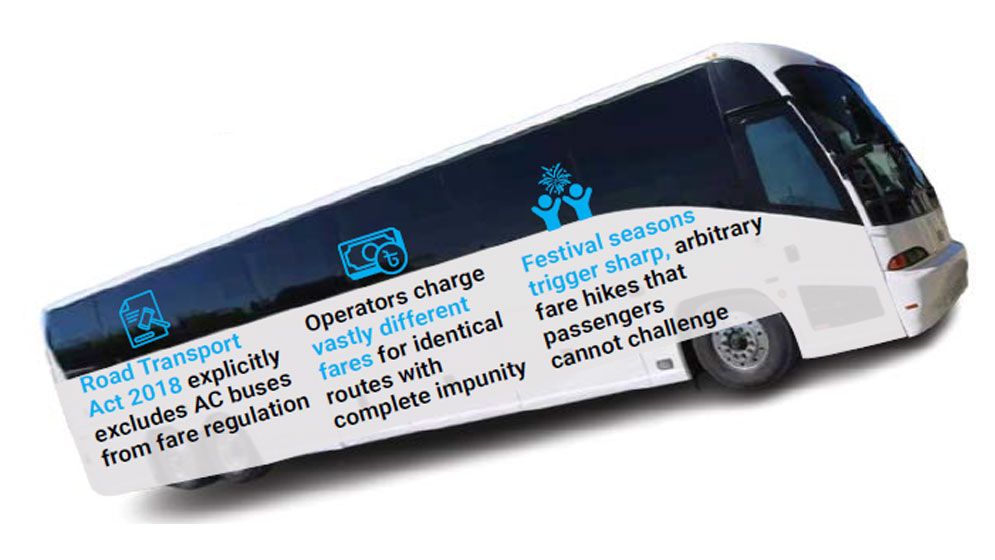
Air-conditioned buses across Bangladesh are charging wildly different fares for identical routes – and hiking prices sharply during Eid and other major festivals – because the law simply does not allow the government to stop them.
Transport experts say a gap in the Road Transport Act 2018 leaves AC bus fares entirely unregulated, and despite years of promises, the government has shown little appetite for closing it.
Section 34 of the Act empowers the government or the Bangladesh Road Transport Authority (BRTA) to fix fare rates through gazette notification – but explicitly excludes air-conditioned, luxury, and special-amenity public transport from that provision.
It allows authorities to act on overcharging complaints, but critics point out that this is meaningless without a fixed fare ceiling to measure against.
“Ridiculous, absolutely ridiculous,” said Professor Md Shamsul Hoque of the Bangladesh University of Engineering and Technology, a transport expert who works closely with the government on policy matters.
“When the fare for an air-conditioned bus is not fixed, how can a passenger say he is facing overcharge? The government has amended the Road Transport Act many times at the request of bus owners for their benefit, but passengers have had no say in this particular section.”
He added, “I have heard from the minister for Road Transport about setting a fare chart, but I still see no visible progress. When the Act was drafted, the owners were handed this specific advantage. Now the government seems nonchalant about the issue.”
BRTA officials have themselves acknowledged the legal constraints that prevent them from setting a fare schedule for AC services. The consequences for passengers are stark.
The Dhaka-to-Patuakhali route – a distance of roughly 280 kilometres – illustrates the disparity well. The government has fixed the fare for a standard 40-seat bus at Tk935 per passenger. Non-AC operators charge between Tk650 and Tk935 for the same journey. AC operators, however, charge anywhere from Tk1,300 to Tk2,000 – in some cases more than double the regulated rate. On the Abdullahpur-to-Kuakata corridor, Euro Coach charges up to Tk2,000, Bengal Paribahan charges Tk1,500, and Royal Paribahan Tk1,300, all for the same route.
By contrast, on the Dhaka-Feni route, the gap between non-AC and AC fares is a more modest Tk40 – Tk440 versus Tk480 – suggesting the disparity is not inherent to the service but a matter of what operators believe they can get away with.
Beyond the fare variations, passengers also complain about being charged for entire routes regardless of where they board or alight. Habib Sikder, who travelled from Dhaka to Patuakhali last Friday, said, “The bus travels between Abdullahpur and Kuakata, but I only needed to go from Badda to Sakhira. They charged me for the whole route – Tk1,600. There is no option to choose your boarding and dropping point.”
Festival travel brings additional strain.
Sujon Mia, a private sector employee in Dhaka, said fares on his regular Dhaka-Rangpur AC route climb from Tk1,200 to Tk1,800 during festivals or when transport is scarce. “There is nothing you can do about it,” he said.
The government has indicated it is aware of the problem.
Replying to a parliamentary question on 9 April, Road Transport and Bridges Minister Shaikh Rabiul Alam said the government intended to introduce a separate fare chart for AC buses and minibuses, with rates displayed digitally inside vehicles to improve transparency.
He also noted that committees have been established at metropolitan, divisional, and district levels under the 2018 Act to oversee transport operations and approve route permits.
Whether those assurances translate into action remains to be seen. Transport experts say they have heard similar commitments before.