


 For all latest news, follow the Daily Sun's Google News channel.


CRUEL JOURNEY OF SACRIFICIAL ANIMALS
How does meat standard deteriorate due to stressful transportation?

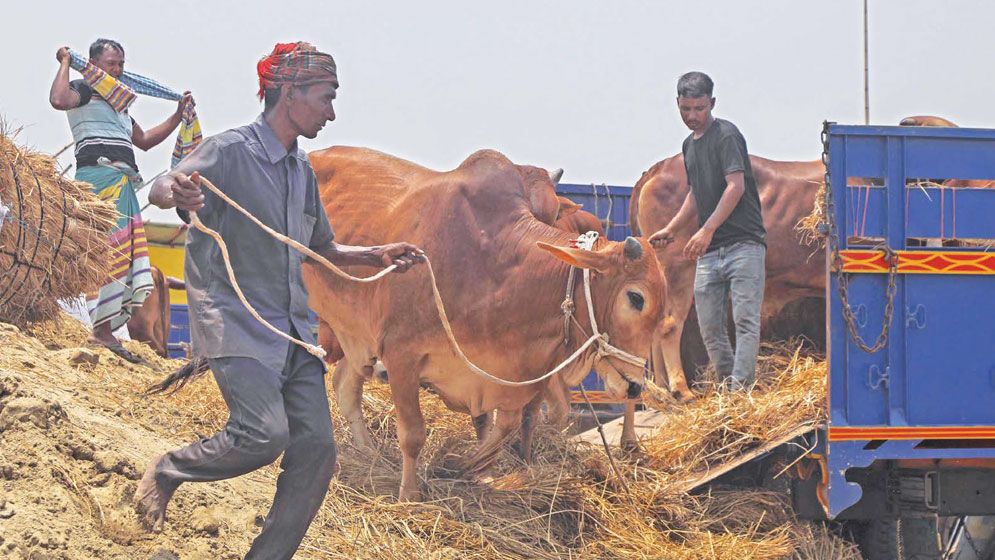
Workers unload cows from a truck at Sagorika cattle market in Chattogram on Thursday ahead of Eid-ul-Azha. Photo: Rabin Chowdhury
At 3am on Wednesday, a medium-sized truck from northern Bangladesh stopped in Shamsher Para on the outskirts of Chattogram city. As the driver opened the rear part, a heavy, suffocating stench spread through the air.
Inside, 18 cattle stood tightly packed, their bodies pressed so closely that one animal’s horn was poking into another’s back. The wooden floor beneath offered barely an inch of space to step.
During a 16-hour journey over 350 kilometres, none of them got any water or food. Some were bleeding from their hooves; others were discharging thick fluids from their noses. Fear was visible in their eyes.
Ahead of Eid-ul-Azha, this is a common sight across the country.
Thousands of cattle arrive daily in different cities and towns ahead of Eid-ul-Azha, transported from northern districts, hill tracts, and even across borders.
But what remains hidden in this supply chain, researchers say, is not just animal suffering – it is a public health risk that silently reaches consumers’ plates.
Deteriorating condition of cattle during journeys
In Chattogram’s Sagorika cattle market, one of the largest livestock hubs in the country, handling 15,000–20,000 animals daily during peak Eid season.
A landmark study in 2015 by researchers from Chattogram Veterinary and Animal Sciences University (CVASU), published in Veterinary Record Open, tracked cattle movement from Benapole to Sagorika – a 648-kilometre route.
The clinical study on 100 cattle revealed alarming deterioration during transportation.
Animals with visible injuries rose from 26% before transport to 47% after arrival. Nasal discharge cases increased from 15% to 28%. Severe dehydration rose from 8% to 20%.
Dr Md Manirul Islam, associate professor at the CVASU, describes the system as a “black hole of irregularities.”
“Each animal should get 15–20 square feet of space, but in reality, they get barely half that,” he said. “They cannot even sit during the entire journey. It is a form of prolonged stress-induced suffering.”
When an animal experiences prolonged fear or stress, the brain signals the adrenal glands to release cortisol and adrenaline.
These stress hormones break down stored glycogen in muscles, preparing the body for “fight or flight.” But in a tightly packed truck, there is neither fight nor escape; the process continues unchecked.
A recent study by Bangladesh Agricultural University (BAU), published in Meat Research in June 2025, explains the biochemical consequences.
Professor MA Hashem, who led the study, explains that in normal conditions, post-slaughter lactic acid reduces meat pH from 7.2 to around 5.5, keeping meat tender, red and palatable.
But under transport stress, glycogen is depleted before slaughter. As a result, lactic acid formation drops, and meat pH remains above 6.0 – producing what is known as DFD meat (dark, firm, dry).
“DFD meat is not only tough and tasteless,” Prof Hashem warned, “it becomes highly prone to bacterial growth. While normal meat lasts 3–5 days, DFD meat can begin to spoil within 24–48 hours.”
He added that extreme heat conditions can also produce PSE (pale, soft, exudative) meat, which appears pale, watery and shrinks during cooking.
A journey of 48 hours and systemic pressure
At Sagorika market, trader Mohammad Yusuf from Rajshahi described the realities of transport economics.
“We are forced to load 18–20 animals to avoid losses. If we stop for water breaks, informal tolls increase on highways,” he said.
Another trader from the hill routes of Bandarban, Alaudin, said animals often collapse during transit.
“When one falls, others step on it. We lost two cattle on the road last year and had to sell the rest at a loss,” he said.
The suffering, however, does not end at arrival.
A 2017 BAU field study in Mymensingh found that 32% of animals had deep injuries before slaughter.
Dr Md M Islam noted, “Animal welfare awareness is almost absent. Throwing, dragging, twisting tails – these are considered normal practices here. But every injury increases toxin levels in the body.”
What consumers don’t realise
In Chattogram’s Muradpur area, housewife Shamsun Nahar said she once bought what she believed was a young, healthy animal for Eid.
“But even after cooking, the meat was extremely tough,” she said. “I thought I was cheated with an old cow.”
However, researchers say age is not always the reason.
Dr Manirul Islam explained that transport stress inactivates μ-calpain, an enzyme responsible for breaking down muscle fibres and tenderising meat.
“In DFD meat, protein structure changes. Amino acid composition is affected. Nutritional value may remain, but bioavailability decreases, and spoilage risk increases,” he said.
Bangladesh’s tropical climate intensifies the problem. During transport, truck temperatures often remain between 31°C and 33°C in the daytime, and 26°C to 29°C at night, according to CVASU data.
With no roof, no bedding, and metal walls that cause injury, cattle are exposed to extreme stress.
This heat-humidity combination accelerates glycogen depletion and bacterial growth inside carcasses after slaughter.
A system without enforcement
Despite the scale of the problem and changing realities, Bangladesh still operates under a colonial-era law – the Animal Cruelty Act of 1920 – with little enforcement in modern livestock transport.
Chattogram District Livestock Officer Dr Md Alamgir said, “We run veterinary camps at markets, but there is no monitoring during transport. That system simply does not exist.”
Experts suggest a simple but critical intervention – a mandatory resting period before slaughter, known as the “layover” or “lairage period”.
Animals should be given at least 12–24 hours of rest, water, and feed after transport. This allows partial restoration of glycogen and significantly improves meat quality, they said.
Professor Hashem believes pH testing should also be introduced.
“If meat’s pH exceeds 6.0, it should not be allowed for sale. That is the standard the country urgently needs,” he said.
Developed countries have already moved ahead. The European Union enforces mandatory rest, water, and temperature control for journeys exceeding eight hours, he added.