




 For all latest news, follow the Daily Sun's Google News channel.


Local investment slump deters foreign capital
Political instability, energy shortages, and declining local confidence leave Bangladesh trailing regional rivals

Bangladesh possesses many of the core elements that typically attract foreign capital: a massive domestic market, a strategic geographical position bridging South and Southeast Asia, a young workforce, and one of the world’s largest garment export industries. Yet, global investors are consistently looking elsewhere.
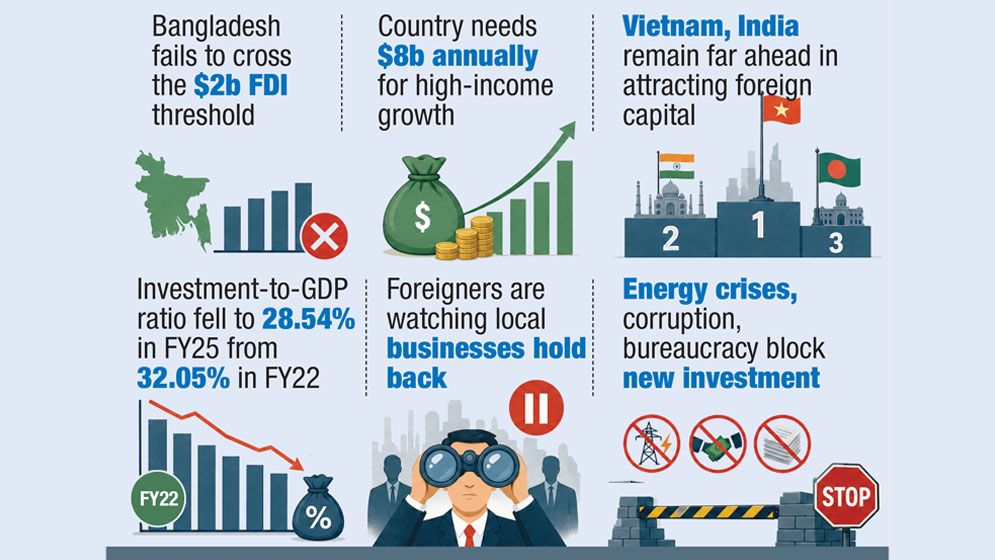
While regional neighbours draw tens of billions of dollars in foreign direct investment (FDI) annually, Bangladesh remains trapped in a low-investment cycle, struggling to cross even the $2 billion threshold.
Economists and business leaders warn that the challenge has evolved beyond a simple loss of foreign confidence.
Increasingly, local Bangladeshi investors are holding back – a trend experts say delivers the most damaging signal of all to the international community.
“Foreign investors first observe domestic investors,” Dr Mustafa K Mujeri, former chief economist of Bangladesh Bank, told the Daily Sun.
“If local investors are not expanding investment, foreigners naturally become cautious. They assume local businesses understand the risks better than anyone else.”
This warning comes at a critical juncture for the economy, which is battling slowing private sector investment, rising debt obligations, persistent energy shortages, and fierce competition from regional manufacturing rivals like India and Vietnam.
Far below potential
There are signs of recovery. According to the latest Bangladesh Bank survey, net FDI inflows rose by 39.36% in 2025 to $1.77 billion, up from $1.27 billion in 2024.
To achieve its ambition of becoming a high-income economy, Bangladesh needs an estimated $8 billion in annual FDI. Currently, its FDI-to-GDP ratio sits at an inadequate 0.3%.
The regional disparity is stark. Vietnam attracted nearly $36 billion in FDI commitments in 2024, while India secured over $28 billion.
Even smaller Southeast Asian economies, such as Cambodia, are outperforming Bangladesh in greenfield manufacturing.
Rupali Chowdhury, president of the Foreign Investors’ Chamber of Commerce & Industry (FICCI) and managing director of Berger Paints Bangladesh Ltd, argued that the country’s main hurdle is global competitiveness.
“Investors compare countries and ask why Bangladesh should be chosen over alternatives such as Vietnam – that is the first filter,” Rupali Chowdhury told the Daily Sun.
She highlighted infrastructure, logistics, and policy inconsistency as major constraints.
“Investors entering 20-to-25-year contracts often face unexpected changes in gas pricing and other terms. Without predictable revision mechanisms, disputes arise and confidence weakens.”
A domestic slowdown
The domestic indicators are equally concerning.
Official data from the Bangladesh Bureau of Statistics (BBS) reveals that the investment-to-GDP ratio has steadily declined from 32.05% in FY22 to 28.54% in FY25.
Local business owners report that expansion plans are stalled due to erratic gas pressure, load-shedding, and bureaucratic delays in securing utility connections.
Political transition has further fueled this hesitation. Many foreign firms adopted a “wait-and-see” approach following the 2024 national vote.
Mahmud Hasan Khan, president of the Bangladesh Garment Manufacturers and Exporters Association (BGMEA), emphasized that rising raw material costs and energy shortages are squeezing exporters.
“An investor cannot establish a factory without a guaranteed energy supply,” Mahmud Hasan told the Daily Sun, adding that the issue is critical as Bangladesh attempts to pivot toward high-value sectors like electronics and pharmaceuticals.
Institutional friction
Despite the introduction of a government “One-Stop Service,” businesses complain that implementation is weak.
“There is a one-stop service in theory,” one foreign investor remarked. “But in practice, businesses still move from office to office.”
Corruption, informal payments, and fears that agreements signed under one administration might be torn up by the next continue to deter capital.
Economist M Masrur Reaz warned that weak revenue mobilization, poor project governance, and political influence in project selection are exacerbating these economic vulnerabilities.
He called for stronger tax systems, deeper capital markets, and greater transparency in public investment.
Reflecting on the data, Ashik Chowdhury, executive chairman of the Bangladesh Investment Development Authority (BIDA), acknowledged that while the 39.36% rise in net FDI is encouraging, absolute inflows remain below potential.
He noted that global greenfield investment declined in 2025, hit developing economies hard, and stated that BIDA is focusing on structural readiness.
“With current global conditions still uncertain, we are preparing so that when the tide turns, Bangladesh is better placed to compete for serious capital,” he said.
Yet, until internal structural issues are resolved, the outlook remains challenging.
As Dr Mujeri concluded, “If local entrepreneurs do not feel secure enough to invest, foreign investors will never feel fully confident either.” Recommended Stories