




 For all latest news, follow the Daily Sun's Google News channel.


New budget to tame inflation or fuel it further?
Govt vows inflation control, but policies raise fresh price fears

As Bangladesh prepares to unveil what could be its largest-ever national budget for FY2026-27, the government is projecting an ambitious vision of lowering inflation, accelerating growth and expanding social protection. Yet economists, businesses and consumers fear that many of the policies being considered to finance the record budget may intensify the inflationary pressure that households have endured for nearly four years.
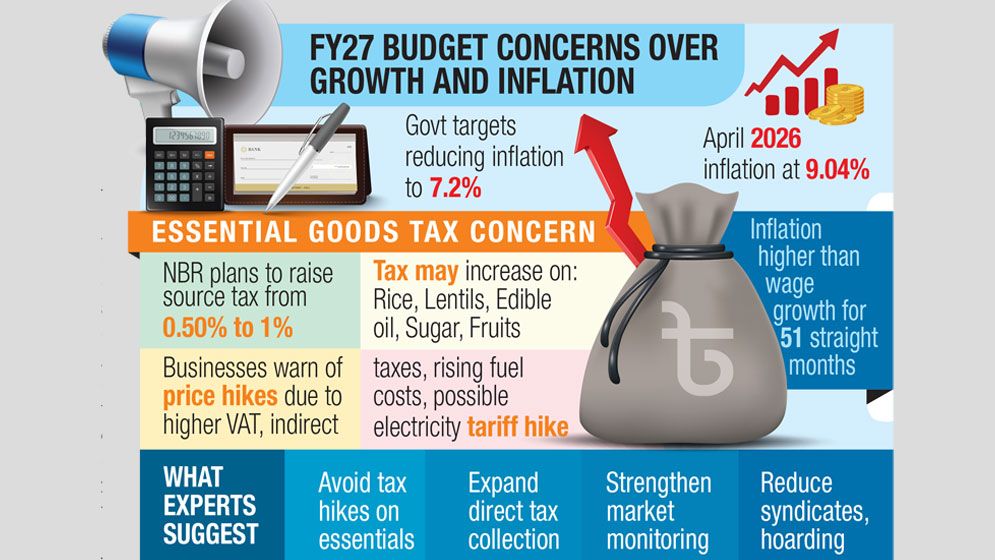
Finance ministry officials say that the upcoming budget may exceed Tk9.3 lakh crore, alongside a revenue target approaching Tk6.95 lakh crore – both unprecedented in the country’s history. At the same time, the government aims to reduce inflation to around 7.2% next fiscal year and raise GDP growth to 6.3%.
However, analysts warn that achieving such aggressive revenue mobilisation amid weak income growth and persistent inflation could force the government to rely heavily on indirect taxes, VAT expansion and higher duties on essential goods – measures that eventually push prices higher for consumers.
The concern has become sharper following a proposal by the National Board of Revenue (NBR) to double source tax on the local supply of 28 essential agricultural and food products from 0.50% to 1%, according to NBR sources.
The proposed list includes rice, wheat, lentils, edible oil, sugar, potatoes, onions, garlic, flour, salt and fruits – products consumed daily by millions of households, they added.
The tax proposal is expected to be placed before Prime Minister Tarique Rahman in an upcoming meeting and could be incorporated into the national budget if approved, they said.The move has triggered widespread concern among businesses and economists who argue that increasing taxes on essentials directly contradicts the government’s stated goal of controlling inflation.
Inflation eases slightly, but pressure persists
According to data from the Bangladesh Bureau of Statistics (BBS), overall inflation stood at 9.04% in April 2026, while food inflation remained high at 8.39%.
Although inflation has moderated slightly from the double-digit levels recorded in 2024, economists say the relief remains limited because wage growth continues to lag behind rising living costs.
The wage growth rate in April stood at only 8.16%, meaning real incomes are still declining.
For more than four years, millions of Bangladeshi families have remained trapped in what economists describe as a “silent income squeeze” – earning marginally more on paper while losing purchasing power in reality.
BBS data shows wage growth has remained below inflation for 51 consecutive months since February 2022, steadily eroding the financial stability of low- and middle-income households.
The gap has become one of the defining features of Bangladesh’s post-pandemic economy.
In 2024, average inflation reached 10.33%, while wage growth averaged only 7.94%. Food inflation that year climbed to 11.28%, peaking at 14.10% in July – the highest in more than a decade.
Even in April 2026, non-food inflation remains stubbornly elevated at around 9.57%, driven by rising housing, healthcare, transport and utility costs.
Middle-income households across urban areas say they are cutting savings, reducing consumption and taking loans simply to maintain basic living standards.
“Prices may not be rising as fast as before, but incomes are still not keeping pace with it,” said Mohammad Selim, a private-sector employee in Dhaka. “Every month feels like the time of another survival budgeting.”
Revenue pressure versus inflation control
Economists say the contradiction between inflation control and aggressive revenue collection lies at the heart of the upcoming budget challenge.
To meet the proposed revenue target, the NBR would need an extraordinary jump in collection growth at a time when revenue expansion remains sluggish.
During the first eight months of the current fiscal year, revenue growth stood at only 12.4%.
According to finance ministry officials, the National Board of Revenue (NBR) is expected to get a collection target of around Tk6.04 lakh crore for the next fiscal year – a rise of more than 20% from the revised target of the current fiscal year.
The challenge is already becoming visible. To meet this year’s Tk5.03 lakh crore revenue target, the NBR would need to collect more than 36% higher revenue than last year, despite revenue growth reaching only 12.4% during the first eight months of the fiscal year. If current trends continue, revenue collection would need to rise by nearly 40% next year to meet the proposed target.
Economists warn that such pressure historically leads to increased dependence on indirect taxation.
Dr Mustafa K Mujeri, former chief economist of the Bangladesh Bank and executive director of the Institute for Inclusive Finance and Development, told the Daily Sun that inflationary pressure could intensify if revenue measures focus excessively on consumption taxes.
“When fuel prices rise or taxes increase, the impact spreads throughout the economy,” he said.
“Transport costs rise, production costs increase, and eventually consumers pay more for goods and services. The purchasing power of ordinary people declines further.”
He noted that VAT and source taxes are ultimately borne by consumers regardless of whether they are imposed on producers, suppliers or businesses.
Essential goods tax proposal sparks concern
Businesses fear the proposed increase in source tax on food and agricultural products may add fresh pressure to already elevated market prices.
Former Bangladesh Cold Storage Association president Mostofa Azad Chowdhury Babu said that companies usually treat source taxes as additional costs because recovering the amount from tax authorities later is often difficult in practice.
“Once the money goes to the NBR, businesses rarely get it back smoothly,” he said. “So the tax becomes part of the product cost and is added to market prices.”
He warned that raising taxes on essentials while food inflation remains high could further weaken consumer purchasing power.
The irony, analysts say, is that the same tax was previously reduced by the government to help stabilise prices.
In the latest budget, the interim administration cut source tax on these products from 1% to 0.50% specifically to ease inflationary pressure.
Now, amid continuing economic stress, the proposal is being reconsidered in the opposite direction.
Critics also point to an apparent policy reversal by the current NBR leadership.
Utility costs adding fresh strain
Alongside taxation concerns, rising fuel and utility prices continue to add pressure across the economy.
Repeated LPG price adjustments, higher transport costs and discussions surrounding possible electricity tariff increases have heightened anxiety among consumers and businesses alike.
Consumers Association of Bangladesh (CAB) Vice-President SM Nazer Hossain said that, “Ordinary people are already under severe pressure,” he said, adding that, “Expanding VAT or increasing taxes at this moment may worsen the burden further.”
He also criticised weak market monitoring and urged stronger action against syndicates, hoarding and extortion in essential goods markets.
Govt prioritising growth and social spending
Government officials argue that the larger budget is necessary to stimulate investment, support economic recovery and finance social protection programmes.
Officials said that the upcoming budget may include increased allocations for health, education, social safety nets and employment generation.
The Annual Development Programme (ADP) is also expected to expand significantly to support infrastructure projects and economic activity.
At the same time, the government is trying to maintain fiscal discipline while dealing with global economic uncertainty, high import costs and pressure on foreign exchange reserves.
Economists, however, caution that increasing budget size alone will not solve the country’s structural economic problems.
Bangladesh’s GDP growth slowed to 3.49% in FY25 – the lowest since the pandemic period – while investment growth has weakened and unemployment pressures remain elevated.
Each year, roughly 2 to 2.2 million people enter the labour market, intensifying the need for sustainable job creation.
Dr Mujeri said improving the quality and efficiency of public spending is now more important than simply increasing expenditure.
“Large budgets do not automatically deliver public welfare,” he said.
“Without accountability, efficiency and proper implementation, higher spending can increase inflationary pressure without improving people’s living conditions.”
The reporter can be reached at: [email protected] Recommended Stories