


 For all latest news, follow the Daily Sun's Google News channel.


Every hour, more than a thousand people around the world die from strokes and heart attacks caused by hypertension that was never adequately treated. In Bangladesh, the figures are especially stark – and, experts warn, the situation is getting worse.
Hypertension has long overtaken other conditions to become the country’s single most prevalent disease.
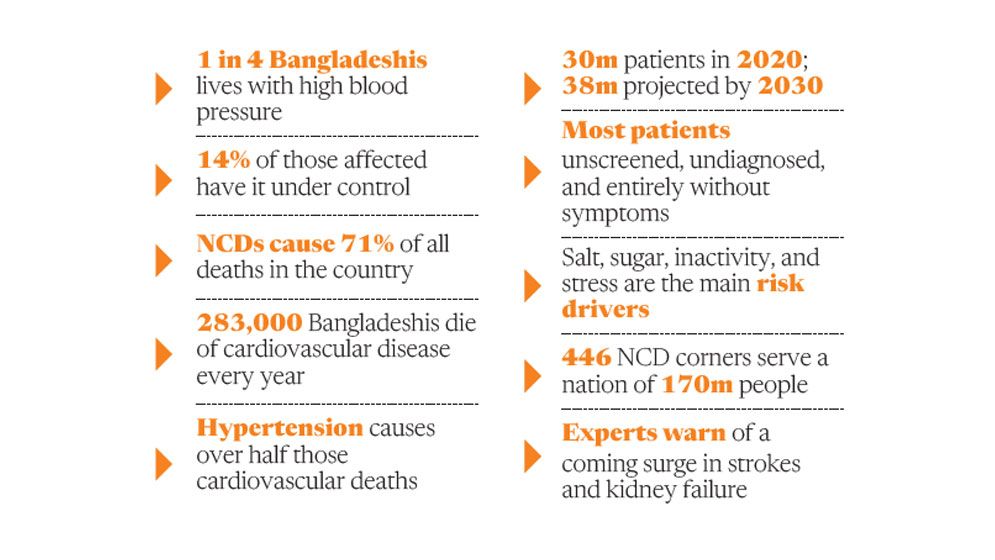
One in four Bangladeshis lives with high blood pressure, yet the vast majority remain unscreened, undiagnosed, and entirely unaware of the risk they carry.
Of the roughly 21% to 23% of the population affected, only 14% have their condition under control.
“The hypertension situation in Bangladesh is alarming,” said Professor Md Halimur Rashid, director of disease control at the Directorate General of Health Services, adding, “A large number of people remain outside the screening.”
The consequences cascade through the healthcare system and beyond.
Non-communicable diseases account for 71% of all deaths in Bangladesh – a proportion that reflects decades of shifting dietary habits, rising sedentary lifestyles and an ageing population. Premature mortality from those same conditions stands at 51%, a full ten points above the global average.
According to the WHO Global Report on Hypertension 2025, some 283,000 Bangladeshis die of cardiovascular disease every year, and more than half of those deaths are linked directly to high blood pressure.
The Bangladesh Demographic and Health Survey recorded 30 million hypertension patients in 2020. That number is projected to climb to 38 million by the end of the decade.
What makes this particularly troubling is the nature of the disease itself. Hypertension produces no obvious symptoms – no pain, no fever, no visible sign of distress.
It accrues damage silently, over years, to five organs: the heart, kidneys, brain, blood vessels and eyes.
By the time a patient presents with a serious complication, the underlying disease has often been untreated for a decade or more.
The WHO describes it plainly as a “silent killer”, and the label is apt.
“Increasing life expectancy, unhealthy lifestyles, high salt and sugar intake, and physical inactivity are among the main drivers,” said Professor Sohel Reza Choudhury, head of epidemiology and research at the National Heart Foundation of Bangladesh.
He argues that government intervention is essential – not merely in healthcare settings, but upstream, in food regulation and urban planning.
“Policies to increase physical activity facilities, ensure healthy levels of salt and sugar in foods, and make people aware of the problem are all necessary,” he said.
The government has not been entirely inactive.
Some 446 NCD corners have been established in upazila health complexes and district hospitals, providing screening and treatment for non-communicable diseases.
More than 918,000 hypertension patients and 731,000 diabetes patients have been digitally registered through these facilities. Officials say the network will be expanded.
But the scale of what remains unaddressed dwarfs what has been achieved.
Experts speaking at a seminar at Bangladesh Medical University on Friday pointed to the persistent gap between diagnosis and effective management.
BMU Vice-Chancellor Professor FM Siddiqui called for a revised drug policy centred on long-acting antihypertensive medications – which are more effective at maintaining stable blood pressure – and stressed the importance of treating the condition as a systemic priority rather than an individual one.
The risks, if the trajectory continues unchecked, are considerable.
Without mass screening, sustained treatment and meaningful lifestyle change, Bangladesh faces a sharp rise in heart attacks, strokes and kidney failure in the years ahead.
The WHO’s South-East Asia office places the regional challenge in sobering context.
Of the 273 million people in the region living with hypertension, more than 159 million remain unaware of their condition.
Nearly eight in ten have blood pressure that is not under control.
Dr Catharina Boehme, WHO’s officer-in-charge for South-East Asia, described the burden as placing significant pressure “on individuals, families, and health systems” across the region.
World Hypertension Day, observed each year on 17 May, falls today.
This year’s theme – “Controlling Hypertension Together” – frames the challenge as one that cannot be solved by clinicians alone.
It requires action, the WHO says, at every level: individuals monitoring their own blood pressure, families encouraging one another, communities reducing barriers to healthy living, and governments treating the epidemic with the urgency it demands.