





 For all latest news, follow the Daily Sun's Google News channel.


The sweet aroma of ripe litchi usually signals prosperity across northern Bangladesh every summer. In districts like Dinajpur, where thousands of farmers and traders depend on the seasonal fruit economy, the litchi harvest is more than agriculture – it is a multi-crore business driving local employment, transport, wholesale trade and rural consumption.
But this year, uncertainty is clouding the season.
Early heatwaves, drought, fuel shortages, storms and hailstorms have raised fears of lower production and financial losses in Dinajpur, one of the country’s largest litchi-producing regions.
Farmers said the season began with promise as orchards in Dinajpur Sadar, Biral, Chirirbandar, Kaharole and Bochaganj upazilas were filled with blossoms.
However, weather conditions soon turned hostile.
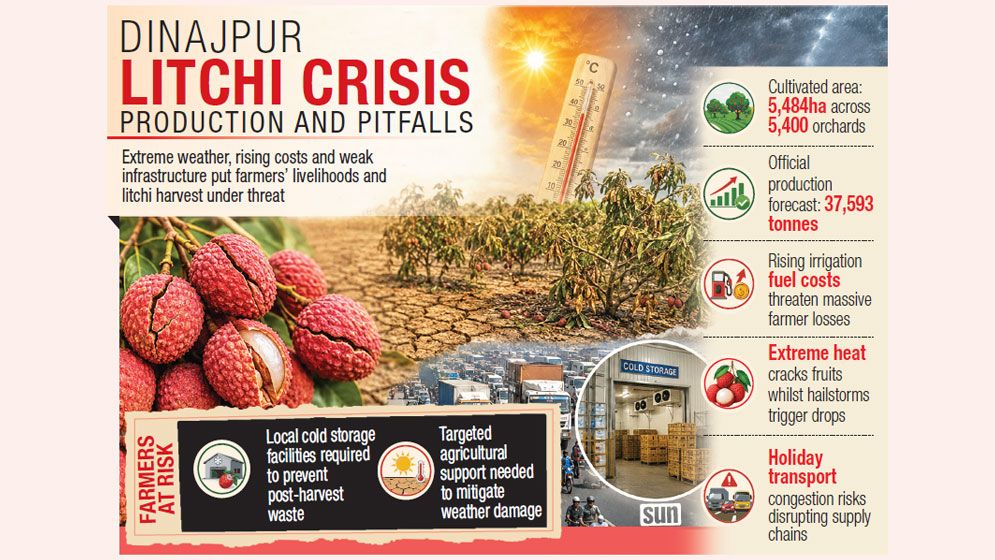
“At the beginning of the season, temperatures reached 35 to 37 degrees Celsius, while 33 degrees is considered ideal for litchi. The flower buds were damaged by extreme heat and morning fog,” said orchard owner Babul Mia from Mahabbatpur village in Dinajpur Sadar. “Now storms and hailstorms are causing further damage. Many litchis are falling from trees or cracking before maturity.”
Growers said repeated climatic shocks are making the litchi business increasingly unpredictable. Last year, severe heatwaves burned fruits on trees, forcing traders to sell at unusually low prices. This year, storms and irregular rainfall are threatening production despite relatively milder heat.
Farmers said insufficient rainfall during the early growing period affected fruit development, while fuel shortages increased irrigation costs and disrupted water supply in many orchards.
In recent weeks, Kalbaishakhi storms and hailstorms swept through several areas of Dinajpur, causing premature fruit drops. Traders said excessive moisture has also triggered rotting in some orchards.
“Every year we face a new disaster,” said farmer Moklesur Rahman from Madhabbati village in Biral upazila. “Last year the fruits burned in the heat. This year storms and rain are damaging them. We are again expecting losses like last season.”
“If storms continue, the fruits will rot at the roots,” he said. “We invested heavily this year expecting good business. Now even protecting our capital is becoming difficult.”
Despite the concerns, Dinajpur’s famous Bombay and China-3 varieties are expected to arrive in markets from mid-May or later.
Traders, however, warned that Eid-ul-Azha could create transport congestion and higher logistics costs, disrupting supply chains and pushing up retail prices.
“Transportation costs have increased significantly,” said orchard owner Jewel Islam from Chirirbandar upazila, where he cultivated litchi on three acres of land. “If transport costs rise further during Eid season, consumers will have to pay more.”
Storage limitations are adding to the pressure.
Unlike many export-oriented fruits, litchi is highly perishable and requires rapid transportation and cold-chain facilities. Farmers and traders said the lack of adequate cold storage in northern Bangladesh causes significant post-harvest losses every year.
“Thousands of tonnes of litchi are wasted because there are not enough preservation facilities,” said Jewel Islam. “If cold storage support existed, farmers could avoid major losses.”
Agriculture officials remain cautiously optimistic.
According to the Department of Agricultural Extension (DAE), litchi cultivation has been carried out on 5,484 hectares of land in Dinajpur this year through more than 5,400 orchards. Authorities expect production to reach around 37,593 metric tonnes.
As the first batches of litchi prepare to enter markets this week, farmers and traders are once again hoping favourable weather and strong consumer demand will help rescue a season hanging between profit and loss.