



 For all latest news, follow the Daily Sun's Google News channel.


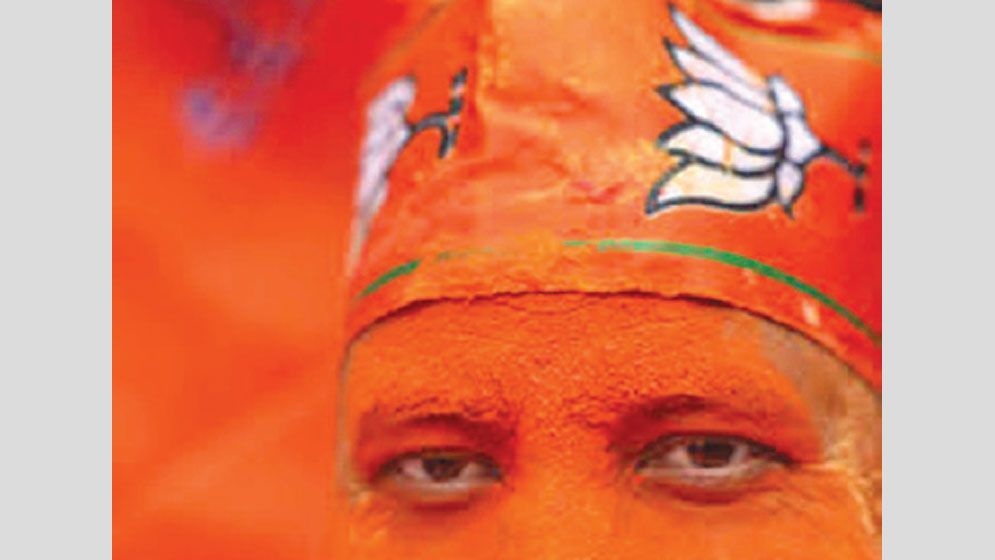
The 2026 West Bengal Legislative Assembly election will be remembered in Indian electoral history not merely as a date on a calendar, but as the witness to the collapse of a long-standing political hegemony.
The ascension of Bharatiya Janata Party (BJP) to the throne of West Bengal, ending fifteen years of Trinamool Congress (TMC) rule, is no ordinary transfer of power.
It represents a fundamental evolution in the state’s psychology, demographics and long-cherished political philosophy.
In 2011, Mamata Banerjee ended decades of Left rule with the slogan of ‘Parivartan’ (Change). About 15 years later, TMC camp was swept away by a “Saffron Storm” of similar intensity. An analysis of this historic victory reveals that TMC’s unexpected debacle was not the result of a single factor; rather, it was a complex interplay of fierce anti-incumbency, monumental corruption allegations, and a new synthesis of Hindutva politics with Bengali identity.
One of the most debated aspects of the 2026 election remains the unprecedented voter turnout. West Bengal recorded an average turnout of 92.47 % across two phases, which is a figure unheard of in the history of parliamentary democracy.
This massive turnout has birthed two opposing narratives. BJP explains it as a “spontaneous explosion of public anger” against TMC’s misrule, suggesting that citizens flocked to booths to vent years of suppressed grievances. Conversely, TMC has alleged “voter engineering” by pointing to the Systemic Identification and Removal (SIR) process, where nearly nine million names, predominantly from Muslim and SC/ST communities, were reportedly removed from the rolls. This controversy over the electoral process has cast a long shadow over the transparency of the transition.
Historically, TMC’s core strength was its “women’s vote bank”. Through schemes like “Lakshmir Bhandar”, Mamata Banerjee provided a semblance of financial security to women at the grassroots level.
However, in 2026, this financial incentive failed to outweigh the demand for personal safety and justice.
The aftermath of the R.G. Kar Medical College incident and subsequent statewide protests resonated far beyond urban centres, creating a sense of insecurity among rural women. When the very women of Bengal, whom Mamata claimed to represent, took to the streets against her, the foundation of TMC fortress began to crumble.
BJP successfully organised this public resentment by convincing a significant portion of the electorate that a small monthly allowance is no substitute for dignity or life’s security.
The Muslim vote, comprising nearly 30% of the electorate, has traditionally been the kingmaker in West Bengal. While this bloc previously stood solidly behind TMC, 2026 saw a major fracture. The rise of alternative leadership, such as the Indian Secular Front (ISF) led by Naushad Siddiqui, offered the younger Muslim generation a vision beyond the politics of “fear-based voting”.
Furthermore, a three-way split caused by the Left-Congress-ISF alliance and the presence of AIMIM significantly benefited the BJP. Beyond religious polarisation, the lack of employment opportunities and the plight of migrant workers alienated Muslim youth from TMC, pushing them towards alternative political identities.
After 15 years of continuous rule, anti-incumbency is inevitable. For TMC, it was exacerbated by systemic corruption. The massive recruitment scams in the education sector, which left thousands of qualified candidates protesting on the streets, deeply unsettled the Bengali middle class.
A new generation of voters, who had seen no other administration but TMC’s, sought a change in governance. The failure to industrialise and the increasing reliance on doles rather than sustainable jobs turned the tide. BJP capitalised on this frustration by promising a “Double Engine” government, aligning the state with the central administration to bring direct central benefits and industrial growth to the people.
In the 2021 elections, Mamata Banerjee successfully resisted BJP by invoking Bengali pride against “outsiders”. By 2026, the appeal of this secular Bengali identity began to wane.
BJP successfully integrated its political philosophy with the religious sentiments of Bengali Hindus. The construction of Ram Mandir and the central leadership’s powerful Hindutva narrative managed to penetrate the state’s traditional cultural fabric.
BJP’s long-standing accusation of “appeasement politics” against TMC finally gained widespread traction. Consequently, for a large section of the electorate, religious identity began to take precedence over linguistic or ethnic identity.
The political shift of 2026 marks the beginning of a new and uncertain chapter in West Bengal. The defeat of TMC proves that populist schemes and doles cannot indefinitely suppress the fundamental demands for justice, security and transparent administration.
While BJP’s victory is a product of both TMC’s failures and their own organisational persistence, the fall of a charismatic leader like Mamata Banerjee leaves a significant vacuum in the region’s politics. For neighbouring Bangladesh, this shift is of immense geopolitical importance.
As the “Lotus” establishes its dominance over the land of red soil, only time will tell if this change heralds a new era of regional instability. One truth is clear: as of May 2026, West Bengal is no longer the same.
_______________________________________________
The writer is a Senior Lecturer, Department of Global Studies & Governance, School of Liberal Arts and Social Sciences, Independent University, Bangladesh, and PhD Candidate, Centre for Global Sustainability Studies, Universiti Sains Malaysia, Malaysia. He can be reached at [email protected]
Read More