





 For all latest news, follow the Daily Sun's Google News channel.


Will 1/11 plotters face trial for crimes against humanity?
Enforced disappearances, ‘AynaGhor’ (secret prisons), and extrajudicial killings trace their roots back to 1/11
Special Correspondent
Published: 12 May 2026, 12:00 AM
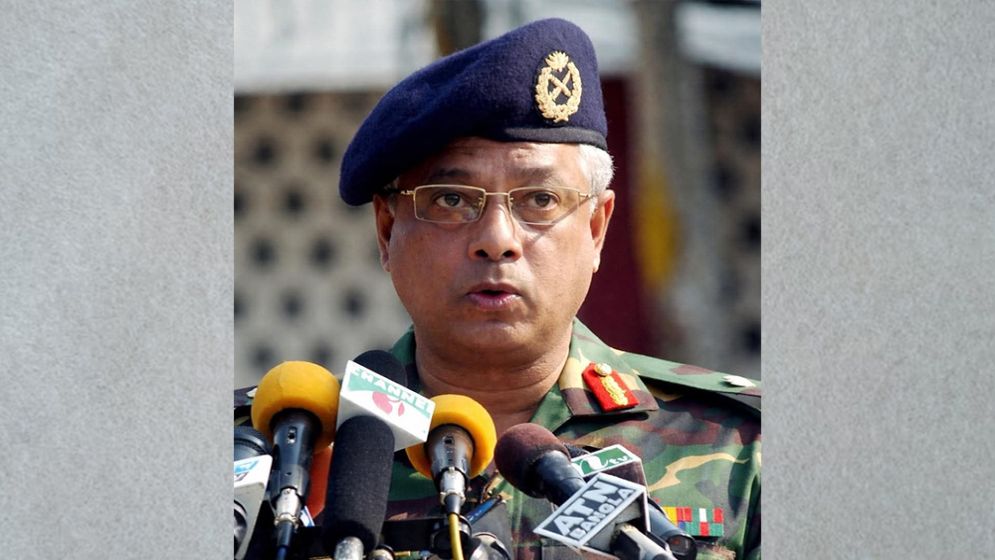
Lieutenant General (Retd.) Masud Uddin Chowdhury. File Photo
The Chief Prosecutor of the International Crimes Tribunal (ICT), Mohammad Aminul Islam, has stated that Lieutenant General (Retd.) Masud Uddin Chowdhury was the “main hero” behind the inhumane acts and crimes against humanity committed during the 1/11 interim government.
The Chief Prosecutor made these remarks during a briefing at his office at the Tribunal last Sunday.
Last Thursday, Tribunal-2 showed Masud Uddin arrested in a case involving crimes against humanity committed during the July mass uprising. On the same day, the Tribunal granted permission for a one-day interrogation. However, the Chief Prosecutor clarified that he is being questioned specifically regarding the inhumane acts and crimes against humanity associated with the 1/11 era.
This clearly indicates that preliminary evidence has been found to bring the 1/11 conspiracy, the subsequent oppression, torture, disappearances, killings, and extortions under the jurisdiction of international criminal law.
Section 3(1)(a) of the International Crimes (Tribunals) Act defines Crimes Against Humanity as:
“...murder, extermination, enslavement, deportation, imprisonment, abduction, confinement, torture, rape or other inhumane acts committed against any civilian population or persecutions on political, racial, ethnic or religious grounds, whether or not in violation of the domestic law of the country where perpetrated.”
An analysis of this section shows that many illegal activities carried out during the 1/11 period fall under this definition. This implies that most of what the government of Fakhruddin Ahmed and Moeen U. Ahmed did after January 11, 2007, constitutes crimes against humanity.
For instance, extrajudicial killings occurred under the 1/11 regime. Immediately after taking power, people were killed in so-called “crossfires” under the guise of arms recovery. According to Amnesty International, 67 people were extrajudicially killed during that period. The culture of extrajudicial killings, disappearances, and the inception of “AynaGhor” in Bangladesh began during 1/11.
During this time, innocent people were tortured, detained without trial, and forced into exile. Over a thousand political leaders and activists—including BNP Chairperson the late Begum Khaleda Zia, the current Prime Minister [sic], BNP Chairman Tarique Rahman, the late Arafat Rahman Koko, and Awami League President Sheikh Hasina—were detained without trial. Notably, brutal torture was inflicted upon Tarique Rahman under the direct orders of Masud Uddin. All of these qualify as crimes against humanity.
Chief Prosecutor Aminul Islam mentioned that the 1/11 government was often referred to as a “De Facto Government,” involving Masud Uddin and a few others. They effectively ran the entire administration. Consequently, the investigative agency and prosecution have gathered information through interrogation, with more expected to surface. The statements provided by him are currently being verified, and he may be questioned again if necessary.
Recent investigations have begun to reveal sensational information. Findings show that Tarique Rahman was arrested from his Cantonment residence on March 7, 2007.
Investigating officers stated that, following orders from senior military officials, Colonel (Retd.) Imran arrested him from his Mainul Road residence without specific charges and took him to the DGFI Joint Interrogation Cell (JIC). The decision to arrest Tarique Rahman was made at Army Headquarters in the presence of General Moeen and Brigadier General ATM Amin. The primary architects of this arrest were Lt. Gen. Masud Uddin and several representatives of “civil society.”
According to Major Imran, he arrived at Khaleda Zia’s residence with a runner and a driver. The house was surrounded by heavy security. Major Imran entered through the main gate but remained inside his vehicle. After about three hours, Tarique Rahman emerged, and Major Imran took him into the car. Shortly into the journey, the runner covered Tarique Rahman’s face with a black cloth. Tarique Rahman requested to open the window, but Major Imran refused, citing security concerns.
Subsequently, CTIB officials began interrogating Tarique Rahman. The then-Acting Colonel GS of CTIB, Lt. Col. (Retd.) Saiful Islam Joarder, was present. Under his direction, other officers subjected Tarique Rahman to vile verbal abuse. He was kept at the JIC for three to four days, where he was blindfolded for hours, hung by his tied hands, and subjected to prolonged, barbaric physical torture.
Tarique Rahman was brought to the JIC twice. In December 2007, he was interrogated there for several consecutive days. Retired Colonel Abdur Rob Khan stated in his testimony that a forced confessional statement was recorded from Tarique Rahman under the orders of Lt. Col. (Retd.) Saiful Islam Joarder. In that statement, it was claimed that Tarique Rahman sought forgiveness from the nation for his mistakes.
The investigation has also identified those present during these sessions. Four high-ranking military officers were present throughout to extract the statement: Lt. Col. (Retd.) Saiful Islam Joarder, Lt. Col. (Retd.) Abdur Rob Khan, Lt. Col. (Retd.) Zahid Hossain, and Major (Retd.) Monir. The torture left Tarique Rahman nearly crippled.
He was unable to walk normally. A report on his torture has been prepared. It notes that the now-arrested Lt. Gen. (Retd.) Masud Uddin Chowdhury provided a statement regarding this. According to the statement, when Tarique Rahman was released on parole in January 2008 following the death of his maternal grandmother, Masud Uddin observed him limping. Lt. Col. (Retd.) Abdur Rob Khan admitted during questioning that the torture was carried out under the orders of General (Retd.) ATM Amin, which included hanging Tarique Rahman from the ceiling.
Warrant Officer Fazlu stated during interrogation that Brigadier Amin told them he should remain hanging until further notice. At one point, he fell from the ceiling and suffered severe waist injuries.
Investigating officers believe Masud Uddin did not plan these tortures alone. He was supported by a section of “civil society” who were the masterminds of 1/11. The former military officer stated that the army was initially not in favor of arresting Begum Zia and Tarique Rahman, but representatives of civil society—specifically two editors—exerted significant pressure for their arrest.
During 1/11, businessmen and industrialists were harassed by being labeled “corrupt,” and money was illegally extorted from them. Many entrepreneurs were detained for months without any crimes. All these acts fall under the jurisdiction of the International Crimes Tribunal.
Therefore, the time has come. The ICT should be tasked with investigating all crimes committed during the 1/11 period. This dark chapter must be revealed to the nation impartially so that no one can seize power in this manner again. Action must be taken against everyone involved.
To permanently block the path of a conspiracy, one must find its source. Once the source is found, it must be completely shut down; otherwise, conspirators will seize new opportunities. 1/11 is a “malignant wound” in Bangladesh’s political history.
The seeds of the conspiracy to establish a long-term rule by unelected civil society members in 2007 have deep roots. The actual 1/11 plotters are still at large and are more powerful now than in 2007 because no action was taken against the masterminds of this “depoliticisation” after the 2008 elections. Instead, they organized themselves through various think tanks.
Even before the 12 February elections, they attempted to foil the polls until the very last moment. It would be a mistake to assume they have accepted democracy and elections. They are attempting to hatch new plans and reorganize.
The 1/11 conspiracy and democracy cannot coexist. Thus, the arrest of Masud Uddin Chowdhury for crimes against humanity is a positive step. The public expects the International Crimes Tribunal to immediately initiate an investigation into the events of 1/11.
Read More