


 For all latest news, follow the Daily Sun's Google News channel.


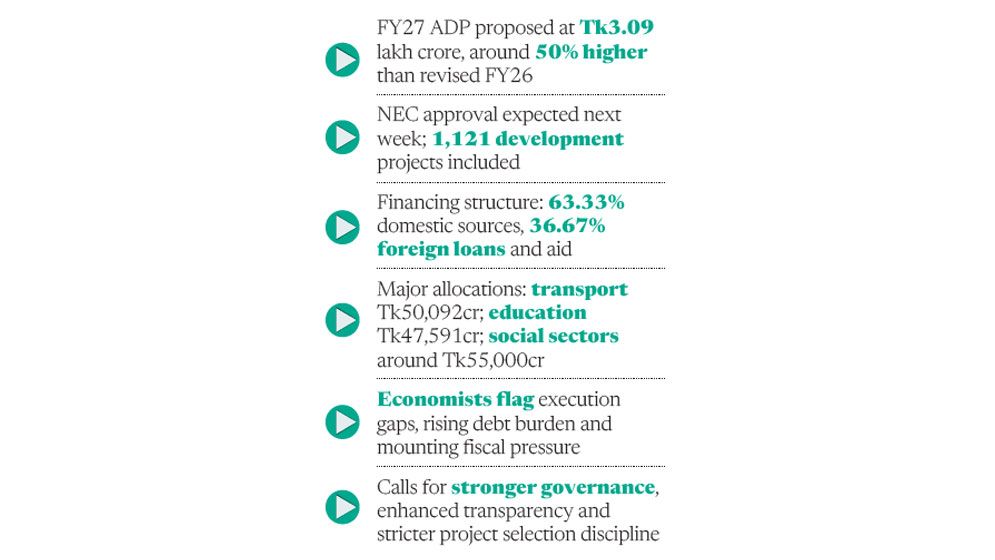
The Planning Commission has finalised a record Annual Development Programme (ADP) worth around Tk3.09 lakh crore for the 2026-27 fiscal year, marking Bangladesh’s largest-ever public development budget at a time when implementation performance has fallen to historic lows.
The proposed ADP was approved at an extended meeting on Saturday at the NEC conference room of the Planning Commission.
This will be placed before the National Economic Council for final approval during a meeting scheduled for 18 May, a senior Planning Commission official told the Daily Sun.
The sharp increase in development spending comes despite mounting concerns over institutional inefficiency, weak governance, growing fiscal pressure and Bangladesh’s increasing dependence on foreign borrowing.
Planning Commission officials said the proposed ADP is nearly 50% higher than the revised allocation for the current fiscal year, reflecting the government’s continued emphasis on infrastructure and social sector investments despite severe implementation bottlenecks.
However, the timing of the expansion has raised questions among economists and policy analysts.
Official data show that only 36.19% of the current fiscal year’s ADP was implemented during the first nine months of FY26, leaving nearly two-thirds of the programme unfinished with only one quarter remaining.
Officials privately acknowledged that meeting the remaining implementation target within such a short timeframe is highly unlikely.
Largest development budget
Under the proposed FY27 ADP, the government plans to finance Tk1.90 lakh crore, or 63.33% of the total allocation, from domestic resources.
Another Tk1.10 lakh crore, or 36.67%, is expected to come through foreign loans and assistance from development partners, highlighting Bangladesh’s growing reliance on external financing for major development projects.
The original ADP for the current fiscal year stood at around Tk2.39 lakh crore.
However, amid fiscal constraints, weak revenue collection and sluggish project implementation, the government later revised the allocation downward to around Tk2.09 lakh crore. Compared with the revised figure, the proposed FY27 ADP represents an increase of Tk91,065 crore.
Including self-financed projects undertaken by autonomous bodies and state-owned corporations, the total size of the development programme is projected to reach Tk3.09 lakh crore.
The proposed allocation covers the implementation of 1,121 projects across ministries and government agencies.
Infrastructure, social sectors dominate spending
Sector-wise, transport and communication will receive the highest allocation at Tk50,092 crore, underscoring the government’s continued prioritisation of large-scale infrastructure development.
The education sector has been allocated Tk47,591 crore, while Tk55,000 crore has been earmarked for special needs and social development assistance programmes.
Officials said the proposed budget aims to maintain economic activity, strengthen social protection and continue strategic infrastructure investments despite growing economic challenges.
However, economists argue that expanding allocations alone cannot guarantee development outcomes without corresponding improvements in implementation capacity and governance standards.
Weak implementation raises alarm
Bangladesh’s ADP implementation performance has steadily deteriorated in recent years.
In FY25, the country recorded its lowest-ever implementation rate at 67.85%.
Out of a total allocation of Tk2.26 lakh crore, ministries and divisions collectively managed to spend only Tk1.53 lakh crore by the end of the fiscal year, leaving nearly one-third of the budget unutilised.
The current fiscal year has shown even weaker momentum.
Government officials attributed the slowdown partly to expenditure controls, funding shortages and the suspension of several politically motivated projects approved under previous administrations.
As a result, implementation during the first nine months of FY26 remained stuck at 36.19%.
To achieve annual targets, authorities would now need to implement 63.81% of the programme within the final quarter – a pace analysts describe as virtually impossible.
Economists warn against waste, irregularities
Economists have urged the government to exercise stricter discipline in project selection, approval and implementation, warning that larger development budgets without stronger institutional oversight could deepen corruption and waste.
Dr Mustafa K Mujeri, former chief economist of Bangladesh Bank, told the Daily Sun that Bangladesh must learn from past failures in public project management.
“Development projects in Bangladesh have often involved excessive expenditures on foreign trips, furniture procurement and unnecessary infrastructure components where significant irregularities frequently occur,” he said.
Dr Mujeri stressed the need for greater transparency, accountability and fiscal discipline in public spending.
“If implementation capacity is not strengthened, the risk of wastage in development projects will remain high,” he warned.
He added that eliminating corruption and ensuring accountability should become central priorities if Bangladesh wants to achieve sustainable economic development.
Mounting fiscal and debt pressures
The widening disconnect between ambitious development targets and weak execution capacity is increasingly becoming a major macroeconomic concern for Bangladesh.
The country is already facing rising external debt repayment obligations, pressure on foreign exchange reserves, persistent inflation and slower private sector investment growth.
Analysts warn that delays in project completion and inefficient spending could further reduce the economic returns expected from large-scale public investments.
For many economists, the challenge is no longer about announcing bigger budgets but ensuring that public spending generates measurable economic value.
Economist and public policy expert Dr M Masrur Reaz described the increasing reliance on foreign financing in the upcoming ADP, around 52%, as a “warning signal” for the economy.
He told the Daily Sun that the trend reflects longstanding weaknesses in fiscal management, which have become more pronounced in recent years.
He said Bangladesh’s revenue mobilisation system remains structurally weak, while modern financing instruments such as the bond market have not been effectively utilised.
He also pointed out that political influence and unnecessary expenditure have undermined the quality of development projects, further increasing dependence on external borrowing.
Dr Reaz emphasised that addressing these challenges would require a three-pronged approach: strengthening the tax system, expanding the use of both domestic and global capital markets, and ensuring greater transparency and discipline in project selection.
In his view, such reforms are essential to gradually steer the economy toward a more stable and sustainable path.