


 For all latest news, follow the Daily Sun's Google News channel.


Logistics bottlenecks eroding export advantage: DCCI
Chamber urges integrated port, rail, digital logistics reforms to cut business costs
Daily Sun Report, Dhaka
Published: 10 May 2026, 12:00 AM
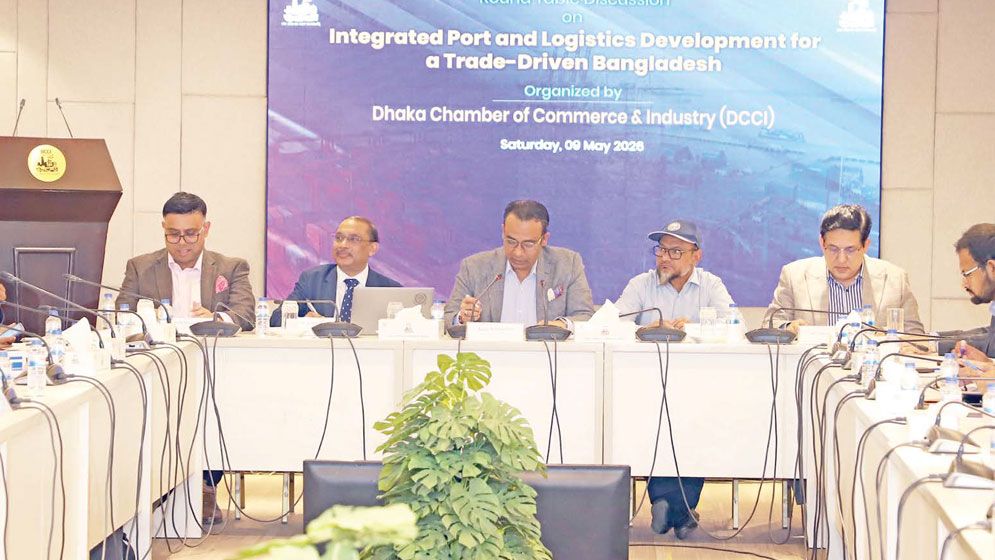
The Dhaka Chamber of Commerce and Industry (DCCI) has warned that persistent weaknesses in Bangladesh’s logistics and port management systems are eroding export competitiveness, inflating business costs and discouraging investment at a time when the country is striving to diversify its export base.
Business leaders, policymakers and development partners at a high-level roundtable on Saturday said Bangladesh could struggle to sustain trade growth momentum amid intensifying global competition unless it develops an integrated and efficient logistics ecosystem.
The observations came at a discussion titled “Integrated Port and Logistics Development for a Trade-Driven Bangladesh” organised by DCCI in Dhaka.
Addressing the event, DCCI Senior Vice President Razeev H Chowdhury said infrastructural bottlenecks, lengthy cargo clearance procedures and weak institutional coordination are significantly increasing the cost of doing business in Bangladesh.
“Bangladesh is falling behind competing countries due to inefficiencies in ports, transport connectivity and supply chain management,” he said, adding that delays in road and rail transportation, alongside inadequate cold-chain logistics facilities, are undermining export efficiency.
He called for the rapid introduction of paperless and automated systems at ports, expansion of logistics infrastructure through Public-Private Partnership (PPP) initiatives and greater investment in modern cold-chain facilities to attract both local and foreign investment.
Presenting the keynote paper, Dr M Masrur Reaz, chairman and CEO of Policy Exchange Bangladesh, said Bangladesh’s manufacturing sector contributes around 25% to GDP, yet export earnings remain heavily concentrated in a limited range of products and markets.
He noted that reducing logistics costs by 25% could boost exports by nearly 20%, while a 1% reduction in transport costs could increase exports by 7.4%.
“Export diversification will remain difficult without improving logistics efficiency, trade infrastructure and policy support,” he observed.
Dr Reaz also stressed the need for effective implementation of the national logistics policy, faster container clearance at Chattogram Port and greater private sector participation in port management.
Special guest Md Salim Ullah, director general of the Bangladesh Institute of Management (BIM), said Bangladesh remains significantly behind in integrated logistics management, resulting in rising operational costs for businesses.
Former Chittagong Port Authority member Md Habibur Rahman said expanding railway connectivity with ports is the only sustainable long-term solution, as there is limited scope for further widening the Dhaka-Chattogram highway corridor.
Experts at the event also highlighted the need for structural reforms, digitisation of customs procedures and modernisation of inland waterway logistics to reduce delays and improve supply chain efficiency.
Nusrat Nahid Babi, senior transport specialist at the World Bank, said customs clearance systems, particularly at land ports, remain insufficiently modernised, contributing to prolonged cargo release times and higher logistics costs.
Meanwhile, Humayun Kabir, senior project officer (transport) at the Asian Development Bank, said the ADB is currently working on the development of the Dhirashram Inland Container Depot and a multimodal logistics hub project. He also emphasised the importance of ensuring digitisation and automation across all levels of logistics services.