


 For all latest news, follow the Daily Sun's Google News channel.


Public to race for matching govt’s budget vision
Stakeholders fear higher VAT, utility costs and shrinking purchasing power

As Bangladesh prepares its national budget for the 2026-27 fiscal year, concern is growing among middle-income families already struggling with persistent inflation, rising utility costs and stagnant incomes.
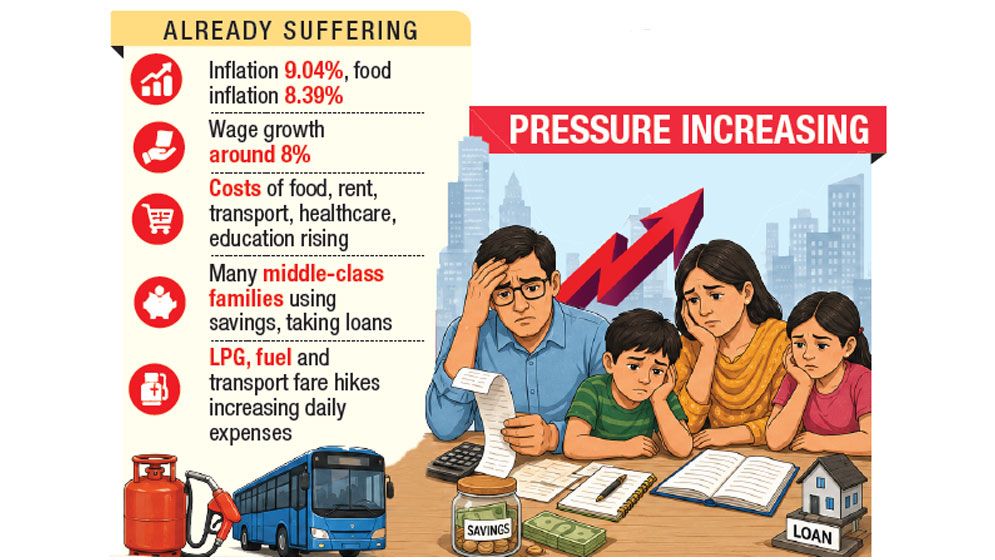
According to the Bangladesh Bureau of Statistics (BBS), inflation stood at 9.04% in April, while food inflation reached 8.39%, one of the highest levels recorded in the past year. Wage growth, however, remained around 8%, meaning real incomes continued to decline. Economists say this gap between inflation and wage growth has steadily eroded household purchasing power over the past four years.
The government is finalising what is expected to be one of the country’s largest budgets ever, estimated at around Tk9.3 lakh crore, alongside an ambitious revenue collection target of nearly Tk6.95 lakh crore. Economists warn that meeting such a large revenue goal could increase pressure on ordinary consumers through higher taxes, VAT and indirect duties.
According to finance ministry officials, the National Board of Revenue (NBR) is expected to get a collection target of around Tk6.04 lakh crore for the next fiscal year – a rise of more than 20% from the revised target of the current fiscal year.
The challenge is already becoming visible. To meet this year’s Tk5.03 lakh crore revenue target, the NBR would need to collect more than 36% higher revenue than last year, despite revenue growth reaching only 12.4% during the first eight months of the fiscal year. If current trends continue, revenue collection would need to rise by nearly 40% next year to meet the proposed target.

Economists say such aggressive revenue expansion often results in increased VAT and indirect taxation, costs that are eventually passed on to consumers through higher prices of goods and services.
For Bangladesh’s middle class, the pressure has already been building for years. Food prices, rent, transport costs, healthcare expenses and education costs have continued rising, while salaries in many sectors have remained largely unchanged.
Middle class under increasing pressure
Many middle-income families are now relying on savings, taking additional jobs or depending on loans to maintain basic living standards.
The pressure has intensified further following repeated increases in LPG prices and higher fuel costs, which have pushed up transportation and production expenses across the economy. Discussions over possible electricity price adjustments have also added to public anxiety over future living costs.
Dr Mustafa K Mujeri, former chief economist of the Bangladesh Bank and Executive Director of the Institute for Inclusive Finance and Development (InM) said the timing of further utility price increases would place additional pressure on households already burdened by prolonged inflation.
“When fuel prices increase repeatedly, the impact spreads across the entire economy. Transport costs rise, production costs increase, and eventually consumer goods become more expensive. As a result, people’s purchasing power declines further,” he told Daily Sun.
He warned that a larger budget usually means greater pressure to collect revenue, often through indirect taxation. “VAT is ultimately paid by consumers through product prices, regardless of whether it is imposed on producers or businesses,” he said.
Economists believe the middle class is currently under the greatest strain because they receive little support from social safety programmes while lacking the financial resilience of higher-income groups.
Dr Mujeri said prolonged inflation had already depleted much of the middle class’s savings. “Many people also have savings trapped in weak banks, while new employment opportunities are not being created fast enough. Educated unemployment is rising, particularly among middle-income families,” he added.
According to BBS data, Bangladesh’s GDP growth slowed to 3.49% in FY25, the lowest since the pandemic period. Growth in agriculture and services has weakened, while the investment-to-GDP ratio has fallen to 28.54%.
Economists warn that without stronger private and public investment, job creation will remain insufficient. Each year, around 2 to 2.2 million people enter the labour market, increasing pressure on employment generation.
The government argues that higher public spending is necessary to stimulate investment and economic growth, while greater revenue mobilisation is required to finance development spending.
Alongside the large budget, the government has also set targets to raise GDP growth to 6.3% and reduce inflation to 7.2% in the next fiscal year. The size of the Annual Development Programme (ADP) is also expected to increase to support infrastructure investment and employment generation.
However, analysts caution that increasing budget size alone will not solve economic pressures unless spending quality improves.
Dr Mujeri said past experience showed that large projects often failed to deliver expected public benefits due to corruption, inefficiency and wasteful expenditure. “Ensuring accountability and improving the quality of spending are now more important than simply expanding the size of the budget,” he said.
Consumer rights activists have also raised concerns over the possible expansion of VAT collection at the grassroots level.
Vice-President of the Consumers Association of Bangladesh (CAB), SM Nazer Hossain, said rising fuel prices, transport fare increases, global conflict and recent flooding had already driven up prices of essential goods.
“Ordinary people are now facing a very difficult reality, especially low and fixed-income groups,” he said.
He warned that expanding VAT coverage further could increase pressure on consumers because businesses usually transfer all additional costs - including taxes, bank interest and unofficial expenses - directly to buyers.
Hossain also criticised weak market monitoring, saying stronger action was needed against market syndicates, hoarding and extortion to keep prices stable. He urged the government to expand social safety programmes, increase Trading Corporation of Bangladesh (TCB) support cards and reduce import duties on essential commodities to protect consumers.
_____________________________________________
The reporter can be reached at [email protected]