



 For all latest news, follow the Daily Sun's Google News channel.


Soaring prices of essentials push fixed-income families to the brink
Market analysts and economists warned that the cumulative impact of the hikes could worsen inflationary pressure and reduce the purchasing power of fixed- and low-income families

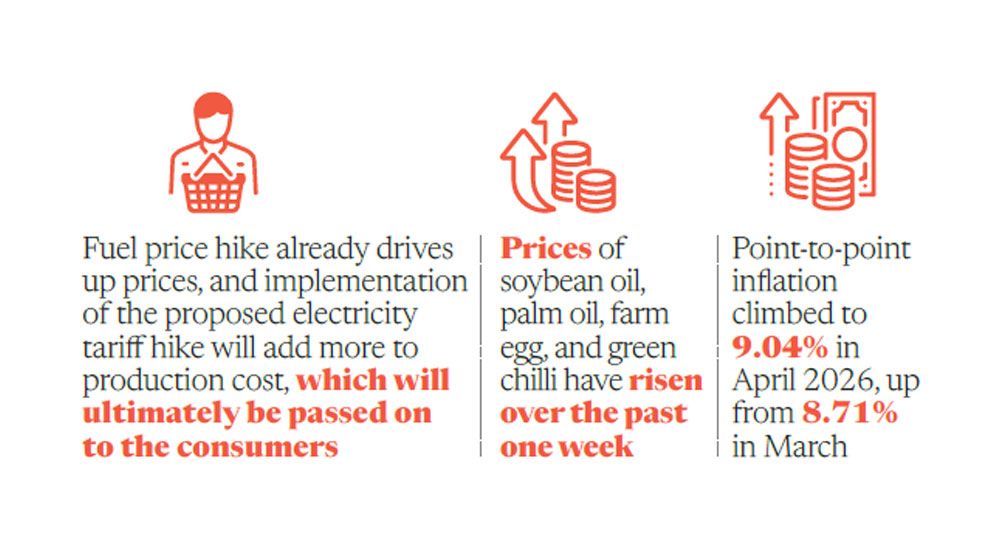
Consumers are hit hard by significant financial pressure and skyrocketing prices of essential commodities due to a combination of high inflation and rising energy costs.
While people have been feeling the surge in the prices of essential commodity items soon after the fuel price hike on 18 April, a recent proposal to increase electricity tariffs has made ordinary people as well as economists concerned.
This will add a new burden on fixed-income groups who were already grappling with spiralling prices of food and daily necessities following recent hikes in fuel prices, they said.
Market analysts and economists warned that the cumulative impact of the hikes could worsen inflationary pressure and reduce the purchasing power of fixed- and low-income families.
Economist and researcher Dr Jahangir Alam told the Daily Sun that people in fixed-income groups are already facing financial pressure, and another hike in electricity bills would further increase their cost of living, particularly by fueling food-price inflation. Prices of all types of food including prepared and processed food as well as grains will rise.
“The cost of production will increase. This will trigger what is known as cost-push inflation. As a result, people’s cost of living will continue to rise, and food inflation will further fuel overall inflation,” he said.
“This will disrupt the lives of general people and create immense pressure on fixed-income groups and poor people. Earlier increases in gas, fuel especially diesel and kerosene have already created a multiplier effect. It is not only the direct cost of buying these commodities that increases; transportation costs and expenses across all aspects of life also go up,” the economist said.
“Transport costs have already increased. Therefore, production costs in agriculture and industry will rise further, and the cost per unit of services in the service sector will also increase. This could create a severely painful situation, particularly for poor people, who will face devastating hardship,” he added.
Retailers and wholesalers in major kitchen markets in the capital said that transportation costs surged sharply after the fuel price adjustment in April, forcing traders to pass on additional expenses to consumers.
Small restaurant owners and food vendors also reported rising operating costs due to higher LPG prices, raising concerns about another round of food price increases in the coming weeks, he added.
Tanzin Ahsan, a consumer who came to Mirpur 6 kitchen market on Friday, said that due to soaring prices, he can no longer afford to buy adequate food items and is being forced to purchase fewer essentials than needed to run his household.
The Bangladesh Power Development Board (BPDB) has proposed a 17% to 21% hike in wholesale electricity tariffs to manage subsidy burdens. This follows earlier gas price hikes that already increased energy inflation to 14.9% in the January-March 2026 quarter.
SM Nazer Hossain, vice president of Consumers Association of Bangladesh (CAB), said that if electricity prices are increased, it will trigger another round of inflation, similar to the impact caused by fuel price hikes.
“Like fuel, electricity is connected to almost every sector. Industries, factories, agriculture and domestic use all depend on electricity. As a result, production costs will increase across the board,” he said.
“The impact will ultimately fall on consumers, and its effect could be even greater than that of fuel price hikes. The negative impact may surpass what was seen after the increase in fuel prices. The living standards of fixed-income people will be affected further due to this abrupt rise in commodity prices. Many people from fixed-income groups have already reduced their protein intake amid the higher prices of essential commodities,” he added.
The repeated hikes in utility and fuel prices are now cascading through the economy, sharply increasing transportation, production and distribution costs of goods and services.
According to Trading Corporation of Bangladesh, prices of a number of essential commodities have increased over the past week. These are loose soybean oil (1.6% rise), 5-litre bottle of soybean oil (1.05%), 1-litre bottle of soybean oil (1.03%), loose palm oil (0.30%), green chilli (26.32%), and farm egg (5.88%).
Visiting different kitchen markets in Mirpur and other areas across the capital it was seen that the prices of all kinds of summer vegetables increased by Tk10 to Tk20 per kilogram compared to the previous week.
In these markets, the price of bitter gourd increased by Tk10 per kg and was sold at Tk60 to Tk70, brinjal by Tk20 and was sold at Tk80 to Tk140 per kg depending on variety, sponge gourd by Tk10 and was sold at Tk80 per kg, green chilli by Tk20 per kg and was sold at Tk100 to Tk160, local cucumber increased by Tk20 and was sold at Tk100 to Tk120 per kg, and okra by Tk20 to Tk50–Tk60 per kg.
Pointed gourd was sold at Tk60 to Tk80 depending on quality, taro root at Tk100 to Tk120, yardlong beans at Tk80 to Tk100, taro stems at Tk80 to Tk100, snake gourd at Tk70 to Tk80, drumsticks at Tk180 to Tk200, hybrid cucumber at Tk80 per kg, papaya at Tk60, and sweet pumpkin at Tk40.
Red layer chicken was sold at Tk310, white layer at Tk290, broiler chicken at Tk180, and local chicken at Tk750 per kg.
Beef was sold at Tk800 per kg in these markets and mutton at Tk1,200 per kg.
Recommended Stories