


 For all latest news, follow the Daily Sun's Google News channel.


Sammilito Islami Bank at risk of collapse as EXIM Bank, SIBL seek exit
Depositors continue protests over restricted access to savings

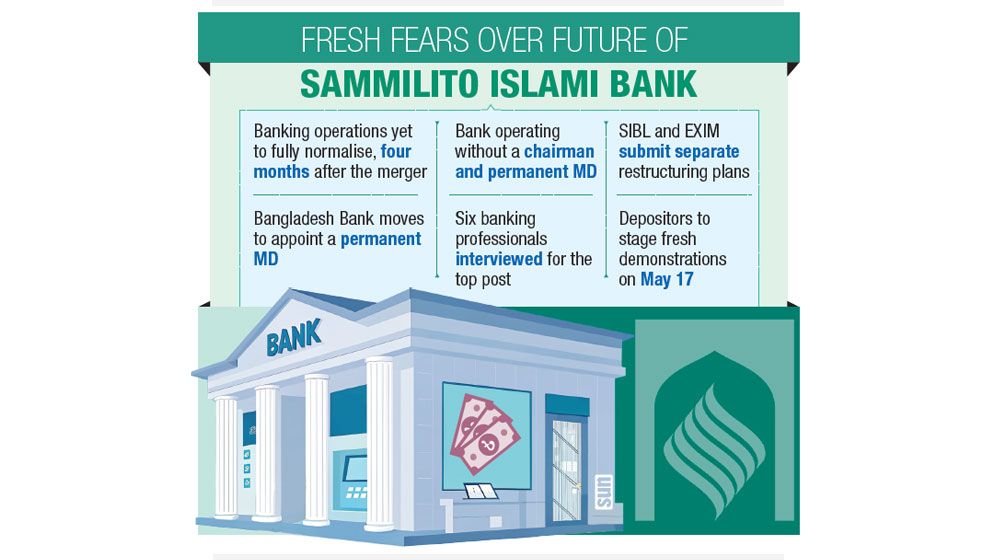
The future of Sammilito Islami Bank, formed through the merger of five troubled Islamic banks, has come under renewed uncertainty as Export Import Bank of Bangladesh PLC (EXIM Bank) joined Social Islami Bank Limited (SIBL) in seeking to exit the merged structure and resume independent operations.
The latest development has intensified concerns that the ambitious banking reform initiative could unravel before achieving stability, while frustration among millions of depositors continues to mount over withdrawal restrictions and incomplete banking services.
The interim government had established Sammilito Islami Bank under the Bank Resolution Ordinance by merging EXIM Bank, First Security Islami Bank, Global Islami Bank, Union Bank and SIBL.
Later, the current government amended the law by introducing Section 18(a), allowing former directors to regain ownership of bank shares under certain conditions.
Taking advantage of the new legal provision, EXIM Bank’s former board, led by ex-chairman Nazrul Islam Swapan, recently submitted a formal application to Bangladesh Bank seeking approval to separate from the merged entity and restart operations independently.
Earlier, SIBL filed a similar application on 27 April under the same provision, raising fresh questions about the sustainability and effectiveness of the merger framework.
Bangladesh Bank Executive Director and spokesperson Arief Hossain Khan confirmed that the application had been received and would be reviewed in line with existing laws and regulations.
However, central bank officials indicated that separating from the merged structure would be extremely difficult.
According to officials, the banks would initially need to deposit around Tk1,200 crore at an interest rate of 7.5% and repay government financial support within two years.
They would also have to demonstrate financial strength of Tk25,000 crore to Tk30,000 crore, including covering provisioning shortfalls, before approval for independent operation could be considered.
Merger built on weak financial foundations
The merger initiative was launched on 21 December last year under the leadership of then-governor Dr Ahsan H Mansur, with the aim of rescuing five financially distressed Islamic banks through the creation of Sammilito Islami Bank.
Before the merger, Bangladesh Bank had declared the shares of the five banks effectively worthless, as their liabilities far exceeded their assets, pushing share values into negative territory.
The decision triggered widespread criticism, particularly because the banks were publicly listed companies and investors were not consulted before the move.
More than four months after the merger, however, the situation has shown little improvement.
Banking operations have yet to fully normalise, with many branches still unable to provide complete services.
Restrictions on cash withdrawals remain in place, while fresh deposit inflows have slowed significantly, further eroding public confidence in the institution.
Before the merger, the financial condition of the five banks was considered extremely fragile.
Their non-performing loan (NPL) ratios ranged from 48% to as high as 97%.
Combined defaulted loans stood at nearly Tk1.5 lakh crore against total loans of around Tk1.96 lakh crore, highlighting the depth of the crisis the merger sought to address.
Initiative underway to appoint MD
Bangladesh Bank has intensified efforts to appoint a permanent managing director (MD) for Sammilito Islami Bank as the newly merged institution continues to struggle with operational and governance challenges.
Since its formation through the merger of five troubled Islamic banks, the bank has been operating without a permanent MD.
The leadership crisis deepened further after former secretary Mohammad Ayub Miah, who had been appointed chairman of the board, resigned within nearly three months citing personal reasons.
The bank is currently functioning without both a chairman and a permanent MD, raising concerns over governance and strategic decision-making at a critical stage of its restructuring process.
To ensure day-to-day operations continue, Bangladesh Bank has temporarily assigned five officials of executive director rank to oversee the bank’s administration.
As part of the initiative, the central bank recently interviewed six experienced banking professionals for the top executive position.
Banks promise restructuring plans
In their applications, both SIBL and EXIM Bank proposed separate restructuring plans aimed at restoring financial stability.
The banks pledged to reduce risky assets, strengthen loan recovery efforts and reinforce capital structures.
SIBL, in its proposal, said it plans to reduce its NPL ratio to 25% by December this year. The bank also aims to reactivate 22 suspended government accounts and recover nearly Tk500 crore in deposits.
Additionally, it has sought Tk11,000 crore in liquidity support from Bangladesh Bank over the next 10 years.
Former EXIM Bank chairman Nazrul Islam Swapan told the Daily Sun that “the bank had submitted a detailed recovery plan along with its application under Section 18(a) of the Bank Resolution Act.”
Depositors continue protests
The biggest victims of the crisis, however, remain the depositors.
Thousands of customers say they are still unable to withdraw their savings despite repeated assurances from the authorities.
Many report severe hardships, including difficulties paying medical expenses, arranging family events and running businesses.
Under the Bank Resolution Ordinance, Bangladesh Bank had announced that depositors would initially be allowed to withdraw up to Tk2 lakh from savings accounts, followed by another Tk1 lakh after three months, with full repayment promised within two years.
But depositors allege that these commitments are not being properly implemented.
“We want our hard-earned money back. We do not accept any haircut. Normal banking operations must be restored,” said Abul Kalam Azad, president of the Depositors’ Association.
According to available estimates, around 75 lakh depositors have nearly Tk1.31 lakh crore deposited in the troubled banks.
The association has already announced fresh demonstrations on 17 May, including a planned siege of the main branch of Sammilito Islami Bank in Dhaka, demanding the immediate restoration of normal banking services and unrestricted access to deposits.