



 For all latest news, follow the Daily Sun's Google News channel.


The government is set to place the fulfilment of its election manifesto commitments at the heart of the national budget for fiscal year 2026-27, as it navigates a turbulent global economic landscape marked by energy market volatility and stubborn domestic inflation.
Sources at the Ministry of Finance have confirmed to the Daily Sun that, despite mounting external pressures, the administration remains firmly focused on delivering the promises it made to voters.
Finance Minister Amir Khosru Mahmud Chowdhury was unequivocal at a recent preparatory meeting, “The election manifesto is the foundation of the government’s development philosophy. Therefore, the budget is being prepared with highest importance given to social protection, employment generation, infrastructure development, and energy security.”
A budget of historic scale
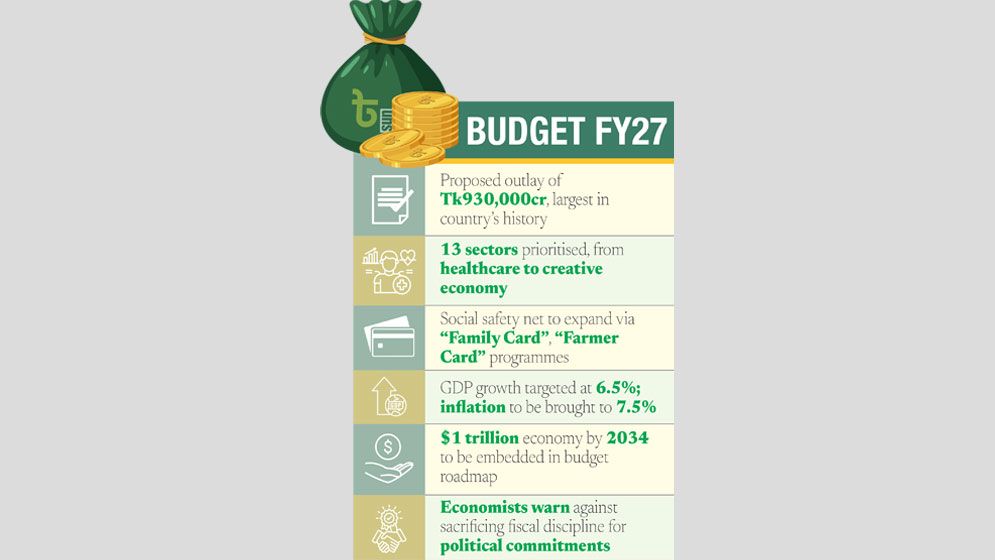
The proposed budget for FY27 stands at Tk930,000 crore – roughly 25%, or Tk140,000 crore, higher than the current fiscal year.
Revenue collection has been targeted at Tk695,000 crore. In nominal terms, this would represent the largest budget in the country’s history.
GDP growth has been projected at 6.5%, with inflation expected to ease to 7.5% against a total GDP estimate of Tk6,831,633 crore.
Thirteen priority sectors
Government planners have identified thirteen areas as central to the upcoming budget.
Foremost among these is honouring manifesto pledges, followed by restoring robust economic growth on the path towards a one-trillion-dollar economy by 2034 – an ambition the government intends to anchor formally within the budget framework through increased investment in research, technology-driven industries, and the creative economy, encompassing film, music, sports, and rural cultural sectors.
Tackling inflation sits prominently on the agenda. Food inflation currently exceeds 8%, and the continuing instability in the Middle East – compounded by tensions involving Iran, the United States, and Israel – has raised real concerns over fuel supply disruptions that could push prices higher still.
In response, the budget is expected to include enhanced subsidies on essential goods alongside tighter market controls.
The social safety net is set for expansion through Family Cards and Farmer Cards, with the aim of sharper targeting and better accountability.
Increased allowances for the poor and vulnerable are anticipated, as are strengthened incentives for small and medium enterprises to stimulate job creation.
Skills development and entrepreneurship programmes will be stepped up to widen access to employment both at home and abroad.
Other priorities include stricter project selection in physical and social infrastructure, enhanced healthcare provision at the grassroots level, financial sector reform, agricultural support to bolster food security, progress towards Sustainable Development Goals, climate change adaptation, and deregulation to improve the investment climate.
Energy security also features prominently, with plans for increased imports, including additional diesel, to stabilise power and fuel supply.
Economists sound notes of caution
While broadly supportive of the government’s social objectives, economists have raised important concerns about execution and fiscal discipline.
Dr Mustafa K Mujeri, former chief economist of Bangladesh Bank, warned that spending ambitions must be matched with hard-headed realism.
“Inflation control must remain the central objective of the budget. Without bringing inflation under control, increased spending on social protection will not yield the desired outcomes. Restoring discipline in the banking sector is equally important,” he told the Daily Sun.
On longer-term growth, Dr Mujeri argued that achieving the trillion-dollar target demands more than aspiration.
“To achieve the goal of a one-trillion-dollar economy, emphasis must be placed on increasing investment and exports. A business-friendly environment, policy stability, and effective deregulation are essential.”
He also cautioned against allowing political priorities to compromise sound public finances: “Implementing election commitments is important, but it must not undermine fiscal discipline. Controlling the budget deficit and reducing reliance on external borrowing are major challenges.”
Dr Mohammad Abu Eusuf, professor of Development Studies at the University of Dhaka, highlighted the importance of coherence between revenue collection and expenditure.
He welcomed the expansion of the social safety net in principle but struck a note of caution: “While expanding social safety net programmes is positive, improper beneficiary selection and lack of transparency could lead to misuse.”
He urged the government to consolidate existing schemes rather than simply increasing costs, ensuring support reaches only those who genuinely need it.
With the budget expected to be the most expansive in Bangladesh’s history, the coming months will test whether the government can translate its considerable ambitions into effective, disciplined governance – or whether the weight of election promises proves too heavy a burden for the economy to bear.
The reporter can be reached at: [email protected]
Recommended Stories