


 For all latest news, follow the Daily Sun's Google News channel.


Teesta barrage turns ‘bane’ for northern communities
Locals call for urgent, coordinated measures

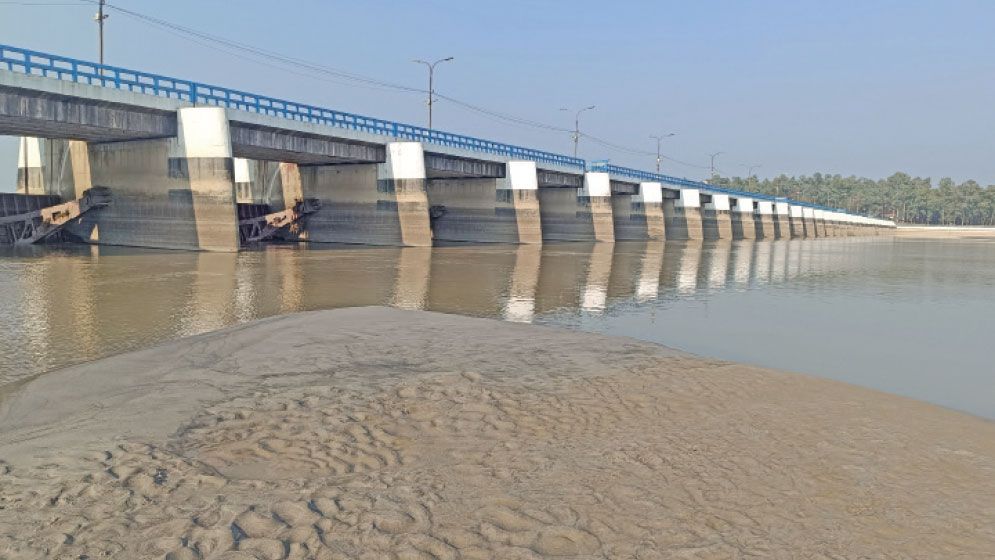
Residents of northern Bangladesh, particularly in Lalmonirhat and Kurigram, alleged that the Teesta barrage, once envisioned as the country’s largest irrigation project, has brought more suffering than benefit, as recurring floods, river erosion and dry-season water scarcity continue to devastate livelihoods.
Built in 1990 at Dalia in Hatibandha upazila of Lalmonirhat at a cost of around Tk1,500 crore, the 615-metre-long barrage with 52 gates was designed to irrigate vast tracts of land across greater Rangpur. However, locals claimed poor planning and lack of proper infrastructure, especially the absence of a protective dam on the east bank, have made the project ineffective.
According to residents, large areas of farmland are submerged during the monsoon as excess water is released through the barrage, while in the dry season, acute water shortages leave cropland barren. Farmers in many unions receive no irrigation support despite living near the river.
Joynal Abedin, 65, from Saniajan area, said 18 out of 45 unions across five upazilas are directly affected by the Teesta’s flow, while the remaining areas suffer from lack of irrigation water. “When we need water, we don’t get it. When we don’t need it, everything goes underwater,” he said.
In Hatibandha upazila, six unions along the river frequently face flooding, while the rest struggle with poor crop yields due to water scarcity. Many farmers have lost their ancestral land to river erosion and have been forced to change professions, with some turning to fishing or migrating to cities in search of work.
Locals alleged that upstream water withdrawal by India through the Ghazaldoba barrage has worsened the condition. They claimed that reduced dry-season flow and sudden release of excess water during monsoon disrupt the natural flow of the river, intensifying both drought and flooding.
According to the Department of Agricultural Extension (DAE), consistent water flow in the Teesta could significantly improve agricultural productivity, environmental balance and biodiversity in the region. Currently, many native fish species, birds and vegetation are disappearing due to irregular water availability.
Data from local sources suggest that over the past 34 years, around 350,000 hectares of land in Lalmonirhat and Kurigram have been lost to river erosion, while about 150,000 hectares have become uncultivable. Nearly 100,000 people have reportedly been rendered homeless.
Kofil Uddin, a school teacher from Barakhata, said farmers in Lalmonirhat cannot effectively use irrigation from the barrage due to relatively higher land elevation compared to other districts. “Despite having the barrage here, we are deprived,” he said, urging immediate government action to control erosion.
Officials, however, remain optimistic. Amitabh Chowdhury, executive engineer of the Teesta Barrage under the Water Development Board, said implementation of the proposed Teesta Master Plan could help control floods, reduce erosion and improve livelihoods for millions living along the river.
Locals are now calling for urgent and coordinated measures, including fair water-sharing agreements and infrastructure improvements, to ensure the Teesta becomes a source of life rather than hardship.