


 For all latest news, follow the Daily Sun's Google News channel.


CPD urges renewable shift for long-term energy future
Says fossil fuel reliance will keep Bangladesh vulnerable unless investment barriers are removed
Daily Sun Report, Dhaka
Published: 28 Apr 2026, 12:00 AM
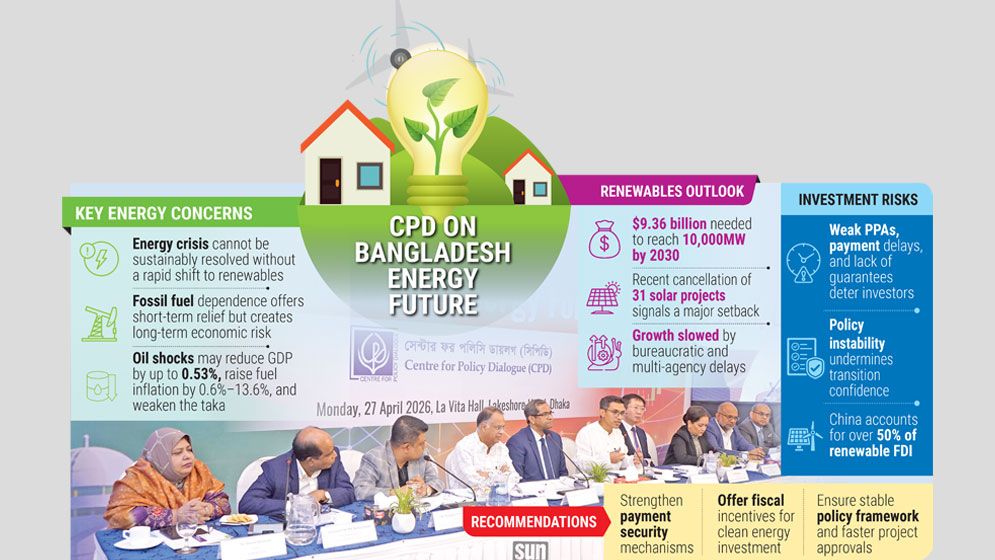
The ongoing energy crisis may ease in the short term, but it cannot be resolved sustainably without a decisive transition to renewable energy, the Centre for Policy Dialogue (CPD) has warned.
Speaking at the 4th Bangladesh-China Renewable Energy Forum in Dhaka on Monday, CPD Research Director Dr Khondaker Golam Moazzem said the country must move beyond its heavy reliance on fossil fuels to ensure long-term energy security.
“The crisis created by fossil-fuel dependency is not something that will disappear overnight. Bangladesh needs to seriously consider alternative energy pathways,” he said.
The forum, held under the theme Transforming Crisis into Opportunities: Renewable Energy Development under the New Government, brought together policymakers, investors and energy experts to discuss structural challenges in the sector and reform priorities.
CPD said that even if global geopolitical tensions ease and fuel supply routes stabilise, Bangladesh would continue to face economic pressures because of its dependence on imported fossil fuels.
Using econometric modelling, the policy research body projected that external oil shocks could cause persistent macroeconomic impacts, including GDP losses of up to 0.53%, inflation ranging from 0.6% to 13.6%, and depreciation of the taka over the medium to long term.
Looking ahead, both the government and CPD stressed the need to accelerate investment in renewable energy.
The country has set a target of generating 10,000 megawatts of electricity from renewable sources by 2030, which CPD estimates will require around US$9.36 billion in investment across solar, wind, biomass and distributed energy systems.
However, the think tank said structural weaknesses in policy and investment frameworks continue to discourage investors.
It identified shortcomings in Power Purchase Agreements (PPAs), including delayed payments, lack of exchange-rate protection and the absence of robust sovereign guarantees.
CPD added that the discontinuation of implementation agreements, previously an important form of payment security, has further weakened investor confidence.
The organisation also highlighted institutional bottlenecks, saying project approvals involving multiple agencies are often delayed due to poor coordination and weak accountability.
It described the recent cancellation of approvals for 31 solar projects, representing about 5.68GW of capacity and an estimated $6 billion in investment, as a major setback for the sector.
Despite these challenges, CPD noted the scope for stronger cooperation with China, which accounts for more than half of foreign direct investment in Bangladesh’s renewable energy sector.
It called for greater policy consistency and stronger contractual safeguards to attract sustained investment.
Among its recommendations, CPD urged the government to introduce payment security mechanisms such as revolving letters of credit, establish a coordinated inter-agency approval system, and restore credible sovereign backing for renewable projects.
It also called for fiscal incentives, including tax and duty exemptions on key equipment, and the creation of dedicated financing facilities to support rooftop solar expansion.
“A fair and predictable investment environment is essential,” Moazzem said, adding that a shift towards resilient renewable energy is no longer optional but necessary for long-term stability.