


 For all latest news, follow the Daily Sun's Google News channel.


Investment slowdown deepens as machinery imports fall
LC settlement growth for capital machinery remains negative in Jul-Mar of FY26
Daily Sun Report, Dhaka
Published: 27 Apr 2026, 12:00 AM
The pace of new investment has slowed significantly, as reflected in the continued decline in capital machinery imports, one of the key indicators of industrial investment.
The downward trend has persisted for three consecutive fiscal years and has continued into the first nine months of the 2025-26 fiscal year.
According to the latest data from Bangladesh Bank, growth in the settlement of letters of credit (LCs) remained in negative territory throughout the period.
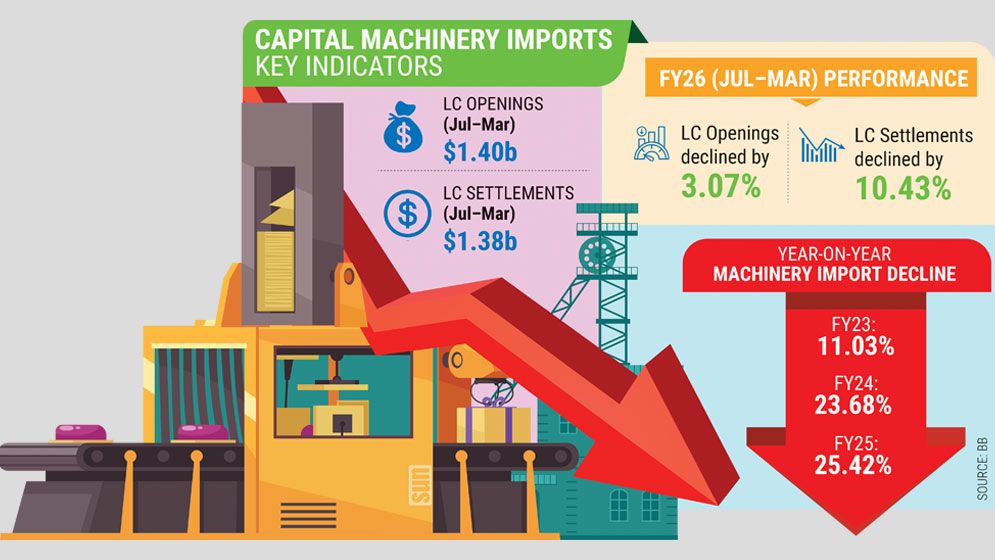
In FY26, LC openings for capital machinery imports stood at US$1.40 billion during July-March, slightly down from $1.44 billion in the same period of the previous fiscal year. LC settlements saw a sharper decline, falling to $1.38 billion from $1.54 billion a year earlier.
Overall, during the first nine months of the current fiscal year, LC openings and settlements for capital machinery imports decreased by 3.07% and 10.43%, respectively.
Previously, capital machinery imports fell by 25.42% in FY25 and by 23.68% in FY24, indicating a sustained contraction in this crucial investment-related sector.
Analysts said the decline in capital machinery imports signals stagnation in new industrial establishments and business expansion.
This is constraining production growth and limiting the adoption of modern technology. As a result, productivity and efficiency are declining, weakening the competitiveness of the export sector.
The slowdown is also affecting the labour market. According to the Bangladesh Bureau of Statistics (BBS), the unemployment rate rose to 4.63% in the October-December quarter of FY25, the highest level in recent times.
The number of unemployed people increased to 27.3 lakh, up by 3.30 lakh from the same period a year earlier.
Economists noted that capital machinery is a key driver of job creation, as it is directly linked to the establishment of new factories and production units.
A decline in this sector raises the risk of shrinking employment opportunities.
Widening trade deficit
Bangladesh Bank’s analysis also showed that global trade tensions and weakening demand in major markets have softened exports, particularly in the ready-made garments sector.
In the first eight months (July-February) of the current fiscal year, the trade deficit stood at $16.91 billion, up from $13.77 billion in the first seven months. This means the deficit widened by $3.13 billion in February alone.
Acknowledging the situation, Rashed Al Mahmud Titumir, adviser on Finance and Planning to the Prime Minister, recently told journalists: “We want to move away from the current trend and shift toward an investment-friendly economic model.”
He said, “Industrial production is declining and unemployment has risen. As a result, the government is having to provide subsidies in various sectors. We want investment to increase, jobs to be created, and growth to strengthen.”
Economic analysts emphasised that sustainable growth is not possible without new investment, which is directly linked to employment, production, marketing, and exports. Capital machinery lies at the core of this process; when it declines, the entire economic chain weakens.
They also noted that investor confidence has fallen due to the dollar crisis, high interest rates, policy uncertainty, and the overall deterioration in economic indicators, leading to reduced imports.
Experts recommended that the government urgently strengthen policy support, resolve the foreign exchange crisis, and diversify markets to revive investment momentum. They further pointed out that higher machinery imports in previous years were partly driven by large-scale mega projects, which have now slowed.
However, boosting both domestic and foreign investment remains essential for long-term economic stability.