


 For all latest news, follow the Daily Sun's Google News channel.


Abul Hashem has farmed the same three bighas of land in Pirgachha, Rangpur for over four decades. He remembers a time when his father’s fields were a mosaic of colour: the amber of “kaon” (foxtail millet), the deep earthy tones of indigenous lentils, and the vibrant greens of half a dozen heirloom gourds.
Today, every inch of Hashem’s land is a monochrome of emerald and gold. For thirty years, he has grown the same two varieties of high-yielding paddy. He cannot recall the last time he saw kaon growing nearby.
Hashem is not alone. Across Bangladesh, millions of farmers have made the same rational, individually sensible choice – one that is collectively damaging. And the countryside has been transformed accordingly.
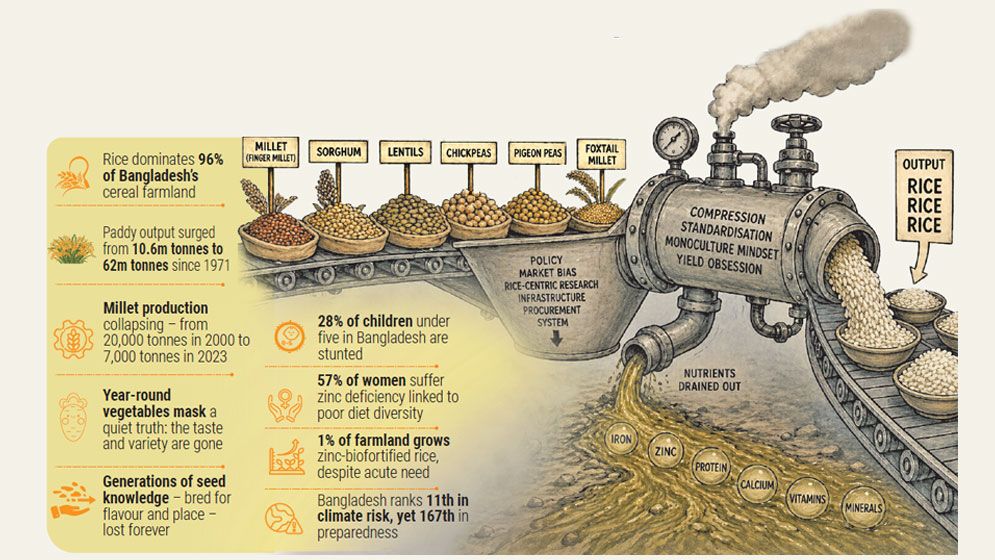
According to data from the Bangladesh Bureau of Statistics (BBS), rice now blankets around 75% to 78% of the total cropped area and more than 96% of the country’s cereal farmland.
This overwhelming dominance has pushed nearly every other grain to the margins of cultivation and, increasingly, to the margins of memory.
The monoculture trap
By many measures, Bangladesh’s agricultural story is a success.
Paddy output has risen from 10.6 million tonnes in 1971 to around 62 million tonnes in 2025.
For a country that once struggled with famine, that transformation matters.
But there is another side to that success.
Rice now occupies close to 80% of the country’s total crop area.
And that expansion has not happened in isolation – it has come at the expense of pulses, oilseeds, vegetables, fruits, and spices, many of which have seen both land and research attention shrink over time.
None of this happened by accident.
For most farmers, the move toward rice was simply the safer option. It grows predictably, irrigation systems are built around it, and decades of research have made it dependable.
Just as importantly, there is always a market. In some cases, there is also the reassurance – formal or informal – of price support or procurement. Other crops do not offer that kind of certainty.
Millets, pulses, and indigenous vegetables are harder to sell, their prices can fluctuate sharply, and access to seeds, credit, or inputs is often limited.
For a farmer working a small plot of land, with little room for loss, those risks are hard to take on.
Choosing rice is not just habit – it is often the only practical decision. The problem is what those decisions add up to. Over time, what works at the level of individual farms has narrowed the system as a whole.
That narrowing is now visible in the data.
Millet production, for example, dropped from around 20,000 tonnes in 2000 to 7,000 tonnes in 2023 and is projected to fall further to around 3,000 tonnes this year. Researchers have begun to describe the system as deeply rice-centric – understandably so, but increasingly difficult to sustain.
At the same time, crops like maize and potato have expanded rapidly. Maize, now the country’s second-largest cereal, is grown largely for poultry and livestock feed.
Potato production has surged as well, though often beyond what the domestic market can absorb, leading to recurring price crashes. Together, they have filled space in the fields–but not necessarily on the plate.
Why these crops matter
To understand what is being lost, one must look at the plate. Millets deliver protein, iron, calcium, and antioxidants – micronutrients frequently absent from rice-heavy diets.
Traditional pulses and indigenous vegetables historically offered a nutritional balance that complemented cereal staples in ways that modern, simplified diets simply do not replicate.
Bangladesh’s own food intake data makes the consequences concrete: per capita daily consumption of pulses, vegetables, fruits, and animal-source foods – fish excepted – remains at between a quarter and one-half of recommended intake values.
As a 2024 report by Barois et al., published by Foresight4Food, Oxford, observed: “the dominant emphasis on staple food production limits the production of other foods, such as fruit and vegetables, and diminishes the accessibility of diversified food.”
These crops are not being sidelined because they have been found wanting. They are being sidelined because policy, markets and infrastructure have converged around a handful of high-yield staples – and everything else has been left to wither.
The loss, moreover, is not only nutritional.
Ask any Bangladeshi over fifty about the vegetables of their childhood and something shifts in their expression. The tomatoes were smaller, the brinjals more bitter, the gourds more fragrant – each variety shaped by generations of seed selection that valued taste and local character as much as yield.
Many of those varieties no longer exist in any field.
Today's vegetables arrive year-round through cold chains and commercial seed systems, visually uniform and reliably available.
But the seasons have been quietly flattened, and with them, something harder to measure than a micronutrient – the taste of place, the flavour of a particular soil, the sensory memory of a diet that once changed with the months.
Availability has been gained. Character has been lost.
A biodiversity lost in a generation
In the mid-20th century, Bangladesh’s fields hosted hundreds of indigenous varieties specifically adapted to local conditions – flood tolerance in the haor wetlands of Sylhet, salinity resistance along the coastal belt, and drought adaptability on the Barind Tract of Rajshahi.
Farmers held not merely seeds, but centuries of accumulated ecological knowledge. Today, that knowledge is vanishing alongside the seeds.
Research tracing Bangladesh’s agricultural policy from 1971 to 2023 finds that the Green Revolution programmes of the 1970s, whilst successfully achieving rice self-sufficiency, simultaneously created structural lock-in effects so entrenched that the farming system has grown increasingly vulnerable to pest pressures, market volatility and climate shocks.
The numbers are stark. Bangladesh has an estimated 1,000 indigenous crop varieties with superior adaptive qualities, yet its 15 million farmers grow just five or six rice varieties.
“For the last 30 years, farmers have been extensively cultivating BRRI 28 and BRRI 29 out of 130 lab-developed varieties, as only these two paddy varieties can give them a comparatively better return on their investment. Eventually, this tendency leads to monocrop culture, which will cause ecological damage in the long run,” warned Jiban Krishna Biswas, former director-general of the Bangladesh Rice Research Institute (BRRI).
The hidden hunger crisis
Bangladesh has made impressive strides in calorie availability. The numbers beneath that progress, however, tell a more uncomfortable story.
According to a new study – “Yield vs. Nutrients: What Drives Farmers' Varietal Adoption Decisions in Bangladesh?” – by ADB Institute, roughly 28% of children under five in the country are stunted, nearly 37% of women of reproductive age are anaemic, and around 13% of the population remains undernourished.
The study, drawing on data from nearly 3,500 farming households, further revealed that zinc deficiency affects more than 40% of preschool-aged children and 57% of non-pregnant, non-lactating women.
These are not the statistics of a nation whose nutrition crisis has been resolved. They are the statistics of a nation that has solved one problem whilst quietly deepening another.
The paradox has a name among researchers: “hidden hunger” – a condition the FAO describes as micronutrient deficiency despite adequate caloric intake, with consequences including lower energy levels, reduced immune function and diminished productivity. Bangladesh is a textbook case.
Research published in a FAO-supported study found that 85% of the country’s caloric intake and 60% of its protein intake are derived from cereals alone.
Zinc-biofortified rice – developed specifically to address the zinc deficiency that afflicts well over half of the country’s women – accounts for just 1% of total rice-growing area, despite being available.
A FAO assessment of food-based nutrition strategies in Bangladesh concluded that “linking horticultural development policies and national nutrition programmes with a focus on increasing food variety may be the best strategy for sustainable reduction of micronutrient malnutrition.”
That recommendation has been on record for years. It remains largely unimplemented.
Climate pressure on a fragile system
The consequences of monoculture dependence would be serious enough in a stable climate. Bangladesh does not have one.
While the country remains among the seven most climate-affected nations over the past three decades, its position in the WorldRiskIndex has surged to 11th in 2026 – yet it ranks only 167th in preparedness. Around 60% of the population lives in highly flood-prone areas.
World Bank projections warn of potential agricultural losses reaching US$7.7 billion, with rice production in vulnerable regions potentially declining by 33% in the coming decades.
In this context, the genetic diversity of indigenous crops is climate insurance. Millets and traditional grains are inherently tolerant of drought and heat stress.
Yet their cultivation has all but disappeared. While India framed its national millet revival – ”Shree Anna” – explicitly as a climate adaptation strategy, Bangladesh has yet to mount a comparable initiative with the necessary scale or urgency.
Policy gaps and glimmers of hope
Twelve policies promoting crop diversification have been identified in legislative records since 1971, yet progress remains limited.
CIMMYT research finds that existing approaches focus primarily on production while neglecting the market systems these new crops require.
“If farmers cannot get a fair price for their produce and cannot access finance to meet their production needs on time, they will definitely go for varieties that have the best yield,” says Ahsan Uddin Ahmed, a member of the Green Climate Fund’s Independent Technical Advisory Panel. The burden of change lies with the state.
There are, nonetheless, reasons for cautious optimism.
The Bangladesh Resource Centre for Indigenous Knowledge (BARCIK) is conserving more than 600 local rice varieties and engaging farmers across the country in what its director Pavel Partha describes as farmer-led, on-farm research to explore indigenous varieties whilst minimising production costs.
In Mohanganj, Roumari, a farmer named Lovely Begum cultivated quinoa on rented land in 2023, earning a profit of Tk67,200 from an initial investment of Tk15,000 – and inspiring her neighbours to do the same. Small stories, but telling ones.
O’Leary et al., writing in a 2024 policy brief published by the LSE’s Grantham Institute, recommended that securing dietary diversity is the essential starting point for building “a more climate-resilient diversified agricultural sector,” calling for climate-smart technologies to develop nutrient-dense crops alongside targeted safety nets for low-income households. The roadmap exists. What has been missing is the political will to follow it.
A question of national will
Bangladesh’s success in feeding its population is remarkable. But the narrative of production growth has long masked a deeper loss: the disappearance of the crop diversity that underpins nutrition and ecological resilience.
Reversing this will require more than policy language and research papers.
It demands a fundamental reimagining of how Bangladesh values its agricultural inheritance – in markets, in schools, in procurement systems and in the allocation of public research funds.
Because when the paddy fields reach their limits – when the climate bears down harder, when pests adapt faster than breeders, when soil exhausted by decades of monoculture begins to fail – it will be the forgotten crops, and the forgotten knowledge bound up with them, that may hold the key to the country’s food security.
The question is whether they will still be there to be found.