


 For all latest news, follow the Daily Sun's Google News channel.


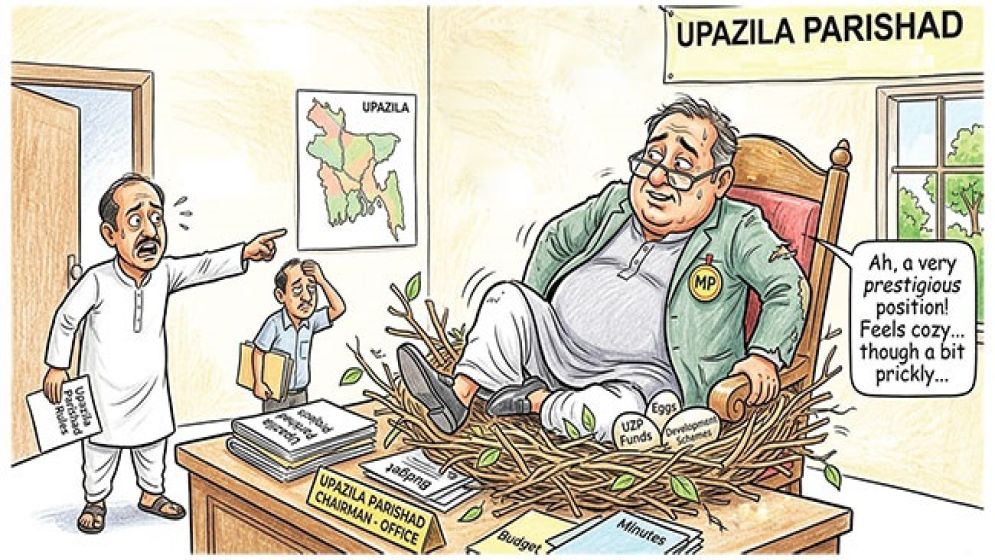
The democratic maturity of a state is measured by the rigidity of its separation of powers and the robustness of its grassroots autonomy. When Montesquieu, a French judge, intellectual, historian, and political philosopher and the principal source of the theory of separation of powers implemented in many constitutions throughout the world, articulated the principle, his primary intent was to prevent the toxic concentration of authority. Yet, in our political landscape, the allocation of permanent suites for central legislators within local government complexes represents more than a mere administrative shift; it is a calculated assault on the philosophical foundations of local democracy. This move orchestrates a paradoxical centralised decentralisation— a sleight of hand that grants the illusion of local governance while tightening the grip of the centre.
It is a rare phenomenon in our parliamentary culture to witness the government and the opposition singing from the same hymn sheet. Yet, whenever the prospect of self-service arises, ideological battle lines vanish, replaced by a harmonious chorus of self-interest. The recent announcement by the state minister for local government that every Upazila Parishad will house a well-furnished room for Members of Parliament (MPs) was met with such jubilant desk-thumping that it echoed as a knell of concern for the public. In a post-uprising Bangladesh – forged in the fires of a bloody struggle for constitutional integrity – this decision is a hollow mockery of the promise to empower the periphery.
The primary vocation of an MP is to serve as a high priest of legislation, debating the grand designs of national policy within the halls of Parliament. They are not, and were never intended to be, executive administrators. To establish permanent offices for them under the euphemistic shroud of ‘inspection rooms’ is a transparent subterfuge. Given that existing laws already provide MPs with a monthly stipend to maintain private constituency offices, the demand for a state-funded sanctum in the heart of local government is both redundant and rapacious. The Upazila Parishad is meant to be a sovereign theatre of local representation, but the looming shadow of a national legislator within its walls will inevitably stifle its independence, turning local representatives into mere extras in their own play.
History is a bitter teacher, and it reminds us that whenever MPs have wielded the baton over local administration, the scales of balanced development have been tipped by patronage. We have seen how district development funds were often transformed into personal fiefdoms to fortify vote banks. Establishing a physical footprint for MPs within the Upazila Parishad will create an invisible but heavy psychological yoke for local officials. The Upazila Nirbahi Officer (UNO) and their colleagues will be placed at risk of being reduced to the MP’s personal retinue. This will not merely pave the road for the abuse of power but will fling open the floodgates for corruption. Once an MP sits at the very table where project files are approved, transparency and accountability will inevitably collapse like a house of cards in a gale.
The most jarring note in this development is the volte-face of the ruling BNP. Having campaigned on the solemn pledge to strengthen local government and decentralise authority, this policy is a stark betrayal of their electoral mandate. While the prime minister’s decree against duty-free vehicles was a commendable gesture of austerity, this new directive sends a conflicting and regressive signal. Furthermore, the spectacle of parties like Jamaat-e-Islami, who before election exhibited a lukewarm or stagnant attitude toward local empowerment, clamouring for these perks suggests that a qualitative change in our political culture remains a distant mirage. It is more interesting that the National Citizen Party (NCP) foaming at the mouth about preventing future tyranny are also now clapping loudly after getting a probable chance to control local administration.
In constituencies spanning multiple upazilas, the exchequer will be bled to furnish multiple suites, complete with modern amenities and attached bathrooms. Why should the taxpayer’s hard-earned money be sacrificed at the altar of unproductive, influence-building vanities? At a time when the Local Government Reform Commission is advocating for a clean divorce between MPs and local administration, the government is instead forcing an unwanted marriage. To call these ‘inspection rooms’ is a semantic lie; in reality, they will function as parallel centres of power that bypass the democratic process.
The soul of the recent mass movement was the desire to dismantle institutional dictatorship and restore the balance of power. If local government remains a shackled entity, the fate of the rural populace will continue to be decided by the whims of the elite. We must not allow Upazila Parishads to be repurposed as the personal outposts of MPs. For the sake of good governance and the preservation of democratic sanctity, the government must beat a retreat from this controversial path. An MP’s duty begins and ends in Parliament. If this encroachment is not halted, the dream of a decentralised and empowered Bangladesh will remain nothing more than a ghost written in ink, forever haunted by the shadow of central overreach.
_____________________________________
The writer is Editorial Assistant at the Daily Sun. He can be reached at [email protected]