


 For all latest news, follow the Daily Sun's Google News channel.


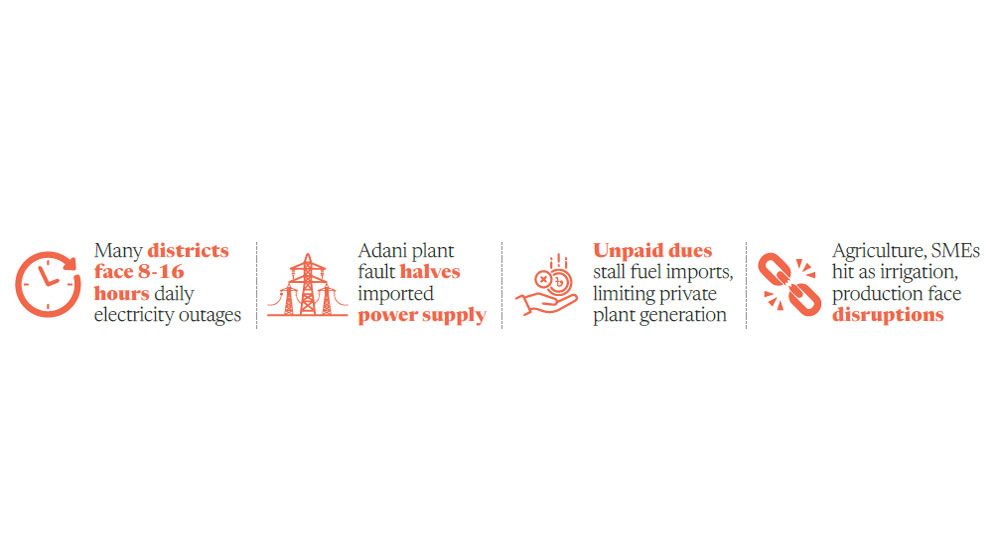
A record electricity shortfall of 2,500 megawatts has pushed large parts of Bangladesh into severe and prolonged power cuts, with rural communities bearing the heaviest burden as fuel shortages, payment arrears and plant disruptions converge into a deepening energy crisis.
According to Power Grid Bangladesh PLC data, peak demand on Wednesday reached around 15,650MW, while supply stood at 13,040MW, marking the highest shortfall of the year.
Officials say the gap has forced widespread load shedding, at times exceeding 2,000MW during peak hours.
Urban centres, including Dhaka, have remained comparatively stable, but rural districts are experiencing outages lasting 8-12 hours a day, severely disrupting daily life, agriculture and small industries.
Adani unit shutdown worsens supply gap
The crisis intensified after a technical fault forced the shutdown of one unit at the 1,600MW Adani power plant in Jharkhand, India, a key electricity supplier to Bangladesh.
A senior official at the plant, speaking on condition of anonymity, said, “A sudden technical fault was detected in one unit. This is not routine maintenance. To avoid major damage, the unit had to be shut down immediately. Our engineers are working to fix it as quickly as possible.”
He added that restoration could take three to five days, depending on technical progress.
The shutdown has reduced imports from the plant from around 1,400-1,500MW to roughly 750MW, significantly widening Bangladesh’s supply deficit.
Md Zahurul Islam, member (generation) of the Bangladesh Power Development Board (BPDB), confirmed the impact, saying, “The main reason for the increased load shedding is the shutdown of one Adani unit. We are trying to compensate by increasing production from oil-based plants, particularly in Sirajganj and Khulna.”
He warned that rising temperatures were further increasing electricity demand, placing additional strain on the national grid.
Rural life under severe strain
Across rural Bangladesh, the consequences have been immediate and severe.
In Jamalpur, residents report up to 16 hours of daily load shedding, with supply nearly 70% below demand. In Rangpur division, businesses are operating at around half capacity due to repeated outages lasting 5–8 hours daily.
In Mymensingh, resident Hridoy Hasan described the disruption as unpredictable and exhausting, “There is no fixed schedule. Sometimes electricity goes off twice in an hour. We cannot sleep, children cannot study.”
For SSC examination candidates, the situation is particularly difficult, with students forced to study under candlelight or mobile phone torches amid oppressive heat.
In Pabna’s Mouladuli area, shopkeeper Ashraful Alam said repeated outages had fundamentally altered daily survival.
“When electricity goes, everything stops – fans, lights, customers. Goods in the fridge get damaged. My children cannot sleep in the heat.”
He added, “Now I understand electricity is not just light – it is livelihood.”
Agriculture and rural industry hit hard
The ongoing crisis is increasingly damaging Bangladesh’s productive sectors, particularly in rural areas.
Farmers relying on electric irrigation systems report delays in watering crops, raising concerns over the upcoming boro rice cultivation season.
In several regions, shallow tube wells and pump-based systems remain idle for hours, reducing soil moisture and threatening yields during a critical growing period.
Fish hatcheries and poultry farms have also been severely affected. Operators report frequent shutdowns of oxygen supply and temperature control systems, resulting in losses of fish fry and increased mortality risks.
Agro-processing units, including rice mills and cold storage facilities, are struggling to maintain operations, causing spoilage risks and supply chain disruptions.
Small and medium enterprises (SMEs) have been among the worst hit, with many rural industrial clusters reporting production declines of up to 50% as machinery remains idle for extended periods.
Business owners increasingly rely on diesel generators, sharply increasing costs and eroding profit margins. Some small workshops have suspended operations entirely due to unsustainable fuel expenses.
Critics also point to widening disparities between urban and rural areas, alleging that cities are being prioritised for stable supply while rural regions endure prolonged and unplanned outages.
Financial stress deepens energy crisis
The power sector is also under severe financial pressure, with outstanding payments to electricity producers exceeding Tk47,000 crore, including more than Tk16,500 crore owed to private oil-based plants.
David Hasanat, president of the Independent Power Producers Association of Bangladesh, said:
“Due to unpaid bills for nearly eight months, we are unable to import fuel. Plants are operating at only 30%-35% capacity, and it could fall further to 20%. This will worsen load shedding significantly.”
He added that Bangladesh’s 5,000MW private generation capacity remains heavily underutilised due to fuel constraints.
Experts warn of structural crisis
Energy analysts say the situation reflects deep structural weaknesses, including foreign exchange shortages, fuel import bottlenecks, global energy volatility and mounting arrears.
A Dhaka-based analyst said the system is “operating below designed capacity despite installed surplus”, noting that nearly half of generation potential remains idle due to fuel shortages.
Shafiqul Alam, lead energy analyst at the Institute for Energy Economics and Financial Analysis (IEEFA), warned, “The government must safeguard industrial production during this period. Expanding renewable energy offers a practical solution, shielding the country from rising global fuel prices and enhancing energy security.”
He added that Bangladesh imported around 77 billion cubic feet of LNG between April and June 2025, warning that repeating such volumes in 2026 could add over $1 billion in subsidy costs, excluding infrastructure expenses.
BPDB officials say they are increasing reliance on oil-fired plants and exploring additional diesel-based generation to stabilise supply. However, they acknowledge that without fuel stability and resolution of arrears, sustained relief remains uncertain.