


 For all latest news, follow the Daily Sun's Google News channel.


Rising costs, policy bottlenecks strain real estate sector
Analysts say a series of overlapping shocks over the past five years have weakened the sector’s resilience

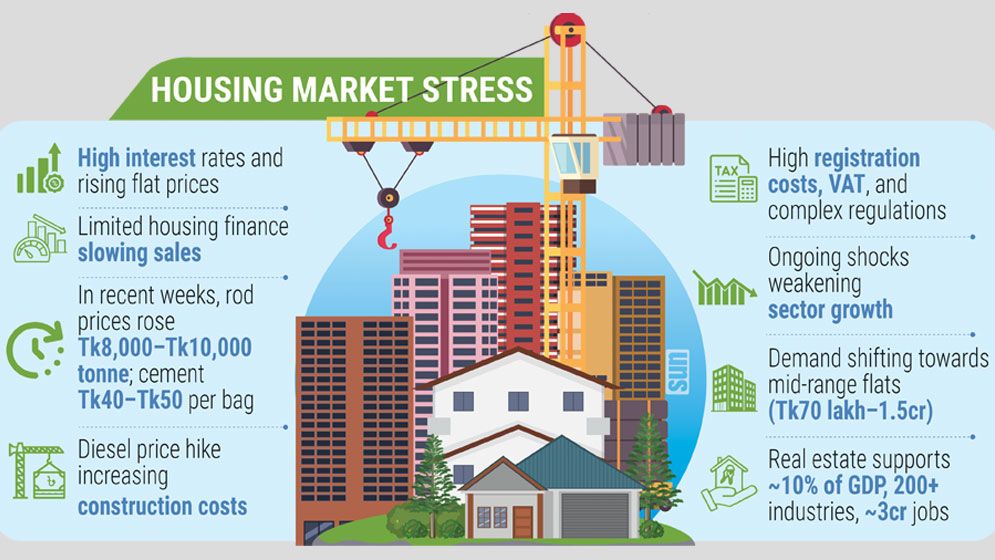
Despite its high potential driven by rapid urbanisation, the real estate sector is currently facing significant challenges due to macroeconomic uncertainty, rising raw material and energy costs, and higher bank interest rates.
Industry insiders say the sector is also grappling with limited access to long-term housing finance, high property registration costs, and complex regulatory procedures.
The latest increase in fuel prices is expected to intensify these pressures, with developers warning of a fresh round of cost escalation across the construction value chain.
Rod prices have already risen by Tk8,000-Tk10,000 per tonne in recent weeks, partly driven by global supply disruptions linked to tensions in the Middle East.
Cement prices have also increased by Tk40-Tk50 per 50kg sack, reflecting higher energy and transportation costs.
Following the government’s 19 April announcement, diesel prices rose to Tk115 per litre from Tk100, while petrol, octane, and kerosene also saw significant increases.
These adjustments are likely to feed directly into production costs for steel, cement, and other construction inputs, amplifying inflationary pressures in the housing sector.
Accumulated shocks weaken investment outlook
Analysts and industry insiders point to a series of overlapping shocks over the past five years that have weakened the sector’s resilience.
These include the COVID-19 pandemic, the Russia-Ukraine war, ongoing geopolitical tensions in the Middle East, and domestic political uncertainty since 2024.
As a result, investment growth has remained subdued despite strong underlying demand, particularly in the mid-income housing segment.
Data from Statista Market Insights estimate Bangladesh’s real estate market at US$2.68 trillion in 2024, with projections suggesting growth to $3.53 trillion by 2028.
However, industry participants argue that this potential remains constrained by rising costs and policy frictions.
Since 2010, annual investment in the housing sector has hovered around Tk1.5 lakh crore, below its estimated potential of over Tk2 lakh crore.
Developers say demand for mid-range apartments, priced between Tk70 lakh and Tk1.5 crore, continues to expand, but affordability pressures are increasing as construction costs rise.
The sector, which contributes around 10% to GDP and supports more than 200 ancillary industries, also has significant employment implications, with an estimated three crore people directly or indirectly dependent on it.
Cost escalation and regulatory burdens converge
Developers say the sharp increase in raw material prices has become the most immediate constraint.
A market visit in Dhaka on Sunday found that rod prices neared Tk98,000 per tonne for leading brands like BSRM, with others ranging between Tk80,000 and Tk96,000.
However, industry leaders argue that cost pressures alone do not explain the slowdown. High registration fees, complex regulatory procedures, and multiple layers of taxation are also dampening market activity, particularly in the secondary housing market.
Liakat Ali Bhuiyan, outgoing senior vice-president of the Real Estate and Housing Association of Bangladesh (REHAB), said: “The country’s economy will suffer if the housing sector stagnates. The government should take proper initiatives to support the sector.”
He stressed the need to regulate raw material prices and strengthen market monitoring through a dedicated cell. “Extortion and corruption must be eliminated first,” he added.
Bhuiyan further urged the government to prioritise the sector’s proposals in the upcoming national budget.
REHAB outgoing president Md Wahiduzzaman said reducing the cost of doing business is essential to overcoming current challenges.
He proposed lowering registration fees, including gain tax, from 3%-6% to 3%, and reducing VAT on apartments (1-1,600 sq ft) from 2% to 1.5% in the FY27 budget.
“To boost the secondary market, all registration fees and gain taxes should be reduced. Lower costs will increase sales. If properties change hands multiple times, the government can ultimately earn more revenue,” he said.
Industry calls for tax reforms
Bangladesh Cement Manufacturers Association (BCMA) President Mohammed Amirul Haque called for comprehensive tax reforms to help the cement industry cope with rising costs and declining capacity utilisation.
He urged the government to reduce customs duty on clinker, a key raw material, from 15% to a flat Tk500 per tonne.
“We also recommend lowering advance income tax on essential inputs such as clinker, slag, limestone, and gypsum to a uniform rate of 0.50% from the current 2%-5%,” he said, adding that this would allow companies to reinvest savings and improve efficiency.
He further proposed reducing advance tax on imported raw materials from 2% to 1%.
Bangladesh Steel Manufacturers Association (BSMA) President Mohammad Jahangir Alam also called for measures to lower the cost of imported raw materials.
He noted that VAT at the production stage for MS products currently stands at Tk1,500 per tonne and should be reduced to Tk800 in the upcoming budget.
Meanwhile, the Bangladesh Land Developers Association (BLDA) proposed reducing withholding tax on land registration to 3% of the deed value to help revive the struggling real estate sector.
Read More