



 For all latest news, follow the Daily Sun's Google News channel.


Power, fuel crisis threatens telecom blackout in Bangladesh
Operators warn prolonged outages and surging generator dependence could disrupt internet, mobile banking and emergency services for millions without urgent intervention

Millions of mobile users in Bangladesh face the risk of major disruptions to internet access, mobile banking, emergency communications and other digital services, as the telecom sector warns that a worsening power and fuel crisis could push parts of the network toward blackout conditions.
The warning comes amid prolonged load shedding and instability in the national grid, forcing operators to rely heavily on diesel generators to keep networks running.
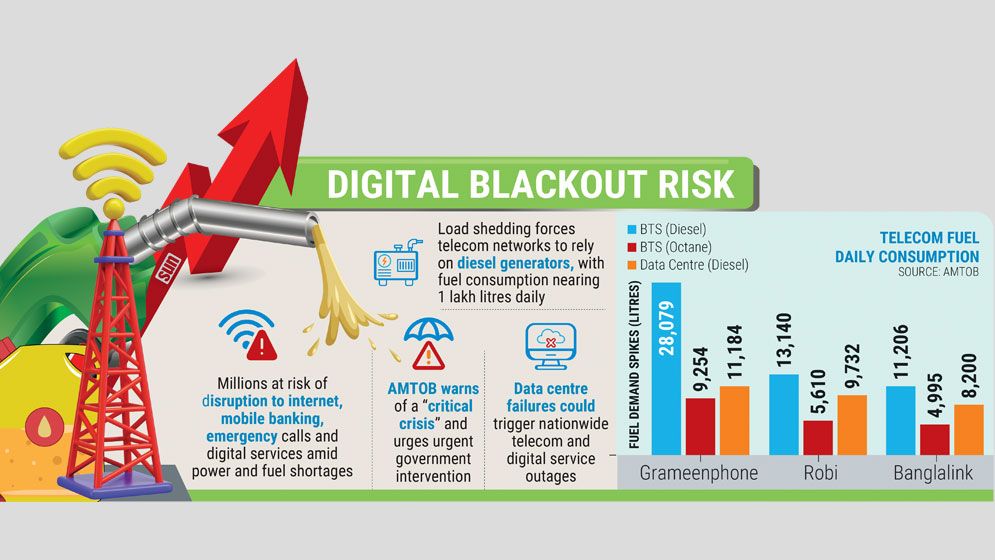
Industry estimates show daily fuel consumption has surged to nearly 1 lakh litres as providers struggle to maintain uninterrupted service.
In a letter sent to the Bangladesh Telecommunication Regulatory Commission (BTRC) on 18 April, the Association of Mobile Telecom Operators of Bangladesh (AMTOB) described the situation as a “critical and escalating crisis” requiring immediate government intervention.
AMTOB said power outages lasting five to eight hours in several regions have made reliable grid electricity largely unavailable for telecom operations, significantly increasing dependence on backup generators.
Industry officials warn that any breakdown could disrupt essential services used daily by millions.
AMTOB Secretary General Lt Col Mohammad Zulfikar (Retd) told the Daily Sun that disruptions at data centres would quickly cascade across the digital ecosystem.
“If power or fuel shortages force data centres to shut down or malfunction, the impact will be immediate and nationwide,” he said. “Calls, internet, SMS, mobile banking, e-commerce and OTP verification systems could all be disrupted or go completely down.”
He added that data centres act as the central control system of mobile networks. “If the brain of the network stops, everything connected to it stops,” he said.
According to industry data, the country’s three major operators – Grameenphone, Robi and Banglalink – are currently consuming more than 52,000 litres of diesel and nearly 20,000 litres of octane daily to keep base stations operational. Grameenphone alone uses over 28,000 litres of diesel per day.
Pressure is even greater at core network facilities such as data centres and switching hubs, which now rely almost entirely on generator power.
These facilities require around four megawatts of electricity daily and consume an estimated 500 to 600 litres of fuel per hour without grid supply. Core infrastructure alone needs more than 27,000 litres of diesel each day to remain operational.
Tanveer Mohammad, chief corporate affairs officer of Grameenphone, said operators are under mounting pressure due to fuel and electricity constraints.
“With the ongoing global fuel crisis, mobile network operators in Bangladesh are experiencing challenges in electricity and fuel availability,” he said. “While we appreciate the government’s support, the evolving situation calls for timely and targeted measures to sustain uninterrupted telecom services nationwide.”
He said urgent steps are needed, including uninterrupted power supply to critical telecom infrastructure, priority access to electricity for data centres and base stations, streamlined fuel supply and facilitation of fuel transport for emergency operations.
Taimur Rahman, chief corporate and regulatory affairs officer of Banglalink, said the energy crunch is placing significant pressure on network operations.
“Reliance on fuel is becoming increasingly unsustainable,” he said. “Telecommunications must be treated as a priority utility in practice, with assured electricity for critical infrastructure and streamlined fuel access. This is essential to maintaining network continuity and safeguarding the digital backbone of the economy.”
Operators are also facing growing logistical challenges in transporting fuel across districts. Supply bottlenecks and administrative delays are slowing deliveries, leaving critical sites increasingly vulnerable.
Stakeholders warn that a large-scale network failure would extend far beyond inconvenience, potentially disrupting digital financial services, emergency response systems, government communications and connectivity for more than 18.5 crore mobile subscribers, according to BTRC data.
To prevent a wider breakdown, AMTOB has urged authorities to ensure uninterrupted electricity supply to critical telecom infrastructure, prioritise power allocation for base stations and streamline fuel distribution.
The association has also called for an urgent inter-agency coordination meeting involving power, energy and fuel authorities to stabilise the situation before it escalates into a nationwide communications disruption.