




 For all latest news, follow the Daily Sun's Google News channel.


Fuel price hike sparks cost shock as govt calls move ‘necessary’
The most immediate impact has been visible in transport fares

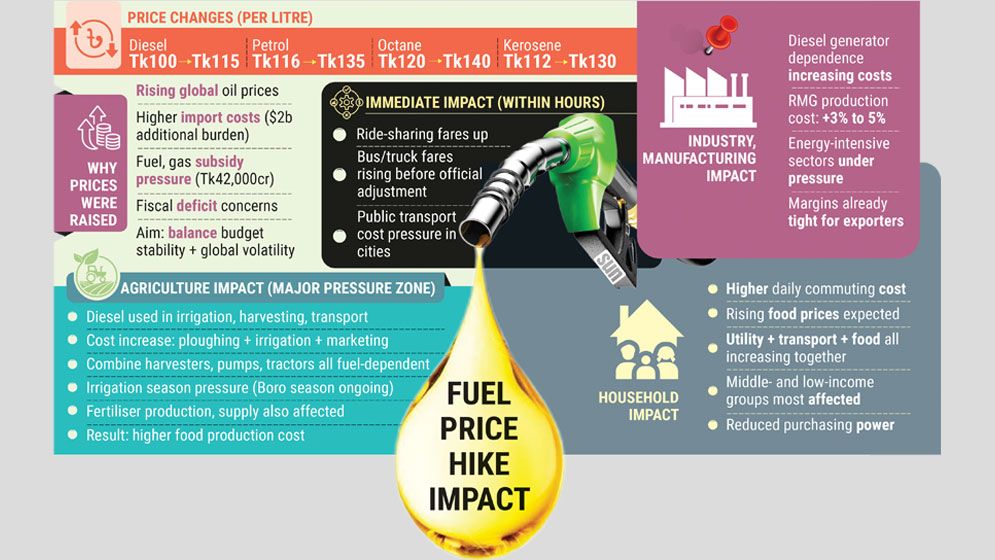
A rise in fuel prices has triggered renewed concern over living costs across Bangladesh, even as the government argues the move was necessary to manage subsidy pressures and respond to volatile global energy markets.
Announced on Saturday night and implemented immediately, the revision raised diesel to Tk115 per litre from Tk100, octane to Tk140 from Tk120, petrol to Tk135 from Tk116 and kerosene to Tk130 from Tk112.
Officials say the adjustment reflects international oil price trends and the growing fiscal burden of energy subsidies, while economists warn it is likely to add short-term inflationary pressure through transport and production channels.
Immediate impact felt in transport and commuting
The most immediate impact has been visible in transport fares. Commuters in Dhaka reported higher ride-sharing costs within hours of the announcement, with motorcycle fares in some cases rising by Tk40–70.
Office worker Farhana Nila said her regular trip from Mirpur to Gulshan increased from around Tk100 to Tk140 overnight.
Transport operators argue the increase was unavoidable, citing higher fuel and maintenance costs as well as supply pressures at filling stations. However, passengers say fare adjustments are often implemented rapidly and can exceed proportional cost increases, adding to household strain.
Economists warn of inflationary ripple effects
Experts say transport is typically the first sector to react to fuel price changes, but the effects quickly spread across the wider economy.
Energy expert M Tamim noted that fare increases tend to cascade through supply chains.
“Bus and truck fares usually rise within a short time. This creates a chain reaction across the market,” he said.
Food items are particularly exposed, as vegetables, fish, eggs and poultry rely heavily on road transport from rural production areas to urban markets. Even modest increases in logistics costs can therefore translate into higher retail prices.
Agriculture, industry and household budgets under pressure
Beyond transport, several key sectors are already feeling the strain.
In agriculture, higher diesel costs are raising irrigation expenses during critical production cycles, with the potential to push up future crop prices.
In industry, reliance on diesel generators due to irregular electricity supply has added to production costs, particularly in energy-intensive sectors.
In the readymade garment sector, industry estimates suggest production costs could rise by around 3% to 5%. While manufacturers say they will continue operations, they acknowledge pressure on already tight margins.
Speaking to Daily Sun, Faisal Samad, director of BGMEA and managing director of Savartex Group, said the sector has limited capacity to absorb further shocks and called for stable fuel supply alongside supportive financial conditions.
For households, the combined pressure of rising transport, food and utility costs is tightening monthly budgets, especially for lower- and middle-income groups whose wages have not kept pace with inflation.
Agriculture faces rising cost pressures and inflation risks
Sharp increases in diesel prices are expected to significantly raise agricultural production costs across the country, with economists warning of upward pressure on food inflation.
The latest adjustment, which increased diesel by Tk15 per litre to Tk115, marks a 15% rise, directly affecting irrigation, ploughing, harvesting and transport of crops.
Experts say the entire agricultural production chain is heavily dependent on fuel. From field irrigation to harvesting, threshing, crop collection, transport and delivery to wholesale markets, diesel-powered machinery plays a central role. This includes combine harvesters, irrigation pumps, tractors, threshers and transport trolleys, all of which are sensitive to fuel price changes.
Agro-economist Dr Jahangir Alam told Daily Sun that the impact would be widespread across production and supply chains.
“There will be problems in agricultural product marketing. All these factors will push prices up. When prices rise, production costs increase, which in turn raises food grain prices,” he said, adding that Bangladesh has remained under sustained food inflation pressure for years. He warned that irrigation, harvesting and market delivery costs would all rise simultaneously, intensifying cost-push inflation.
“For the past four years, we have been at a very high level of food inflation,” he noted, adding that farmers are already facing squeezed margins due to rising input costs and stagnant selling prices.
The economist also highlighted seasonal pressure, noting that the ongoing Boro season requires intensive irrigation at a time when diesel supply constraints and higher prices are already affecting farmers. Long queues at fuel stations and increased kerosene prices are adding further strain in rural areas.
He added that rising production costs reduce farmers’ profitability, discouraging reinvestment and increasing rural economic vulnerability. “When profits fall, poverty increases and farmers lose interest in future investment,” he said.
Fuel price increases are also expected to affect fertiliser production and distribution, creating a multiplier effect. As fertiliser manufacturing is energy-dependent, higher gas and fuel costs could further tighten supply. Several fertiliser factories are already facing operational constraints, with some production disruptions reported due to gas shortages.
According to agricultural estimates, diesel demand in the sector is substantial, particularly during the six-month irrigation season from December to May, when over 1.2 million tonnes of fuel may be required. The widespread use of diesel-powered machinery – from irrigation pumps to combine harvesters – means even small price changes can significantly impact national food costs.
Consumer rights groups warn that this will inevitably feed into higher prices for essential goods.
CAB Vice President S M Nazer Hossain said fuel is directly linked to almost all commodities, meaning price increases will ultimately be passed on to consumers, intensifying public hardship.
Inflation already elevated amid slow wage growth
According to the Bangladesh Bureau of Statistics, inflation stood at 9.13% in February, with food inflation at 9.30%, its highest level in over a year.
Wage growth, however, has remained at around 7% to 8%, meaning real incomes have steadily declined. Economists say this gap has been eroding purchasing power for more than four years.
The IMF has also warned that rising global oil prices can feed into inflation across import-dependent economies. It estimates that a 10% rise in oil prices could lift global inflation by around 0.4 percentage points.
Subsidy burden and global volatility cited
Policy experts say the decision is largely driven by fiscal constraints.
Economist Masrur Reaz noted that fuel and gas subsidies have reached around Tk42,000 crore, limiting the government’s ability to maintain earlier price levels.
He added that sustaining subsidies at previous rates would require additional fiscal resources, which are difficult to generate given weak revenue growth.
Finance Minister Amir Khosru Mahmud Chowdhury said the price adjustment reflects global trends rather than external conditions.
“If we do not adjust prices, pressure on the treasury increases. This decision is necessary and not linked to IMF conditions,” he said.
He added that fuel carries a relatively small weight in the inflation basket and that the overall impact may therefore be limited.
Energy Minister Iqbal Hasan Mahmood Tuku said Bangladesh has already incurred an additional $2 billion in fuel import costs due to international market instability.
He noted that global oil prices have nearly doubled compared to pre-war levels, placing significant pressure on public finances.
Despite this, he said the government has tried to shield consumers by absorbing much of the burden through subsidies and limiting the scale of price adjustments, aiming to balance economic stability with public welfare.
Transport fares, public response and regulatory pressure
Transport operators are now pressing for fare revisions, with some associations proposing increases of up to 55% to account for rising fuel, spare parts and currency costs.
Passenger groups, however, argue that adjustments should be more gradual and transparent. Reports of higher fares being charged even before official approval have added to public frustration.
Consumer advocates have also called for stronger passenger representation in fare-setting discussions, arguing that current processes tend to favour operators.
‘No real shortage; crisis artificially created’
Energy Minister Iqbal Hasan Mahmood also reiterated that there is no genuine fuel shortage in the country, attributing concerns to hoarding and black marketing by unscrupulous traders.
“An artificial crisis is being created due to panic buying and hoarding,” he said in response to a question in parliament. He said the statement previously made in parliament that there is no fuel crisis remains valid.
According to the minister, officers from the Bangladesh Petroleum Corporation (BPC), along with district and upazila administrations, have been deployed nationwide to maintain normal fuel supply.
He added that mobile courts are taking action against hoarders on a daily basis, imposing fines and jail terms where necessary.